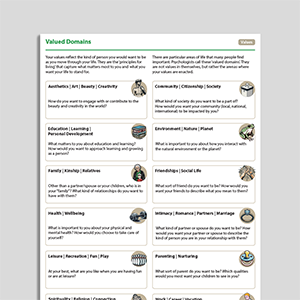
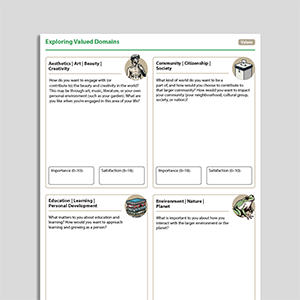
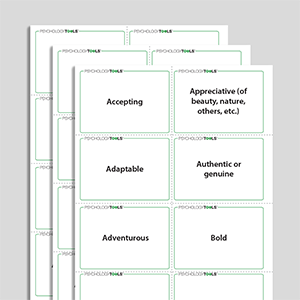
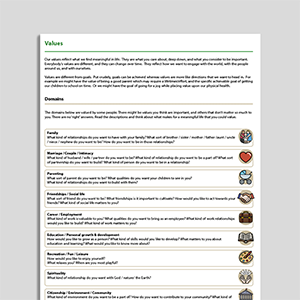
Values: Connecting To What Matters
Links to external resources
Psychology Tools makes every effort to check external links and review their content. However, we are not responsible for the quality or content of external links and cannot guarantee that these links will work all of the time.
Information (Professional)
- Proposed therapeutic interventions of an existential-humanistic psychotherapist | Bob Edelstein
What is Humanistic Therapy?
Approaches Within Humanistic Therapy
Person-centered therapy—Carl Rogers (Rogers, 1951)
Gestalt therapy—Fritz Perls, Laura Perls, Paul Goodman (Perls & Goodman, 1951)
Positive psychology—Martin Seligman (Gillahm & Selgiman, 1999)
Existential therapy—Viktor Frankl (Frankl, 1947)
Personal construct theory / repertory grid—George Kelly (Kelly, 1977)
The Necessary and Sufficient Conditions for Therapeutic Change
Carl Rogers proposed six necessary and sufficient conditions for therapeutic change:Therapist–client psychological contact: a relationship between client and therapist must exist, and it must be a relationship in which each person’s perception of the other is important.
Client incongruence: that incongruence exists between the client’s experience and awareness.
Therapist congruence, or genuineness: the therapist is congruent within the therapeutic relationship. The therapist is deeply involved—they are not ‘acting’—and they can draw on their own experiences (self-disclosure) to facilitate the relationship.
Therapist unconditional positive regard: the therapist accepts the client unconditionally, without judgment, disapproval, or approval. This facilitates increased self-regard in the client, as they can begin to become aware of experiences in which their view of self-worth was distorted by others.
Therapist empathic understanding: the therapist experiences an empathic understanding of the client’s internal frame of reference. Accurate empathy on the part of the therapist helps the client believe the therapist’s unconditional regard for them.
Client perception: that the client perceives, to at least a minimal degree, the therapist’s unconditional positive regard and empathic understanding.
References
Bugental, J. F. T. (1964). The third force in psychology. Journal of Humanistic Psychology, 4(1), 19–25.
Frankl, V. E. (1947). Ein Psycholog erlebt das Konzentrationslager: Österreichische Dokumente zur Zeitgeschichte.
Gillham, J. E., & Seligman, M. E. (1999). Footsteps on the road to a positive psychology. Behaviour Research and Therapy, 37(1), S163.
Kelly, G. A. (1977). Personal construct theory and the psychotherapeutic interview. Cognitive Therapy and Research, 1(4), 355-362.
Perls, F., Hefferline, G., & Goodman, P. (1951). Gestalt therapy. New York.
Rogers, C. (1951). Client Centred Therapy. London: Constable and Company Limited.