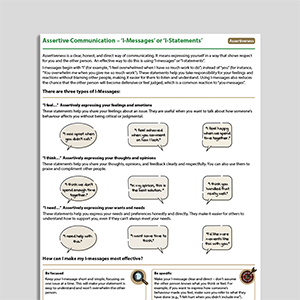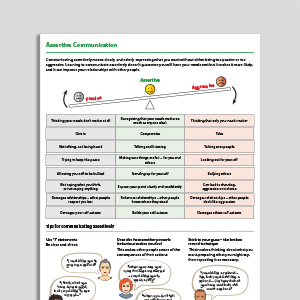
Assertive Communication – 'I-Messages' Or 'I-Statements'
[Free Guide] An Introduction To Values
[Free Guide] An Introduction To Values
Values: Connecting To What Matters
Links to external resources
Psychology Tools makes every effort to check external links and review their content. However, we are not responsible for the quality or content of external links and cannot guarantee that these links will work all of the time.
Assessment
- Positive psychological assessment: a practical introduction to empirically validated research tools for measuring wellbeing
- Subjective happiness scale
- Joseph, S., & Wood, A. (2010). Assessment of positive functioning in clinical psychology: Theoretical and practical issues.Clinical psychology review,30(7), 830-838.
Exercises
- Compassionate letter writing | Paul Gilbert | 2010
Information Handouts
- Positive psychology information and exercises | Black Dog Institute
Information (Professional)
- Highlights from the research project on gratitude and thankfulness | Emmons, McCulloch
Presentations
- Positive psychology, or other intersting things | Dr Aaron Jarden
- Living in flow – the secret of happiness | Mihaly Csikszentmihalyi | 2014
- On positive psychology | Martin Seligman youtube.com
- Positive psychology, a science of human strengths
- Flourish: Positive psychology and positive interventions | Martin Seligman | 2010
Treatment Guide
- Positive psychology lesson plan, incorporating multiple activities | Fineburg
Worksheets
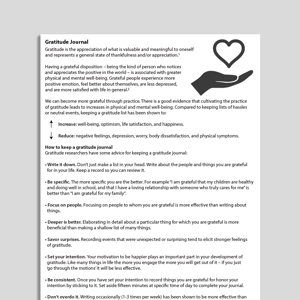
- Gratitude worksheet
Recommended Reading
- Seligman, M. E. P., &Czikszentmihalyi, M. (2000). Positive psychology: an introduction.American Psychologist,55(1), 5-14.
- Seligman, M. E. (2007). Coaching and positive psychology.Australian Psychologist,42(4), 266-267.
- Proyer, R. T., Gander, F., Wellenzohn, S., & Ruch, W. (2015). Strengths-based positive psychology interventions: a randomized placebo-controlled online trial on long-term effects for a signature strengths-vs. a lesser strengths-intervention.Frontiers in psychology,6.
- Lee Duckworth, A., Steen, T. A., & Seligman, M. E. (2005). Positive psychology in clinical practice.Annu. Rev. Clin. Psychol.,1, 629-651.
- Johnson, J., & Wood, A. M. (2017). Integrating positive and clinical psychology: Viewing human functioning as continua from positive to negative can benefit clinical assessment, interventions and understandings of resilience.Cognitive Therapy and Research,41(3), 335-349.
What Is Positive Psychology / Positive Psychotherapy?
Assumptions of Positive Psychology / Positive Psychotherapy
Psychopathology is the result of the thwarting of people’s inherent capacity for growth, fulfillment, and happiness.
Positive emotions and strengths are as authentic and real as symptoms and disorders.
Therapy is a place where hope, optimism, gratitude, compassion, contentment, and emotional and social intelligence are given as much prominence as resentment, frustration, jealousy, anxiety, and competition.
Authentic happinessis composed of the pleasant life, the engaged life, and the meaningful life (Seligman, 2002).
“Build what’s strong” is as valid as “Fix what’s wrong” (Duckworth, Steen, & Seligman, 2005).
Procedures and Techniques of Positive Psychology / Positive Psychotherapy
Positive psychology interventions include (adapted from Seligman, Rashid, & Parks, 2006):identification and building of signature strengths
cultivation of signature strengths and positive emotions
expression of good and bad memories, writing tasks
forgiveness tasks including writing a letter of forgiveness to a transgressor
cultivation of gratitude
satisficing (accepting ‘good enough’) instead of maximizing
cultivating optimism and hope
cultivating love and attachment
savoring and making things last
giving the gift of time
References
Duckworth, A. L., Steen, T. A., & Seligman, M. E. P. (2005). Positive psychology in clinical practice. Annual Review of Clinical Psychology, 1, 629–651.
Maslow, A. H. (1954). Motivation and personality. New York: Harper.
Seligman, M. E. P. (2002). Authentic happiness: Using the new positive psychology to realize your potential for lasting fulfillment. New York: Free Press.
Seligman, M. E. P., Rashid, T., & Parks, A. C. (2006). Positive psychotherapy. American Psychologist,61, 774–788.