500+ professional resources
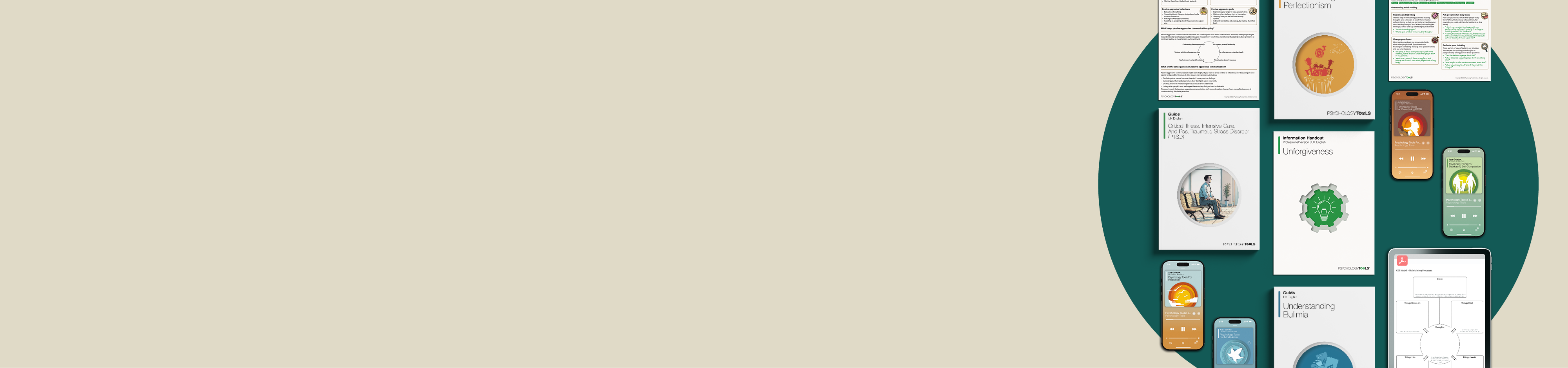
500+ professional therapy resources
A complete clinical toolkit grounded in psychological science.
A comprehensive library for effective therapy
Psychology Tools gives clinicians access to more than 500 high-quality therapy resources, including:
Worksheets
Information handouts
Exercises
Case examples
Psychoeducation
Skills-based exercises
Audio resources
Guides and workbooks
All materials are developed by expert psychologists and reflect well-established psychological models and interventions.
Whether you’re preparing a session, teaching a skill, or supporting between-session practice, you can quickly find accurate, clear, and clinically relevant tools tailored to your clients’ needs.
Why comprehensiveness matters
Therapy spans many presentations – your resources should too
Clients present with diverse and often complex difficulties. A comprehensive library helps clinicians respond flexibly and confidently across a wide range of mental health problems.
Reduces preparation time without compromising quality
With 500+ tools at your fingertips, you can move quickly from assessment to intervention with materials you trust.
Supports evidence-informed practice
Each resource reflects psychological models used in interventions tested in randomised controlled trials (RCTs). This ensures your materials align with well-supported therapeutic strategies.
Helps you find the right tool at the right moment
Whether you need a formulation, an explanation, a behavioural experiment, an imagery exercise, or an audio track – you can access it immediately.
Coverage across a wide range of presentations
Our library includes resources for:
Depression
Anxiety disorders (generalized anxiety disorder [GAD], panic, social anxiety [SAD], phobias)
Obsessive compulsive disorder (OCD)
Post-traumatic stress disorder (PTSD) and trauma
Eating disorders
Bipolar disorder, psychosis and paranoia
Sleep problems
Interpersonal issues
Emotion regulation
Self-criticism and shame
Stress, worry, and rumination
Chronic illness and health anxiety
Assertiveness
Attention deficit hyperactivity disorder (ADHD)
Resources are designed to support therapy in:
Cognitive behavioral therapy (CBT)
Acceptance and commitment therapy (ACT)
Compassion focused therapy (CFT)
Schema therapy
Mindfulness-based approaches
Dialectical behavior therapy (DBT)-informed approaches
Skills training and psychoeducation
Guided self-help formats
Stepped-care services
Evidence supporting a comprehensive library
Strong empirical support for interventions
CBT shows robust effectiveness across a wide range of disorders (Cuijpers et al., 2025; Harrer et al., 2025).
ACT shows consistent effectiveness for depression, anxiety disorders, addiction and somatic health problems (A-Tjak et al., 2015).
CFT shows consistent effectiveness at reducing clinical symptomology across a range of mental health difficulties (Millard-Brewer et al., 2023).
Schema Therapy shows effectiveness for improving borderline personality disorder symptoms (Bamelis et al., 2022).
Mindfulness-based approaches are effective at reducing anxiety, depression, and stress (Khoury et al., 2013).
PT resources are derived from interventions used in RCTs
Our materials translate validated models and treatment components into clear, practical tools.
Engagement predicts improvement
Greater engagement with materials is associated with better outcomes across diagnoses (Gan et al., 2021).
How 500+ resources support clinicians
A comprehensive toolkit allows you to:
Deliver evidence-informed interventions.
Match tools precisely to client needs.
Support understanding through psychoeducation.
Reinforce learning with worksheets and exercises.
Build momentum between sessions.
Respond effectively to complex or comorbid presentations.
Clinicians gain confidence knowing they have a deep library of trusted materials they can draw on at any moment.
Who benefits from a comprehensive resource library?
Clinicians in private or public practice
Teams wanting consistency across therapists
Services providing guided self-help
Trainees learning psychological models
Multidisciplinary teams needing shared conceptual tools
Clinicians supporting clients with varied or complex presentations
Explore the full library
Find worksheets, guides, and exercises for every stage of therapy – all grounded in psychological science and designed for real clinical use.
References
A-Tjak, J. G. L., Davis, M. L., Morina, N., Powers, M. B., Smits, J. A. J., & Emmelkamp, P. M. G. (2015). A Meta-Analysis of the Efficacy of Acceptance and Commitment Therapy for Clinically Relevant Mental and Physical Health Problems. Psychotherapy and Psychosomatics, 84(1), 30–36. https://www.jstor.org/stable/48515932
Bamelis, L. L. M., Arntz, A., Wetzelaer, P., Evers, S. M. A. A., Spinhoven, P., Kremers, I. P., et al. (2022). Effectiveness of predominantly group schema therapy and combined individual and group schema therapy for borderline personality disorder: A randomized clinical trial. JAMA Psychiatry, 79(6), 539–548. https://doi.org/10.1001/jamapsychiatry.2022.0669
Khoury, B., Lecomte, T., Fortin, G., Masse, M., Therien, P., Bouchard, V., … & Hofmann, S. G. (2013). Mindfulness-based therapy: A comprehensive meta-analysis. Clinical Psychology Review, 33, 763–771.
Millard-Brewer, Leah & Wan, Ming & Smith, Debbie & Wittkowski, Anja. (2023). The effectiveness of compassion focused therapy with clinical populations: A systematic review and meta-analysis. Journal of Affective Disorders. 326, 168-192. 10.1016/j.jad.2023.01.010.
Discover everything included with Psychology Tools
Access professional therapy resources, translated materials, fillable PDFs, therapy guides, audio resources, psychoeducation, and evidence-based tools designed to support every stage of therapy. Whether you’re working in private practice, healthcare, education, or community services, Psychology Tools helps you deliver effective, evidence-informed care with confidence.