Guides and workbooks
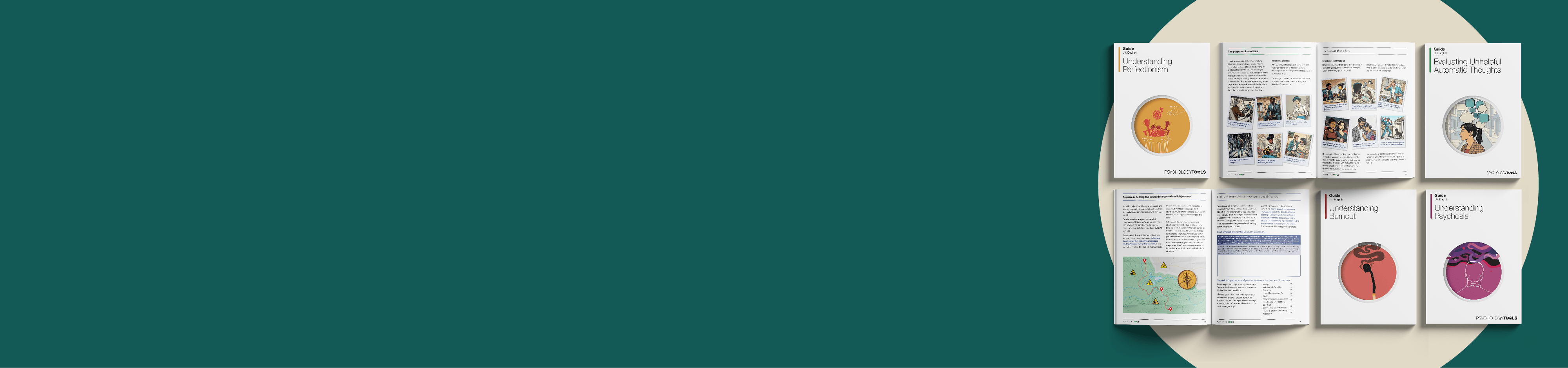
Therapy guides and workbooks
Structured learning for deeper therapeutic change.
What are guides and workbooks?
Psychology Tools offers a growing collection of guides and workbooks designed to support effective therapy across a wide range of mental health presentations.
Guides
Guides provide clear, clinically grounded psychoeducation. They help clients:
Understand symptoms and psychological models.
Make sense of their experiences.
Feel more motivated to engage in therapy.
Access trustworthy information when being signposted to treatment.
Guides are ideal for:
Early-stage treatment
Assessment and formulation
Helping clients prepare for therapy
Building confidence and motivation
Workbooks
Workbooks include psychoeducation plus practical exercises, giving clients structured opportunities to apply skills. They can be used:
To scaffold therapy, session by session.
Between sessions to consolidate learning.
As standalone guided self-help for mild-to-moderate presentations.
Workbooks support clients in learning, practising, and integrating psychological skills in a way that is clear, accessible, and paced.
Why guides and workbooks matter in therapy
Help clients understand the “why” behind treatment
Understanding mechanisms and maintaining a clear rationale increases engagement, motivation, and treatment buy-in.
Support consistent skills practice
Workbooks help clients practise and repeat skills between sessions – a key predictor of clinical improvement.
Strengthen retention and reduce drop-out
Clients who stay in therapy longer tend to show better outcomes. Structured materials make it easier to stay on track.
Ideal for guided self-help
Guides and workbooks reflect the kinds of structured materials used successfully in many digital and low-intensity CBT interventions.
Clear structure for complex cases
For presentations involving multiple symptoms or comorbidities, structured resources help clinicians organise treatment and ensure therapeutic continuity.
What guides and workbooks can help with
Our resources cover psychoeducation and skills across a wide range of psychological difficulties, including:
Depression
Anxiety disorders
Post-traumatic stress disorder (PTSD)
Trauma and dissociation
Obsessive compulsive disorder (OCD)
Panic and agoraphobia
Generalized anxiety disorder (GAD) and worry
Low self esteem
Bulimia and binge-eating disorder
Phobias
Bipolar and psychosis
Interpersonal difficulties
Self-criticism, emotion regulation, sleep difficulties, and more
Evidence supporting guides and workbooks
Strong empirical support for CBT interventions
Cognitive behavioral therapy (CBT) approaches are effective across a broad range of conditions (Cuijpers et al., 2025; Harrer et al., 2025). Our guides and workbooks translate these interventions into structured, accessible tools.
Guided self-help improves outcomes
Materials-based CBT shows effectiveness for depression, anxiety, OCD, PTSD, insomnia, and eating disorders (Moshe et al., 2021; Pauley et al., 2023).
Structured materials help prevent early drop-out
Clients who discontinue therapy early show less improvement (Robinson et al., 2020).
Structured materials help maintain momentum and reduce attrition.
Who benefits from guides and workbooks?
Clinicians using CBT or related approaches
Services offering guided self-help or stepped-care interventions
Clients needing clear explanations and structured tasks
Teams working with complex or comorbid presentations
Students and trainees learning psychological models
Clients motivated to pursue self-directed therapeutic work
Explore guides and workbooks
Enhance understanding, strengthen skills, and scaffold effective therapy with evidence-informed, practitioner-designed guides and workbooks.
Discover everything included with Psychology Tools
Access professional therapy resources, translated materials, fillable PDFs, therapy guides, audio resources, psychoeducation, and evidence-based tools designed to support every stage of therapy. Whether you’re working in private practice, healthcare, education, or community services, Psychology Tools helps you deliver effective, evidence-informed care with confidence.