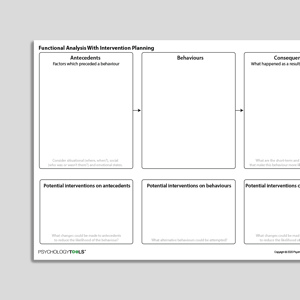
Functional Analysis With Intervention Planning
Links to external resources
Psychology Tools makes every effort to check external links and review their content. However, we are not responsible for the quality or content of external links and cannot guarantee that these links will work all of the time.
Information (Professional)
- Emotional disturbance in a nutshell | Albert Ellis
- Structured disputing of irrational beliefs | Windy Dryden
- What is Rational Emotive Behavior Therapy (REBT)? Outlining the approach by considering the four elements of its name | Windy Dryden
Presentations
- The Empirical Status of Rational Emotive Behavior Therapy (REBT) Theory & Practice | Daniel David | 2014
Treatment Guide
- First steps in using REBT in life coaching – Windy Dryden | Dryden, W. | 2011
- REBT Depression Manual: Managing Depression Using Rational Emotive Behavior Therapy (REBT) | David, Kangas, Schnur, Montgomery | 2004
Video
- Albert Ellis and Gloria – full counselling session youtube
- 21 Ways To Stop Worrying | Albert Ellis | 1991
- Substituting rational thinking for irrational thoughts – Albert Ellis youtube
- Substituting Rational Thinking For Irrational Thoughts | Albert Ellis | 1984
Websites
- REBT Network
Recommended Reading
- A brief introduction to Rational Emotive Behavior Therapy (REBT) | Wayne Froggatt | 2005
- David, D. (2014). The Empirical Status of Rational Emotive Behavior Therapy (REBT) Theory & Practice. Therapy, 3, 175-221
- Dryden, W. (2013). On rational beliefs in rational emotive behavior therapy: A theoretical perspective. Journal of Rational-Emotive & Cognitive-Behavior Therapy, 31(1), 39-48
- Ellis, A. (1980). Rational-emotive therapy and cognitive behavior therapy: Similarities and differences. Cognitive Therapy and Research, 4(4), 325-340
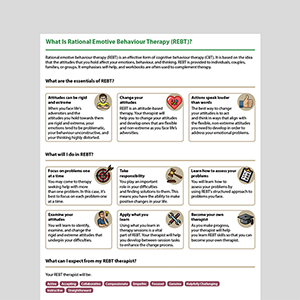
What Is Rational Emotive Behavior Therapy?
Assumptions of REBT
Most people consciously and unconsciously train themselves to be to some degree emotionally disturbed.
People’s self-defeating cognitions, emotions, and behaviors are intrinsically and holistically connected.
If they choose to do so, and work hard at modifying their thinking, feeling, and behaving, they can teach themselves to lead more satisfying lives.
Many irrational beliefs with which people disturb themselves can be categorized under three major headings which include absolutistic shoulds, oughts, and musts. These imperatives, from which other beliefs can be derived, are:
‘I absolutely must perform well at important tasks and be approved by significant others—or else I am an inadequate person!’
‘Other people must absolutely treat me kindly, considerately, and fairly—or else they are bad individuals!’
‘Conditions under which I live absolutely must provide me with what I really want—or else my life is horrible, I can’t stand it, and the world’s a rotten place!’
References
Ellis, A. (2002). Rational emotive behavior therapy. In M. Hersen & W. H. Sledge (Eds.), Encyclopedia of Psychotherapy, Volume 2 (pp. 483–487). Amsterdam, Netherlands: Academic Press.