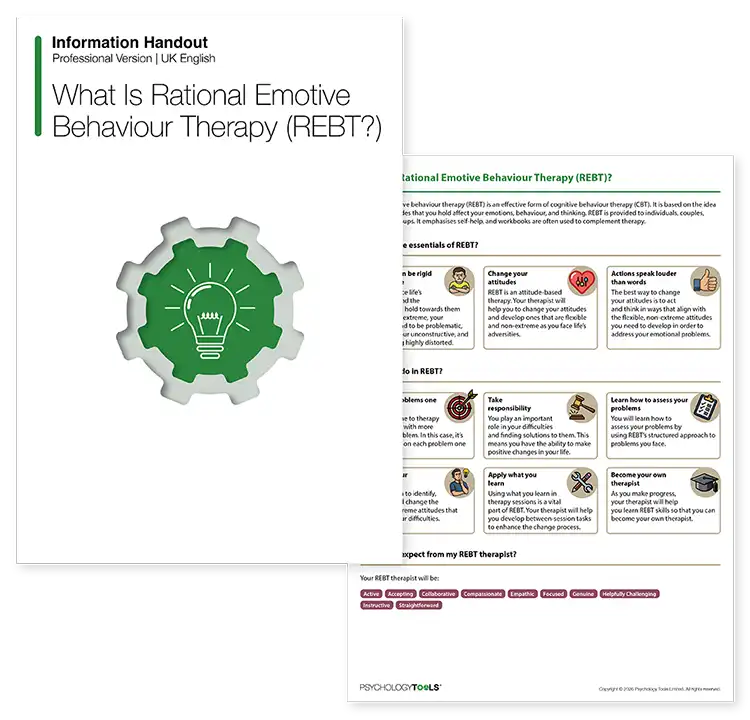
What Is Rational Emotive Behavior Therapy (REBT)?

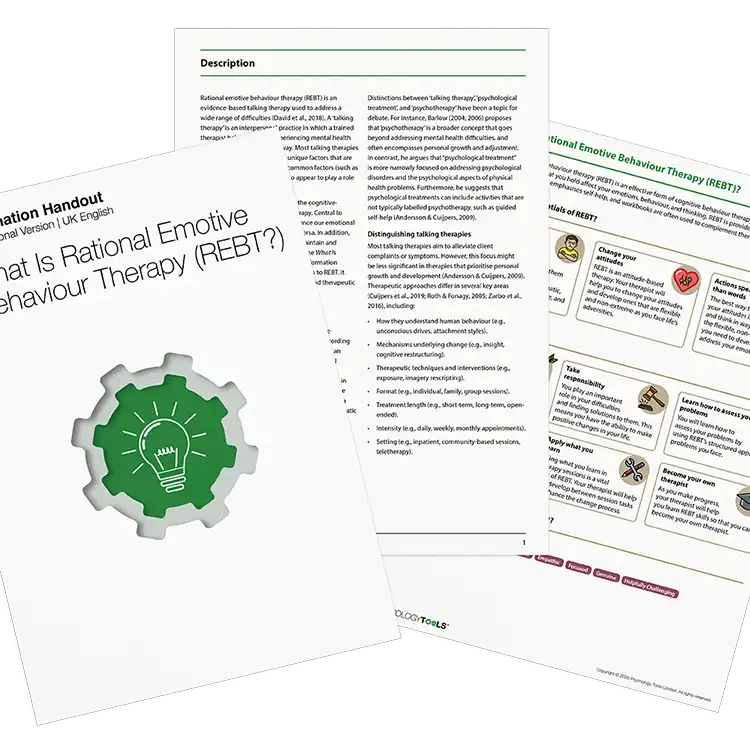
This information handout describes the key principles of rational emotive behavior therapy (REBT).

Download or send

Professional version

Offers theory, guidance, and prompts for mental health professionals. Downloads are in Fillable PDF format where appropriate.
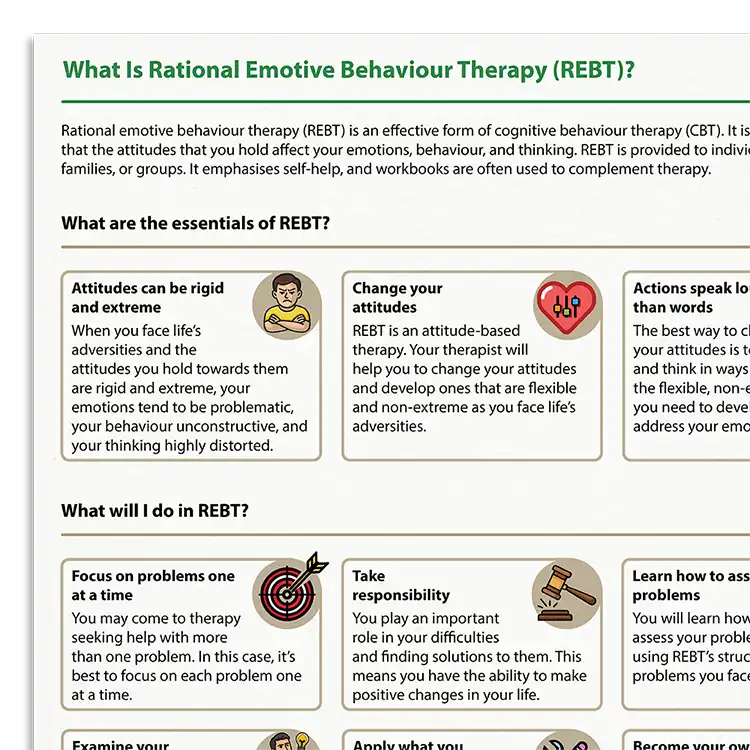
Client version

Includes client-friendly guidance. Downloads are in Fillable PDF format where appropriate.

Overview

Rational emotive behavior therapy (REBT) is a leading approach within the cognitive-behavioral tradition of psychotherapy. Central to REBT is the idea that attitudes influence our emotional responses and behavior, and vice versa. In addition, REBT proposes that behavior can maintain and exacerbate psychological problems. This What Is Rational Emotive Behavior Therapy (REBT)? information handout is designed to introduce clients to REBT. It provides an overview of key concepts and therapeutic tasks.

Why use this resource?

This handout provides a comprehensive and accessible introduction to REBT. Therapists can use it to:

  • Introduce clients to the key ideas in REBT.
  • Support treatment selection, informed consent, and goal-setting at the start of therapy.
  • Reinforce clients’ understanding of REBT principles throughout treatment.
  • Communicate the rationale for core therapeutic tasks.

Key benefits

Clear

Presents key REBT principles using accessible language and illustrations.

Informative

Explains what REBT is likely to involve.

Versatile

Suitable for a wide range of clients.

Engaging

Encourages collaboration and increased motivation for treatment.

Integrating it into your practice

01

Introduce

Start a conversation about the potential benefits of REBT.

02

Explore

Use the information handout to explore the key ideas in REBT.

03

Reflect

Help clients reflect on how REBT might be helpful to them.

04

Reinforce

Use the handout to consolidate client learning between sessions.

Theoretical background and therapist guidance

Rational emotive behavior therapy (previously known as rational therapy and rational emotive therapy) was developed in the mid to late 1950s by Albert Ellis (Ellis, 1962), who proposed that cognition, behavior, and emotion are interdependent processes (Ellis, 1958). Ellis (1957, 1958) was the first to highlight the important role that cognition played in the development and maintenance of psychopathology. Together with Aaron Beck (1967, 1976), he is regarded as a pioneer figure in the cognitive-behavioral therapeutic tradition.

REBT proposes that attitudes (previously known in REBT as beliefs) influence and are influenced by people’s emotional responses and behavior. Like other approaches in the cognitive behavioral tradition, REBT also observes that behavior can maintain and exacerbate problematic psychological states. In particular, REBT argues that a set of rigid and extreme attitudes (previously known as irrational beliefs) play a central role in unhealthy responses to adversities, and that a set of flexible and non-extreme attitudes (previously known as rational beliefs) support healthier responses to the same challenges. Accordingly, the primary aim of REBT is to help individuals identify and address the attitudes and behaviors that contribute to their difficulties.

What's inside

  • A clear and accessible information handout explaining REBT.
  • A helpful introduction to REBT written for therapists.
  • Guidance for using the resource with clients.
  • Key references and recommended further reading.
Get access to this resource

FAQs

REBT is a talking therapy that helps people identify and change rigid, extreme attitudes that contribute to emotional distress and unhelpful behaviors.
REBT places particular emphasis on identifying rigid and extreme attitudes and developing flexible, helpful alternatives.
REBT can be helpful for some difficulties, but it may not be suitable for all individuals. Therapists are encouraged to review best practice guidelines if they are considering offering REBT for the treatment of a specific disorder or condition.

How this resource helps improve clinical outcomes

  • Learn about REBT and what to expect from it.
  • Answer the questions they might have about this talking therapy.
  • Make an informed decision about taking up REBT.
  • Feel confident and motivated about starting REBT.

References and further reading

  • Andersson, G., & Cuijpers, P. (2009). ‘Psychological treatment’ as an umbrella term for evidence-based psychotherapies? Nordic Psychology, 6, 4–15. DOI: 10.1027/1901-2276.61.2.4.
  • Barber, J. P., & DeRubeis, R. J. (1989). On second thought: Where the action is in cognitive therapy for depression. Cognitive Therapy and Research, 13, 441-457. DOI: 10.1007/BF01173905.
  • Barlow, D. H. (2004). Psychological treatments. American Psychologist, 59, 869–878.
  • Barlow, D. H. (2006). Psychotherapy and psychological treatments: The future. Clinical Psychology: Science and Practice, 13, 216-220.
  • Beck, A. T. (1967). Depression: Causes and treatment. University of Pennsylvania Press.
  • Beck, A. T. (1976). Cognitive therapy and the emotional disorders. International Universities Press.
  • Crits-Christoph, P., Gibbons, M. B. C., Temes, C. M., Elkin, I., & Gallop, R. (2010). Interpersonal accuracy of interventions and the outcome of cognitive and interpersonal therapies for depression. Journal of Consulting and Clinical Psychology, 78, 420-428. DOI: 10.1037/a0019549.
  • Cuijpers, P., Reijnders, M., & Huibers, M. J. (2019). The role of common factors in psychotherapy outcomes. Annual Review of Clinical Psychology, 15, 207-231. DOI: 10.1146/annurev-clinpsy-050718-095424.
  • Cuijpers, P., Miguel, C., Ciharova, M., Harrer, M., Basic, D., Cristea, I. A., ... & Karyotaki, E. (2024). Absolute and relative outcomes of psychotherapies for eight mental disorders: a systematic review and meta‐analysis. World Psychiatry, 23, 267-275. DOI: 10.1002/wps.21203.
  • David, D., Coteț, C., Matu, S., Mogoașe, C., & Ștefan, S. (2018). 50 years of rational-emotive and cognitive-behavioral therapy: a systematic review and meta-analysis. Journal of Clinical Psychology, 74, 304-318. DOI: 10.1002/jclp22514.
  • Dryden, W. (2021). Rational emotive behaviour therapy: Distinctive features (3rd edition). Routledge.
  • Ellis, A. (1957). Rational psychotherapy and individual psychology. The Journal of Individual Psychology, 13, 38-44.
  • Ellis, A. (1958). Rational psychotherapy. Journal of General Psychology, 59, 35–49.
  • Ellis, A. (1962). Reason and emotion in psychotherapy. Citadel.
  • King, A.M., Plateau C.R., Turner M.J., Young, P., & Barker, J.B. (2024). A systematic review of the nature and efficacy of Rational Emotive Behaviour Therapy interventions. PLoS ONE, 19, e0306835. DOI: 10.1371/journal.pone.0306835 .
  • Lambert, M. J. & Ogles, B. M. (2004). The efficacy and effectiveness of psychotherapy. In M. J. Lambert (Ed.), Bergin and Garfield’s handbook of psychotherapy and behavior change (pp. 139–93). Wiley.
  • Leichsenring, F., Salzer, S., Beutel, M. E., Herpertz, S., Hiller, W., Hoyer, J., ... & Leibing, E. (2013). Psychodynamic therapy and cognitive-behavioral therapy in social anxiety disorder: A multicenter randomized controlled trial. American Journal of Psychiatry, 170, 759-767. DOI: 10.1176/appi.ajp.2013.12081125.
  • Poulsen, S., Lunn, S., Daniel, S. I., Folke, S., Mathiesen, B. B., Katznelson, H., & Fairburn, C. G. (2014). A randomized controlled trial of psychoanalytic psychotherapy or cognitive-behavioral therapy for bulimia nervosa. American Journal of Psychiatry, 171, 109-116. DOI: 10.1176/appi.ajp.2013.12121511.
  • Roth, A., & Fonagy, P. (2005). What works for whom? A critical review of psychotherapy research (2nd ed.). Guilford Press.
  • Strupp, H. H. (1978). Psychotherapy research and practice – an overview. In A. E. Bergin & S. L. Garfield (Eds.), Handbook of psychotherapy and behavior change (2nd ed.) (pp.3-22). Wiley.
  • Tschacher, W., Junghan, U. M., & Pfammatter, M. (2014). Towards a taxonomy of common factors in psychotherapy - results of an expert survey. Clinical Psychology and Psychotherapy, 21, 82-96. DOI: 10.1002/cpp.1822.
  • Wampold, B. E., & Imel, Z. E. (2015). The great psychotherapy debate (2nd ed.). Routledge.
  • Wampold, B. E., Mondin, G. W., Moody, M., Stich, F., Benson, K., & Ahn, H. (1997). A metaanalysis of outcome studies comparing bona fide psychotherapies: Empirically, ‘all must have prizes.’ Psychological Bulletin, 122, 203-215. DOI: 10.1037/0033-2909.122.3.203.
  • Wolitzky-Taylor, K. B., Horowitz, J. D., Powers, M. B., & Telch, M. J. (2008). Psychological approaches in the treatment of specific phobias: A meta-analysis. Clinical Psychology Review, 28, 1021-1037. DOI: 10.1016/j.cpr.2008.02.007.
  • Zarbo, C., Tasca, G. A., Cattaf, F., & Compare, A. (2016). Integrative psychotherapy works. Frontiers in Psychology, 6, 2021. DOI: 10.3389/fpsyg.2015.02021.