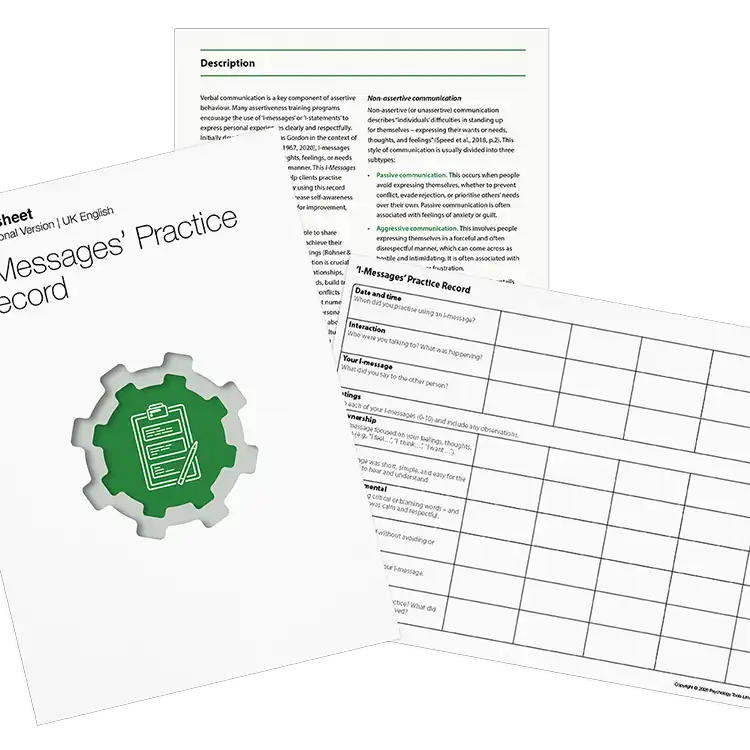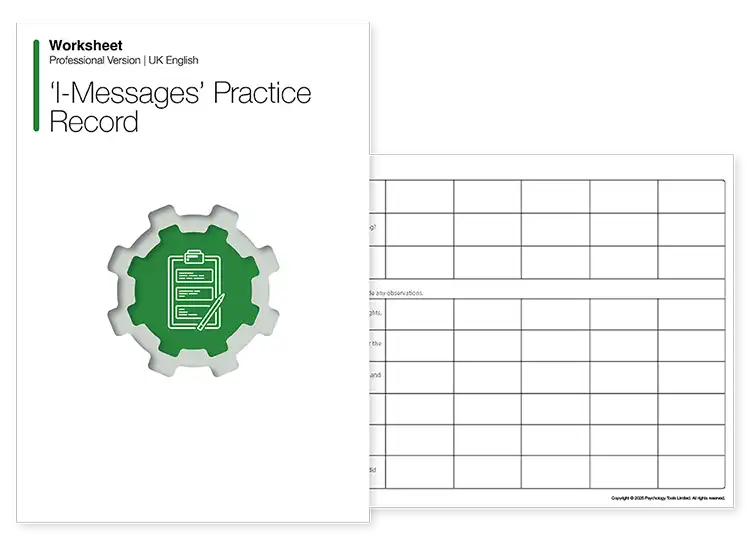
‘I-Messages’ Practice Record

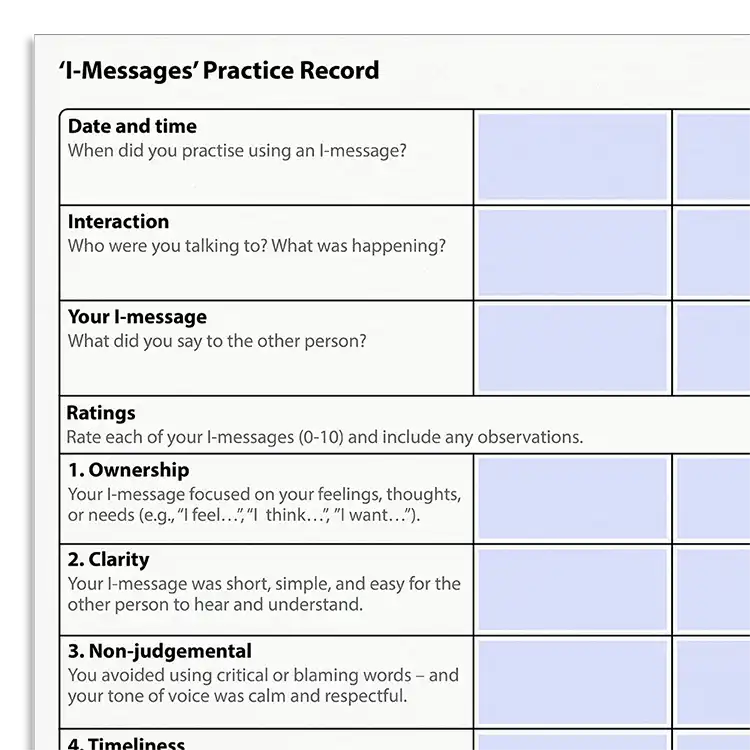
A structured worksheet designed to help clients practice assertive communication using I-messages, identify areas for improvement, and reinforce progress.

Psychology Tools resource: 'I-messages' Practice Record

Download or send

Professional version

Offers theory, guidance, and prompts for mental health professionals. Downloads are in Fillable PDF format where appropriate.
Client version

Includes client-friendly guidance. Downloads are in Fillable PDF format where appropriate.

Psychology Tools resource: 'I-messages' Practice Record

Overview

The ‘I-Messages’ Practice Record is a practical worksheet designed to help clients practice using I-messages in their everyday communications. Grounded in assertiveness training, use of I-messages can enhace communication, allowing feelings, thoughts or needs to be conveyed in a non-blaming manner during interactions.

The resource provides a structured format for practicing and reflecting on real-life interactions. By systematically recording and evaluating communication attempts, clients can build awareness, refine their skills, and strengthen interpersonal effectiveness over time.

Why use this resource?

Assertive communication is a foundational interpersonal skill linked to improved relationships and psychological wellbeing. Many clients struggle to express themselves clearly or respectfully, often defaulting to passive, aggressive, or passive-aggressive styles.

This resource offers a structured, evidence-based way to:

  • Practice the use of I-messages as an assertive communication strategy.
  • Encourage responsibility for personal thoughts and feelings.
  • Reduce conflict arising from blame or criticism.
  • Support skill generalization across real-world situations.

Key benefits

Awareness

Helps clients recognize their communication patterns and styles.

Structure

Provides a clear framework for practicing I-messages.

Reflection

Encourages evaluation and learning from real interactions.

Skill-building

Reinforces assertiveness through repeated practice.

What difficulties is this for?

Social Anxiety Disorder

Difficulty expressing thoughts and needs in social situations.

Depression

Reduced assertiveness and difficulty communicating needs.

Generalized Anxiety Disorder (GAD)

Worry about conflict or negative evaluation.

Interpersonal Difficulties

Challenges in maintaining healthy relationships.

Low Self-Esteem

Difficulty asserting personal rights or opinions

Anger Problems

Tendency toward aggressive or reactive communication.

Workplace Stress

Difficulty expressing boundaries or opinions professionally.

Integrating it into your practice

01

Introduce

Explain assertive communication and the role of I-messages.

02

Identify

Help clients select specific situations to practice.

03

Record

Encourage completion immediately after interactions.

04

Review

Discuss ratings and reflections collaboratively.

05

Reinforce

Highlight improvements and refine future communication attempts.

Theoretical background and therapist guidance

Assertive communication is widely regarded as an effective interpersonal style characterized by clarity, respect, and responsibility. It is distinct from passive, aggressive, and passive-aggressive communication patterns, which are often associated with anxiety, anger, or avoidance.

I-messages, originally developed by Thomas Gordon, are a core component of assertiveness training. They focus on expressing one’s own thoughts, feelings, and needs without blaming others. This approach reduces defensiveness and promotes constructive dialogue by shifting the focus from accusation to personal experience.

The classic structure of an I-message includes describing the situation, expressing feelings, and explaining the impact. This structured format helps individuals communicate more effectively while maintaining respect for both themselves and others.

Research indicates that assertiveness training can improve mental health outcomes, including reductions in anxiety and depression, and enhance relationship quality and occupational functioning. By practicing I-messages in real-world contexts and reflecting on their effectiveness, clients can develop more adaptive communication patterns and strengthen interpersonal skills.

Psychology Tools resource: 'I-messages' Practice Record

What's inside

  • Step-by-step instructions for practicing I-messages.
  • Rating system to evaluate communication effectiveness.
  • Guided reflection prompts to support learning.
  • Real-world practice record for tracking progress.
Get access to this resource

FAQs

I-messages are assertive statements that focus on expressing one’s own thoughts, feelings, or needs in a clear and non-blaming way.
I-messages focus on personal experience, whereas you-messages can sound critical or accusatory and may lead to defensiveness.
Ideally, as soon as possible after an interaction to ensure accurate reflection.
Start with simple situations, role-play in session, and gradually build confidence through practice.
Clients rate components such as ownership, clarity, non-judgment, and timeliness on a 0–10 scale.

How this resource helps improve clinical outcomes

  • Enhances clients’ ability to communicate needs effectively.
  • Reduces interpersonal conflict and misunderstanding.
  • Increases self-awareness and emotional insight.
  • Supports generalization of assertiveness skills across contexts.

References and further reading

  • Alberti, R. E., & Emmons, M. L. (2017). Your perfect right: Assertiveness and equality in your life and relationships (10th ed.). Impact Publishers.
  • Alden, L., & Cappe, R. (1981). Nonassertiveness: Skill deficit or selective self-evaluation? Behavior Therapy, 12, 107-114. DOI: 10.1016/S0005-7894(81)80111-6.
  • Bonham-Carter, D. (2012). Assertiveness: A practical guide. Icon Books.
  • Chłopicki, W. (2017). Communication styles: An overview. Styles of Communication, 9, 9-25.
  • Duckworth, M. P. (2009). Assertiveness skills and the management of related factors. In W. T. O’Donohue & J. E. Fisher (Eds.), General principles and empirically supported techniques of cognitive behavior therapy (pp. 124–132). John Wiley and Sons.
  • Epstein, N., Degiovanni, I. S., & Jayne-Lazarus, C. (1978). Assertion training for couples. Journal of Behavior Therapy and Experimental Psychiatry, 9, 149-155. DOI: 10.1016/0005-7916(78)90062-9.
  • Gilbert, P., & Allan, S. (1994). Assertiveness, submissive behaviour and social comparison. British Journal of Clinical Psychology, 33, 295-306. DOI: 10.1111/j.2044-8260.1994.tb01125.x.
  • Gordon, T. (1967). A theory of parent effectiveness. Parent Effectiveness Training/ERIC.
  • Gordon, T. (2000). Parent effectiveness training: The proven program for raising responsible children. Harmony.
  • Hagberg, T., Manhem, P., Oscarsson, M., Michel, F., Andersson, G., & Carlbring, P. (2023). Efficacy of transdiagnostic cognitive-behavioral therapy for assertiveness: A randomized controlled trial. Internet Interventions, 32, 100629. DOI: 10.1016/j.invent.2023.100629.
  • Hansford, B. C., & Hattie, J. A. (1987). Perceptions of communicator style and self-concept. Communication Research, 14, 189-203. DOI: 10.1177/009365087014002003.
  • Hayward, M., Strauss, C., & Kingdon, D. (2012). Overcoming distress voices: A self-help guide using cognitive behavioral techniques. Robinson.
  • Lange, A. J. & Jakubowski, P. (1976). Responsible assertive behavior. Research Press.
  • Linehan, M. M. (1979). Structured cognitive-behavioral treatment of assertion problems. In P. C. Kendall & S. V. Hollon (Eds.), Cognitive-behavioral interventions: Theory, research, and procedures (pp.205-240). Academic Press.
  • McKay, M., Davis, M., & Fanning, P. (2018). Messages: The communication skills workbook (4th ed.). New Harbinger Publications.
  • Norton, R. W. (1978). Foundation of a communicator style construct. Human Communication Research, 4, 99-112. DOI: 10.1111/j.1468-2958.1978.tb00600.x.
  • Orenstein, H., Orenstein, E., & Carr, J. E. (1975). Assertiveness and anxiety: A correlational study. Journal of Behavior Therapy and Experimental Psychiatry, 6, 203-207. DOI: 10.1016/0005-7916(75)90100-7.
  • Paterson, R. J. (2022). The assertiveness workbook: How to express your ideas and stand up for yourself at work and in relationships (2nd ed.). New Harbinger Publications.
  • Pfafman, T. M., & McEwan, B. (2014). Polite women at work: Negotiating professional identity through strategic assertiveness. Women’s Studies in Communication, 37, 202-219. DOI: 10.1080/07491409.2014.911231.
  • Rakos, R. F. (1991). Assertive behavior: Theory, research, and training. Routledge.
  • Rohner, J., & Schutz, A. (2024). Psychology of communication. Springer.
  • Speed, B. C., Goldstein, B. L., & Goldfried, M. R. (2018). Assertiveness training: A forgotten evidence-based treatment. Clinical Psychology: Science and Practice, 25, e12216. DOI: 10.1111/cpsp.12216.
  • Suzuki, E., Saito, M., Tagaya, A., Mihara, R., Maruyama, A., Azuma, T., & Sato, C. (2009). Relationship between assertiveness and burnout among nurse managers. Japan Journal of Nursing Science, 6, 71-81. DOI: 10.1111/j.1742-7924.2009.00124.x.
  • Vagos, P., & Pereira, A. (2016). A cognitive perspective for understanding and training assertiveness. European Psychologist, 21, 109–121. DOI: 10.1027/1016-9040/a000250.
  • Williams, M. J., & Tiedens, L. Z. (2016). The subtle suspension of backlash: A meta-analysis of penalties for women’s implicit and explicit dominance behavior. Psychological Bulletin, 142, 165–197. DOI: 10.1037/bul0000039.