What Keeps Paranoia Going?

This clear, accessible information handout helps clients understand the cognitive, emotional, behavioral, and physiological processes that can maintain paranoia, supporting collaborative formulation and evidence-based treatment planning.

Download or send

Client version

Includes client-friendly guidance. Downloads are in Fillable PDF format where appropriate.

Professional version

Offers theory, guidance, and prompts for mental health professionals. Downloads are in Fillable PDF format where appropriate.
Overview

Paranoid thoughts are common and can occur in many people from time to time. However, when they persist and begin to affect a person’s wellbeing, relationships, or daily functioning, they may become a significant clinical concern.

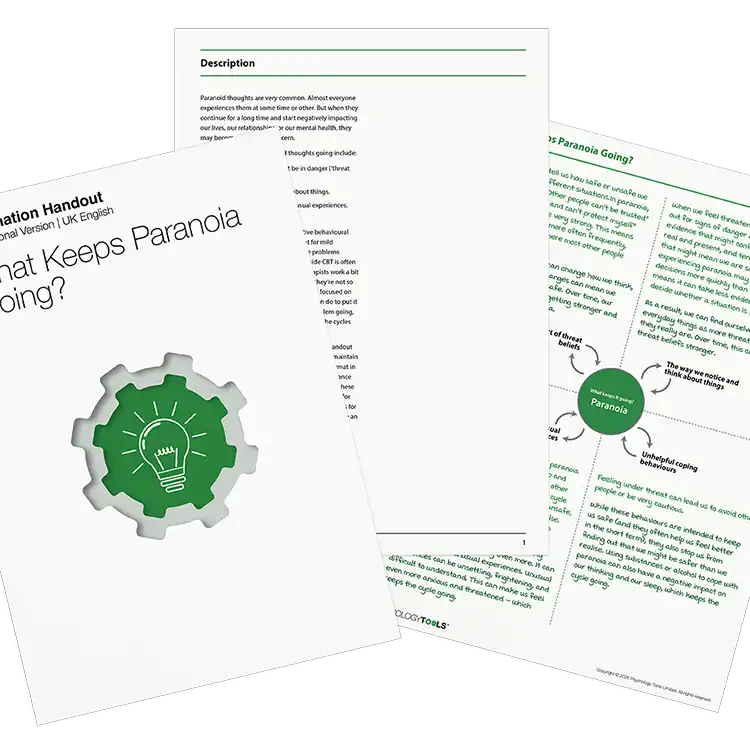
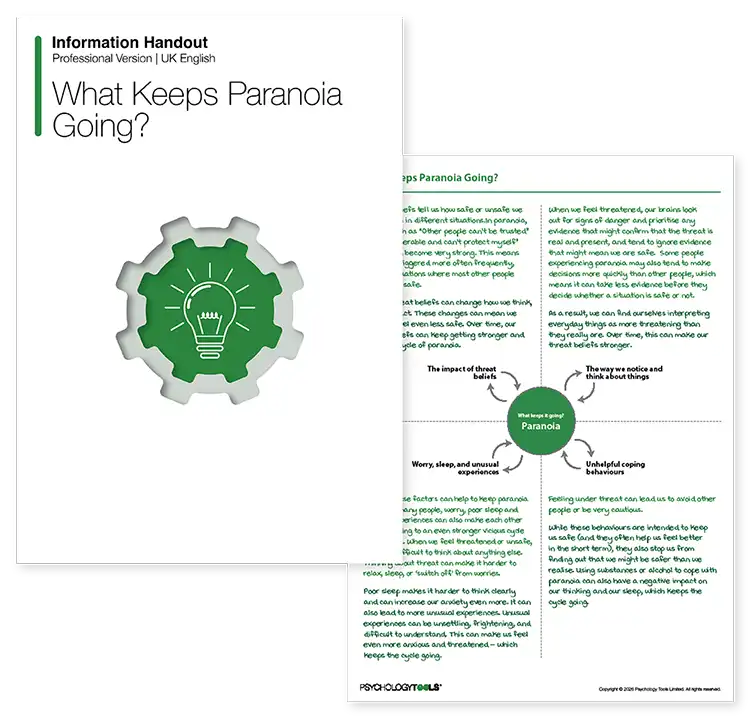
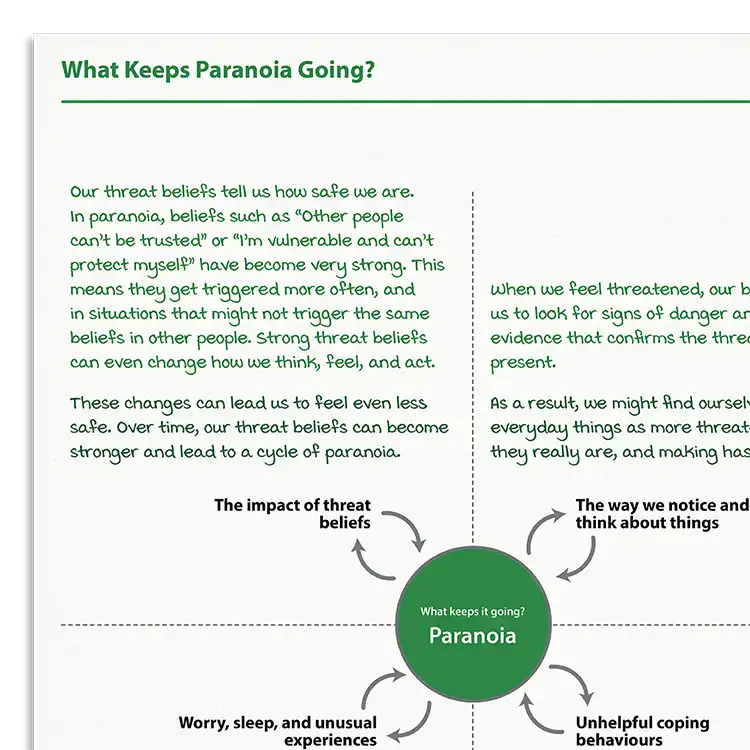
What Keeps Paranoia Going? is an illustrated psychoeducational handout that explains four interconnected processes that can maintain paranoid thoughts:

  • The impact of threat beliefs.
  • The way people notice and interpret information.
  • Worry, sleep problems, and unusual experiences.
  • Unhelpful coping behaviors.

The handout presents these processes in a “vicious flower” format, with each petal representing a separate maintenance cycle. Clinicians can use it to introduce a cognitive behavioral understanding of paranoia, support collaborative discussion, or develop an individualized formulation of a client’s experiences.

Why use this resource?

Cognitive behavioral therapy focuses not only on how a problem began, but also on the processes that keep it going. Identifying these maintaining factors gives clients and therapists practical targets for intervention.

This resource helps make complex psychological processes understandable without dismissing or directly confronting the client’s experiences. It can normalize paranoid thoughts, reduce confusion, and support a compassionate exploration of how beliefs, attention, worry, sleep, unusual experiences, and coping responses interact.

  • Introduces a clear CBT maintenance model of paranoia.
  • Helps clients recognize recurring cycles in their own experiences.
  • Supports collaborative and non-confrontational formulation.
  • Identifies processes that can become targets for treatment.
  • Provides an accessible visual framework for psychoeducation.

Key benefits

Clear

Explains several maintaining mechanisms using accessible language and a simple visual model.

Normalizing

Communicates that paranoid thoughts are common while acknowledging when they become distressing or disruptive.

Practical

Provides a template for developing an individualized understanding of a client’s paranoia.

Engaging

Encourages therapist and client to examine experiences together rather than debating whether beliefs are true.

What difficulties is this for?

Paranoia

Understanding longstanding mistrust, vigilance, and threat-focused interpretations.

Integrating it into your practice

01

Introduce

Explain that CBT often examines what is keeping a difficulty going rather than focusing only on what originally caused it.

02

Normalize

Acknowledge that paranoid thoughts are common and that the purpose of the handout is to understand distressing cycles, not to judge or invalidate the client.

03

Review

Work through each section of the vicious flower and invite the client to consider whether it resembles any part of their experience.

04

Personalize

Replace the general examples with the client’s own beliefs, thoughts, feelings, behaviors, sleep patterns, and unusual experiences.

05

Connect

Explore how the different maintenance cycles influence one another, such as poor sleep increasing anxiety and unusual experiences.

06

Prioritize

Collaboratively identify which maintaining process is currently causing the greatest difficulty or appears most open to change.

07

Intervene

Link each process to appropriate strategies, such as improving sleep, reducing worry, testing interpretations, modifying safety behaviors, or broadening attention.

08

Revisit

Return to the formulation during therapy to review new learning, update the model, and reinforce progress.

Theoretical background and therapist guidance

Paranoid thoughts exist on a continuum and are experienced by many people. They become more clinically significant when they are persistent, strongly held, distressing, or associated with impairment in relationships, functioning, or mental health. Cognitive behavioral approaches aim to understand these experiences in context and identify the processes that maintain them. The handout organizes these processes into four interacting domains.

The first is the impact of threat beliefs. Beliefs such as “Other people can’t be trusted” or “I’m vulnerable and can’t protect myself” can become highly accessible and easily triggered. Once activated, they influence thoughts, emotions, attention, and behavior in ways that can reinforce the person’s sense of danger.

The second domain concerns the way people notice and think about events. When someone feels threatened, attention becomes biased toward possible signs of danger, while information that appears to confirm the threat may be prioritized. Ambiguous events can consequently seem more threatening, and conclusions may be reached quickly without considering alternative explanations.

The third domain includes worry, sleep problems, and unusual experiences. Threat-focused worry can make it difficult to relax or disengage from concerns. Poor sleep can increase anxiety, reduce cognitive flexibility, and contribute to unusual experiences. These experiences may then feel frightening or difficult to understand, further strengthening the perception that something dangerous is happening.

The fourth domain concerns unhelpful coping behaviors. Avoidance, withdrawal, excessive caution, checking, and other safety strategies may reduce distress in the short term. However, they can prevent clients from discovering that situations may be safer than expected. Alcohol or substance use may also worsen sleep and thinking, adding further momentum to the cycle.

Clinicians should use the handout within a comprehensive assessment and treatment plan, working within their professional competencies and attending to risk, safeguarding, substance use, sleep disturbance, and the broader social context.

What's inside

  • A concise explanation of paranoia and when it may become a cause for concern.
  • A visual vicious flower illustrating four maintenance cycles.
  • Psychoeducation about strong threat beliefs and their impact.
  • An explanation of threat-focused attention and interpretation.
  • Guidance on the interaction between worry, poor sleep, and unusual experiences.
  • An overview of avoidance, caution, substance use, and other coping behaviors.
  • A suggested therapist question for introducing the handout collaboratively.
  • Professional background information and supporting references.
Get access to this resource

FAQs

The handout uses paranoia to describe thoughts and beliefs involving possible threat, danger, mistrust, or harmful intentions from other people. It emphasizes that these thoughts are common, but may require clinical attention when they persist and negatively affect a person’s life or mental health.
Its primary focus is on maintenance rather than origin. It helps clients identify what is keeping paranoia going in the present, giving therapy clear and practical targets for change.
Threat beliefs are strongly held ideas about danger, vulnerability, or the trustworthiness of other people. Examples in the handout include “Other people can’t be trusted” and “I’m vulnerable and can’t protect myself.”
Behaviors such as avoidance and excessive caution are understandable attempts to feel safer. Although they may reduce anxiety temporarily, they can prevent clients from learning that a situation may be less dangerous than expected.
Use a curious and collaborative approach. Invite the client to consider whether any parts of the model fit their experience, rather than stating that the model definitively explains what is happening.
Yes. Clinicians can use the vicious flower as a template and replace its general descriptions with the client’s specific beliefs, interpretations, emotions, behaviors, sleep difficulties, and unusual experiences.
The resource states that CBT is effective for mild to moderate paranoia. For more severe problems, including psychosis, medication alongside CBT is often considered the best approach.
It is best used as part of a broader clinical assessment and treatment plan. Psychoeducation can improve understanding and engagement, but intervention should also address the client’s individualized maintaining processes, needs, risks, and goals.

How this resource helps improve clinical outcomes

This handout helps clients move from a confusing or overwhelming account of paranoia toward a structured understanding of how the problem is maintained. Recognizing these cycles can increase insight, reduce self-blame, and create a shared language for therapy.

By identifying specific maintaining processes, clinicians can select interventions more precisely. Treatment may focus on reducing worry, improving sleep, considering alternative interpretations, modifying safety behaviors, broadening attention, or developing more effective coping responses.

The resource can support:

  • Greater understanding of paranoid thoughts and associated distress.
  • Improved engagement in collaborative formulation.
  • Increased recognition of triggers and maintenance cycles.
  • More focused and individualized treatment planning.
  • Reduced reliance on behaviors that prevent corrective learning.
  • Better communication between clients and clinicians about difficult experiences.

References and further reading

  • Freeman, D. (2016). Persecutory delusions: A cognitive perspective on understanding and treatment. Lancet Psychiatry, 3, 685-692.
  • Freeman, D. and Bao Sheng Loe (2023). Explaining paranoia: cognitive and social processes in the occurrence of extreme mistrust. BMJ Mental Health, Nov 9;26(1).
  • Mehl, S., Werner, D., & Lincoln, T. M. (2018). Does Cognitive Behavior Therapy for psychosis (CBTp) show symptom-specific effects? A meta-analysis. Schizophrenia Research, 201, 102–113. https://doi.org/10.1016/j.schres.2017.08.037
  • Morrison, A. P. (2017). A manualised treatment protocol to guide delivery of evidence-based cognitive therapy for people with distressing psychosis: learning from clinical trials. Psychosis, 9(3), 271-281.
  • National Institute for Health and Care Excellence. (2014). Psychosis and schizophrenia in adults: Prevention and management (NICE Clinical Guideline No. CG178). https://www.nice.org.uk/guidance/cg178