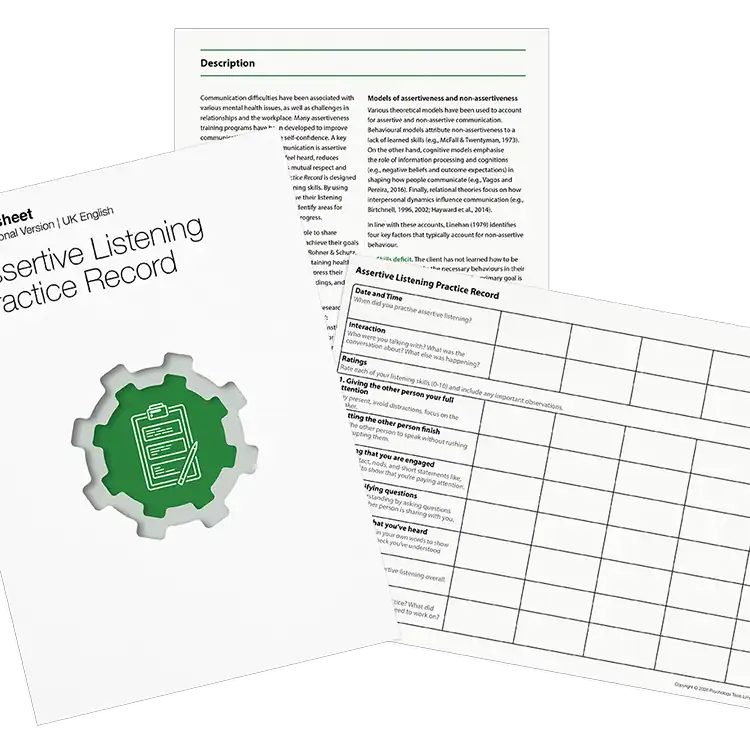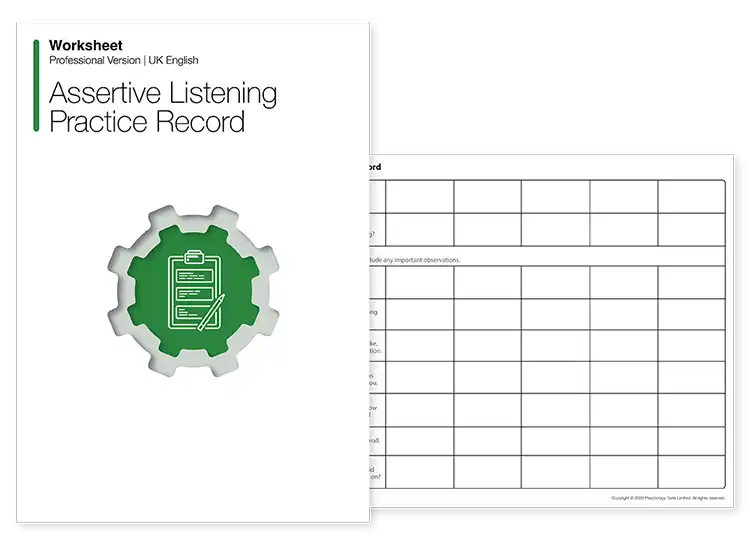
Assertive Listening Practice Record

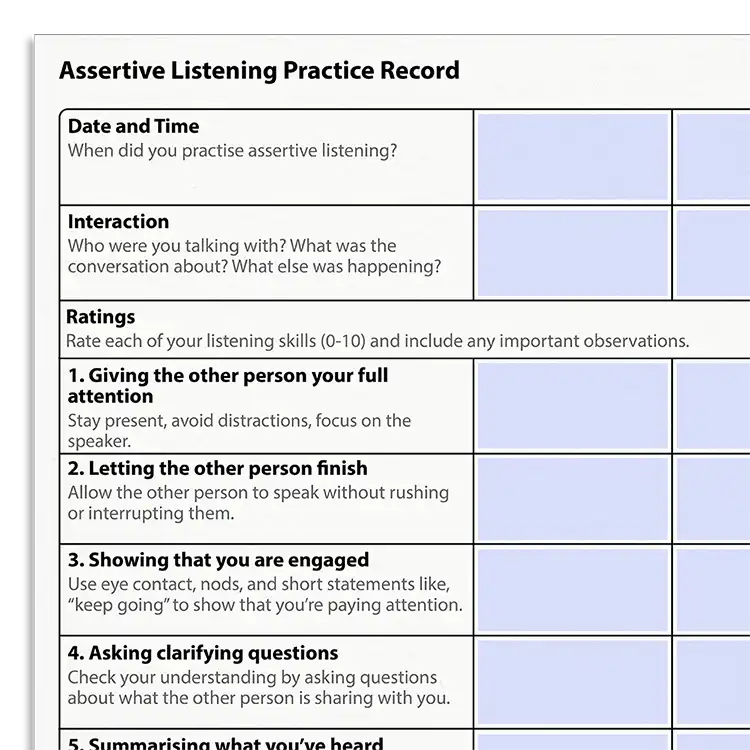
This structured worksheet helps clients practice and refine their assertive listening skills, supporting more effective communication.

Psychology Tools resource: Assertive Listening Practice Record

Download or send

Professional version

Offers theory, guidance, and prompts for mental health professionals. Downloads are in Fillable PDF format where appropriate.
Client version

Includes client-friendly guidance. Downloads are in Fillable PDF format where appropriate.

Psychology Tools resource: Assertive Listening Practice Record

Overview

Communication difficulties have been associated with various mental health issues, as well as challenges at work and in relationships. Many assertiveness training programs have been developed to improve communication and increase self-confidence. A key part of assertive communication is assertive listening, which helps people feel understood, reduces misunderstandings, and builds mutual respect and trust. This Assertive Listening Practice Record is designed to help clients develop their listening skills, identify areas for improvement, and track their progress.

Why use this resource?

Assertive listening helps clients become more attentive, empathic, and effective communicators. By encouraging deliberate practice and reflection, this worksheet helps clients listen and communicate more effectively.

  • Breaks down the different components of assertive listening.
  • Helps clients practice and develop their listening skills.
  • Increases self-awareness through ratings and self-reflection.  
  • Useful for tracking progress over time.

Key benefits

Accessible

Intuitive and easy to use.

Structured

Provides a clear framework for practising assertive listening skills.

Reflective

Increases clients' awareness of their communication habits.

Practical

Outlines the different aspects of assertive listening.

What difficulties is this for?

Generalized Anxiety Disorder (GAD)

For anxious clients who struggle to express themselves.

Social Anxiety Disorder (SAD)

To encourage confident, respectful social interactions.

Depression

Supports clients whose communication is hindered by guilt, hopelessness, or low self-worth.

Relationship Issues

For clients experiencing interpersonal difficulties where communication plays a role.

Low Self-Esteem

Encourages development of self-respect and clear expression of needs.

Workplace Difficulties

Supports effective communication with colleagues and reduces vulnerability to bullying.

Integrating it into your practice

01

Educate

Explain what assertive listening is and why it matters.

02

Review

Discuss the key components of assertive listening skills.

03

Practice

Encourage clients to practice assertive listening and complete the worksheet as soon as possible afterwards.

04

Reflect

Review individual skill ratings and identify areas for improvement.

05

Reinforce

Highlight improvements over time and encourage continued practice.

Theoretical background and therapist guidance

Assertiveness training programs tend to focus on ‘core’ interventions such including psychoeducation, cognitive restructuring, behavioural skills training, and real-world practice (Duckworth, 2009; Linehan, 1979; Hagberg et al., 2023; Speed et al., 2018). Some programs also emphasise the importance of listening skill, referred to as "assertive listening," which they suggest is essential for effective assertive communication (Alberti & Emmons, 2017; Bishop, 2013; Bonham-Carter, 2012; Brown & Carmichael, 1992).

Assertive listening is an active process that involves attending to and understanding another person’s messages, while demonstrating respect and withholding the immediate expression of one’s own needs (Alberti & Emmons, 2017; Bishop, 2013). Key components of assertive listening include giving undivided attention to the speaker, allowing the speaker to finish without interruption, and referencing key points to demonstrate understanding.

While some argue that assertive listening can compromise assertive communication by appearing passive or overly agreeable, others have highlighted its numerous advantages (Ames et al., 2012; Alberti & Emmons, 2017; Bishop, 2013; Bonham-Carter, 2012). They include signalling respect and understanding for the speaker, encouraging openness and reciprocity, and reducing the risk of conflict. Consistent with these points, research indicates that strong listening skills play a key role in effective communication. For instance, Ames and colleagues (2012) found that good listening was related to greater influence on others, beyond what was actually said.

Psychology Tools resource: Assertive Listening Practice Record

What's inside

  • A structured practice record for listening skills development.
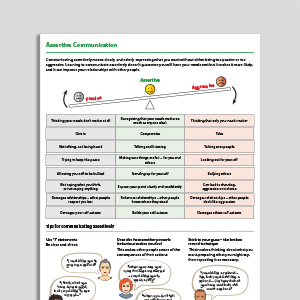
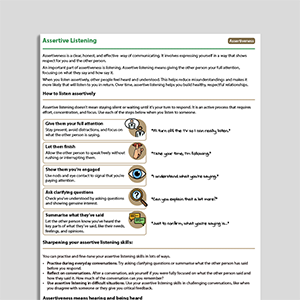
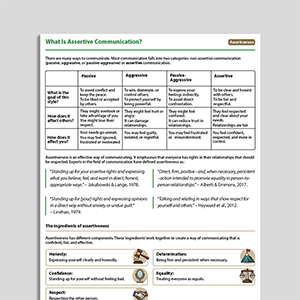
  • An introduction to assertive communication and assertive listening.
  • Guidance for introducing the resource to clients.
  • Helpful questions and prompts that support implementation.
  • Recommendations for further reading.
Get access to this resource

FAQs

Assertive listening is an active listening approach that involves giving another person full attention, demonstrating engagement, asking clarifying questions, and accurately understanding and reflecting their message while temporarily setting aside the expression of one's own needs.
Clients are encouraged to complete the record as soon as possible after practising assertive listening so that details of the interaction remain fresh and reflections are more accurate.
Therapists can compare listening ratings across multiple practice records, identify recurring strengths and difficulties, discuss clients' reflections, and collaboratively plan future practice exercises.

How this resource helps improve clinical outcomes

This resource helps clients by:

  • Supporting assertive communication.
  • Improving their listening skills.
  • Encouraging respectful interactions.
  • Highlighting progress over time.

References and further reading

  • Alberti, R. E., & Emmons, M. L. (2017). Your perfect right: Assertiveness and equality in your life and relationships (10th ed.). Impact Publishers.
  • Ames, D., Maissen, L. B., & Brockner, J. (2012). The role of listening in interpersonal influence. Journal of Research in Personality, 46, 345-349. DOI: 10.1016/j.jrp.2012.01.010.
  • Birtchnell, J. (1996). How humans relate: A new interpersonal theory. Psychology Press.
  • Birtchnell, J. (2002). Relating in psychotherapy: The application of a new theory. Brunner Routledge. DOI: 10.1002/cpp.615.
  • Bishop, S. (2013). Develop your assertiveness. Kogan Page.
  • Bonham-Carter, D. (2012). Assertiveness: A practical guide. Icon Books.
  • Brown, G. T., & Carmichael, K. (1992). Assertiveness training for clients with a psychiatric illness: A pilot study. British Journal of Occupational Therapy, 55, 137-140. DOI: 10.1177/030802269205500404.
  • Chłopicki, W. (2017). Communication styles: An overview. Styles of Communication, 9, 9-25.
  • Duckworth, M. P. (2009). Assertiveness skills and the management of related factors. In W. T. O’Donohue & J. E. Fisher (Eds.), General principles and empirically supported techniques of cognitive behavior therapy (pp. 124–132). John Wiley and Sons.
  • Gordon, T. (1975). P.E.T.: Parent effectiveness training. New American Library.
  • Hagberg, T., Manhem, P., Oscarsson, M., Michel, F., Andersson, G., & Carlbring, P. (2023). Efficacy of transdiagnostic cognitive-behavioral therapy for assertiveness: A randomized controlled trial. Internet Interventions, 32, 100629. DOI: 10.1016/j.invent.2023.100629.
  • Hayward, M., Berry, K., McCarthy-Jones, S., Strauss, C., & Thomas, N. (2014). Beyond the omnipotence of voices: Further developing a relational approach to auditory hallucinations. Psychosis, 6, 242-252. DOI: 10.1080/17522439.2013.839735.
  • Linehan, M. M. (1979). Structured cognitive-behavioral treatment of assertion problems. In P. C. Kendall & S. V. Hollon (Eds.), Cognitive-behavioral interventions: theory, research, and procedures (pp. 205-240). Academic Press.
  • McFall, R. M., & Twentyman, C. T. (1973). Four experiments on the relative contributions of rehearsal, modeling, and coaching to assertion training. Journal of Abnormal Psychology, 81, 199–218. DOI: 10.1037/h0034567.
  • McKay, M., Davis, M., & Fanning, P. (2018). Messages: The communication skills workbook (4th ed.). New Harbinger Publications.
  • Mnookin, R. H., Peppet, S. R., & Tulumello, A. S. (1996). The tension between empathy and assertiveness. Negotiation Journal, 12, 217-230. DOI: 10.1007/BF02187629.
  • Rakos, R. F. (1991). Assertive behavior: Theory, research, and training. Routledge.
  • Rogers, C. R. (1951). Client-centered therapy. Houghton-Mifflin.
  • Rohner, J., & Schutz, A. (2024). Psychology of communication. Springer.
  • Speed, B. C., Goldstein, B. L., & Goldfried, M. R. (2018). Assertiveness training: A forgotten evidence-based treatment. Clinical Psychology: Science and Practice, 25, e12216. DOI: 10.1111/cpsp.12216.
  • Suzuki, E., Saito, M., Tagaya, A., Mihara, R., Maruyama, A., Azuma, T., & Sato, C. (2009). Relationship between assertiveness and burnout among nurse managers. Japan Journal of Nursing Science, 6, 71-81. DOI: 10.1111/j.1742-7924.2009.00124.x.
  • Vagos, P., & Pereira, A. (2016). A cognitive perspective for understanding and training assertiveness. European Psychologist, 21, 109–121. DOI: 10.1027/1016-9040/a000250.