Compulsions In Obsessive Compulsive Disorder (OCD)

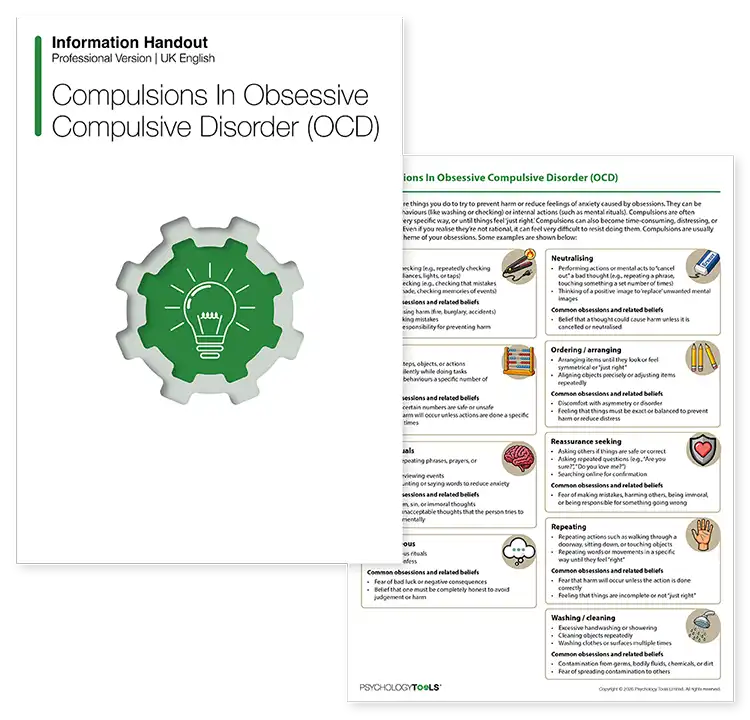
This information handout explains the nature of compulsions in obsessive compulsive disorder (OCD), the different forms they take, and their relationship with obsessions. It helps clients recognize and validate their experiences while supporting evidence-based psychoeducation and treatment.

Psychology Tools Resource: Compulsions In OCD

Download or send

Client version

Includes client-friendly guidance. Downloads are in Fillable PDF format where appropriate.

Professional version

Offers theory, guidance, and prompts for mental health professionals. Downloads are in Fillable PDF format where appropriate.

Psychology Tools Resource: Compulsions In OCD

Overview

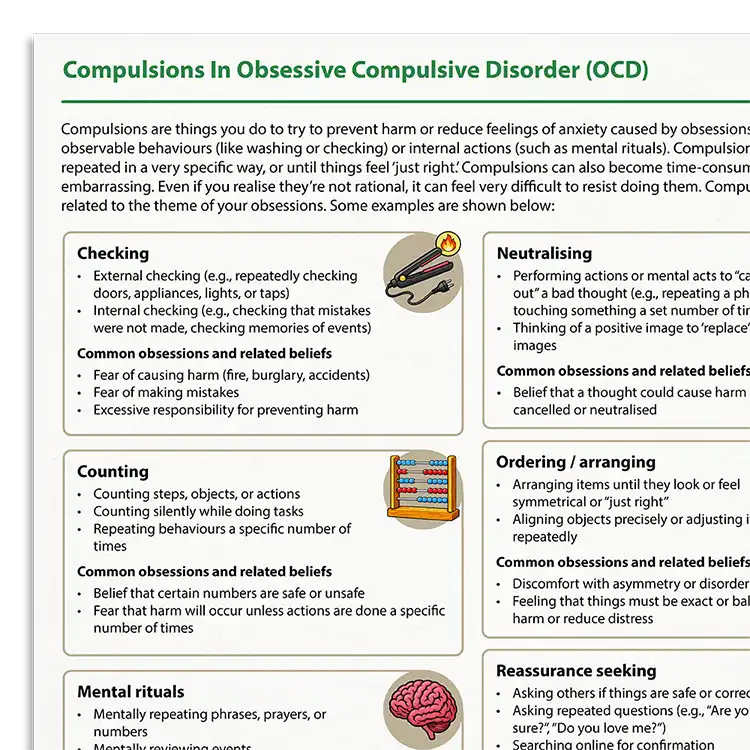
Compulsions are one of the defining features of obsessive compulsive disorder (OCD), yet many clients struggle to recognise the full range of behaviors that maintain their difficulties. While compulsions are commonly associated with visible behaviors such as checking or washing, they can also include reassurance seeking, mental rituals, counting, ordering, repeating, neutralizing, and many other covert behaviors that are less readily identified.

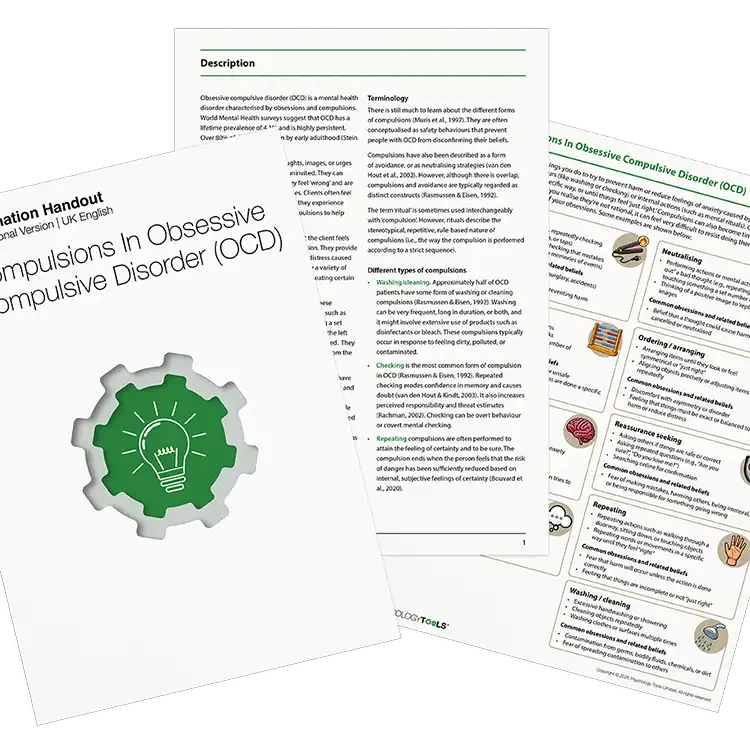
The Compulsions In Obsessive Compulsive Disorder (OCD) information handout provides a clear, evidence-based explanation of compulsions,and the different forms they can take, and the common obsessions and related beliefs that accompany them. Practical examples help clients recognize their own compulsions, understand the relationship between obsessions and compulsions, and appreciate that many people with OCD experience multiple overlapping forms of compulsive behavior.

Why use this resource?

Used as part of psychoeducation, this resource:

  • Helps clients identify covert behaviors, mental rituals, reassurance-seeking, neutralizing, or subtle repeating behaviors.

  • Provides a comprehensive overview of compulsions, and the common obsessions and related beliefs that they develop around.

  • Helps normalize clients' experiences and reduce shame surrounding compulsive behaviors.

  • Provides a shared language for discussing symptoms that clients may previously have concealed.

Key benefits

Education

Explains the purpose and function of compulsions using clear, evidence-based language.

Recognition

Helps clients identify both overt and covert compulsions.

Engaging

Reduces shame and encourages discussion.

Flexibility

Suitable throughout assessment and treatment.

What difficulties is this for?

Obsessive Compulsive Disorder (OCD)

Clients receiving evidence-based treatment for OCD.

Intrusive Thoughts

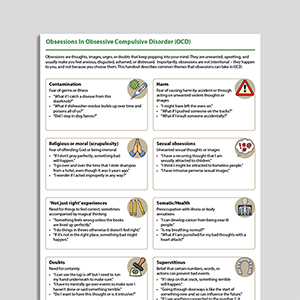
Clients experiencing distressing intrusive thoughts, images, urges, or doubts.

Anxiety Disorders

Clients relying on reassurance or ritualized safety behaviors.

Shame And Concealment

Clients reluctant to disclose compulsions.

Psychoeducation

Therapists introducing the CBT model of OCD.

Integrating it into your practice

01

Introduce

Use early during psychoeducation.

02

Explore

Identify overt and covert compulsions.

03

Normalize

Reduce shame by highlighting the diversity of compulsions.

04

Formulate

Link compulsions to obsessions and maintaining beliefs.

05

Prepare

Introduce the rationale for ERP.

06

Supplement

Use alongside other OCD psychoeducation resources.

Theoretical background and therapist guidance

Compulsions are behaviors performed in response to distressing obsessions. They temporarily reduce anxiety but ultimately maintain OCD by preventing disconfirmation of feared beliefs. They may be behavioral or mental, overt or covert, and are often performed according to strict rules or rituals.

The resource describes the wide range of compulsions encountered in OCD, including washing, checking, counting, repeating, ordering, reassurance-seeking, mental rituals, neutralizing, and miscellaneous compulsions.

The therapist guidance recommends using the handout during psychoeducation, particularly when clients struggle to recognize compulsions, feel ashamed of them, or conceal symptoms. It provides an excellent foundation for collaborative formulation and subsequent ERP.

Psychology Tools Resource: Compulsions In OCD

What's inside

  • Description of the wide range of compulsions, including overt and covert compulsions. Categories including washing, checking, repeating, counting, ordering, reassurance seeking, mental rituals, neutralizing, and miscellaneous compulsions.

  • Therapist guidance for clinical use.

Get access to this resource

FAQs

To help illustrate the wide range of compulsions, to help clients understand that compulsions arise in response to obsessions, and to validate clients’ experiences.
Yes. Most clients experience multiple overlapping compulsions.
The handout helps identify the behaviors that become targets for response prevention.

How this resource helps improve clinical outcomes

This resource improves psychoeducation, collaborative formulation, and treatment engagement by helping clients recognize the wide range of compulsions that may be present in OCD, and the obsessions or related beliefs that may underly them. It also helps therapists identify covert compulsions that may otherwise be overlooked, improving preparation for CBT and ERP.

References and further reading

  • Albert, U., De Cori, D., Barbaro, F., Fernández De La Cruz, L., Nordsletten, A. E., & Mataix-Cols, D. (2015). Hoarding disorder: a new obsessive-compulsive related disorder in DSM-5. Journal of Psychopathology, 21(4), 354-364.

  • Bocci, L., & Gordon, P. K. (2007). Does magical thinking produce neutralising behaviour? An experimental investigation. Behaviour Research and Therapy, 45(8), 1823-1833.

  • Bouvard, M., Fournet, N., Denis, A., Achachi, O., & Purdon, C. (2020). A study of the Repeated Actions Diary in patients suffering from obsessive compulsive disorder. Clinical psychology & psychotherapy, 27(2), 228-238.

  • Coles, M. E., & Ravid, A. (2016). Clinical presentation of not-just right experiences (NJREs) in individuals with OCD: Characteristics and response to treatment. Behaviour Research and Therapy, 87, 182-187.

  • Freeston, M. H., & Ladouceur, R. (1997). What do patients do with their obsessive thoughts? Behaviour research and therapy, 35(4), 335-348.

  • Halldorsson, B., & Salkovskis, P. M. (2023). Reassurance and its alternatives: Overview and cognitive behavioural conceptualisation. Journal of Obsessive-Compulsive and Related Disorders, 36, 100783.

  • Muris, P., Merckelbach, H., & Clavan, M. (1997). Abnormal and normal compulsions. Behaviour research and therapy, 35(3), 249-252.

  • Purdon, C. (2018). There is a lot more to compulsions than meets the eye. Clinical Neuropsychiatry, 15(5).

  • Rachman, S. (2002). A cognitive theory of compulsive checking. Behaviour research and therapy, 40(6), 625-639.

  • Radomsky, A. S., & Rachman, S. (2004). Symmetry, ordering and arranging compulsive behaviour. Behaviour Research and Therapy, 42(8), 893-913

  • Rasmussen, S. A., & Eisen, J. L. (1992). The epidemiology and clinical features of obsessive compulsive disorder. Psychiatric Clinics, 15(4), 743-758.

  • Sibrava, N. J., Boisseau, C. L., Mancebo, M. C., Eisen, J. L., & Rasmussen, S. A. (2011). Prevalence and clinical characteristics of mental rituals in a longitudinal clinical sample of obsessive–compulsive disorder. Depression and Anxiety, 28(10), 892-898.

  • Starcevic, V., Berle, D., Brakoulias, V., Sammut, P., Moses, K., Milicevic, D., & Hannan, A. (2012). Interpersonal reassurance seeking in obsessive-compulsive disorder and its relationship with checking compulsions. Psychiatry Research, 200(2-3), 560-567

  • Starcevic, V., & Brakoulias, V. (2008). Symptom subtypes of obsessive–compulsive disorder: are they relevant for treatment? Australian & New Zealand Journal of Psychiatry, 42(8), 651-661.

  • Stein, D. J., Ruscio, A. M., Altwaijri, Y., Chiu, W. T., Sampson, N. A., Aguilar-Gaxiola, S., ... & Kessler, R. C. (2025). Obsessive-compulsive disorder in the World Mental Health surveys. BMC medicine, 23(1), 416.

  • van den Hout, M., & Kindt, M. (2003). Repeated checking causes memory distrust. Behaviour research and therapy, 41(3), 301-316.

  • van den Hout, M., Kindt, M., Weiland, T., & Peters, M. (2002). Instructed neutralization, spontaneous neutralization and prevented neutralization after an obsession-like thought. Journal of Behavior Therapy and Experimental Psychiatry, 33(3-4), 177-189.