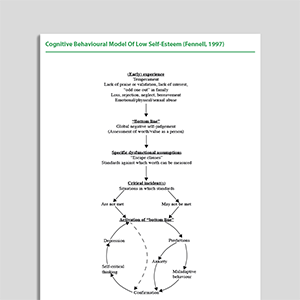
Cognitive Behavioral Model Of Low Self-Esteem (Fennell, 1997)
[Free Guide] Critical Illness Intensive Care And Post-Traumatic Stress Disorder (PTSD)
[Free Guide] Critical Illness Intensive Care And Post-Traumatic Stress Disorder (PTSD)
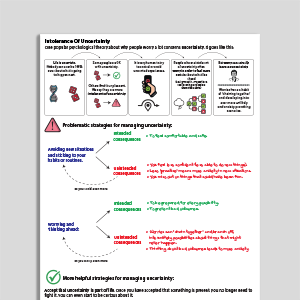
Intolerance Of Uncertainty
Challenging Your Negative Thinking (Archived)
Process Focused Case Formulation
Modifying Rules And Assumptions
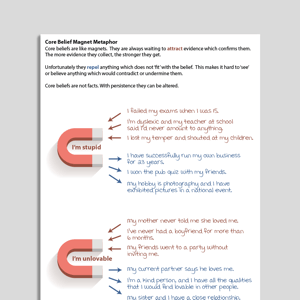
Core Belief Magnet Metaphor
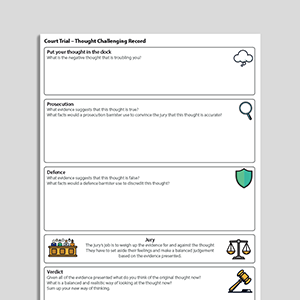
Court Trial Thought Challenging Record (Archived)
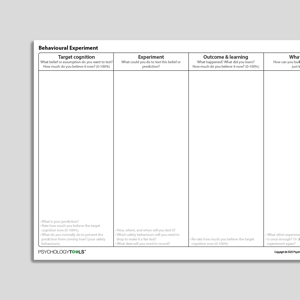
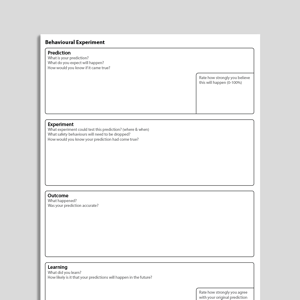
Behavioral Experiment (Portrait Format)
What Is Schema Maintenance?
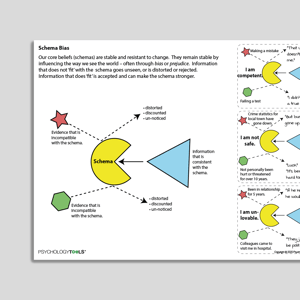
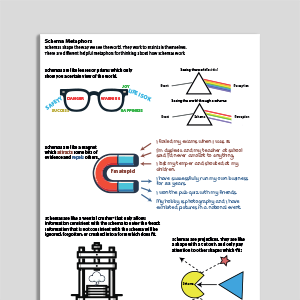
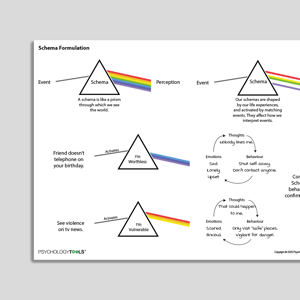
Young, Klosko, and Weishaar (2003) describe how “schemas begin in early childhood or adolescence as reality-based representations of the child’s environment.” Schemas continue to be elaborated upon throughout the course of our life, and then superimposed on later life experiences even when they are no longer applicable. For example, if a child formed an accurate schema during childhood that “other people are scary and unpredictable” then they may live with the emotional and behavioral consequences of this schema even if they live in a substantially different context as an adult.An important property of schemas is that they strive for ‘cognitive consistency’—that we prefer to maintain a stable view of ourselves and the world, even if this schema is inaccurate.“Early maladaptive schemas fight for survival … although it causes suffering, it is comfortable and familiar, it feels right” (Young, Klosko, & Weishaar, 2003).Schemas are a key maintenance factor in cognitive therapy because they determine “what we notice, attend to, and remember of our experiences” (Padesky, 1994). A schema of ‘I’m bad’ may make it hard for an individual to notice when they do something good, leading to the maintenance of the unhelpful way of thinking and being. Mechanisms by which schemas are maintained include:
selective memory;
biased interpretation of ambiguous stimuli such as discounting contradictory information or by seeing the information as an exception to the schema.
Treatment Approaches That Target Schema Maintenance / Schema Change
Padesky (1994) describes a number of techniques within CBT which may be used to change schemas including:continuum methods to evaluate self/behavior on negative and adaptive continuum;
historical texts of schema;
psychodrama / role-play techniques.
References
Padesky, C. A. (1994). Schema change processes in cognitive therapy. Clinical Psychology & Psychotherapy, 1(5), 267–278.
Young, J. E., Klosko, J. S., & Weishaar, M. E. (2003). Schema therapy: A practitioner’s guide. New York: Guilford Press.
Links to external resources
Psychology Tools makes every effort to check external links and review their content. However, we are not responsible for the quality or content of external links and cannot guarantee that these links will work all of the time.
Please login to view our external resources.