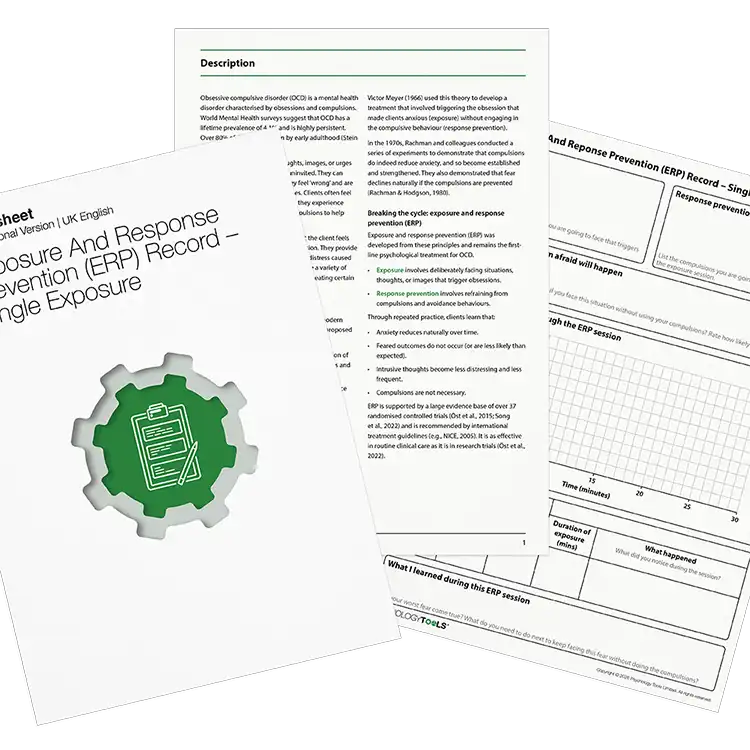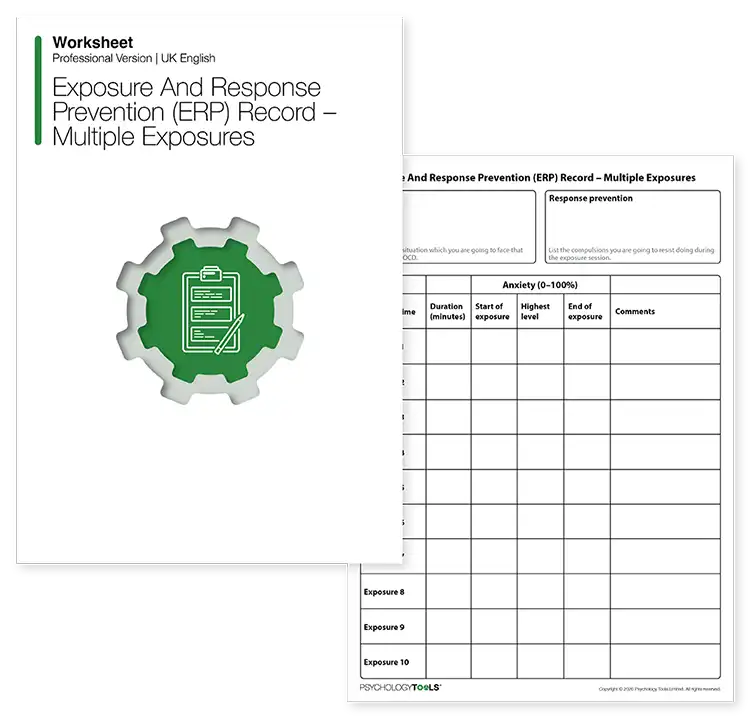
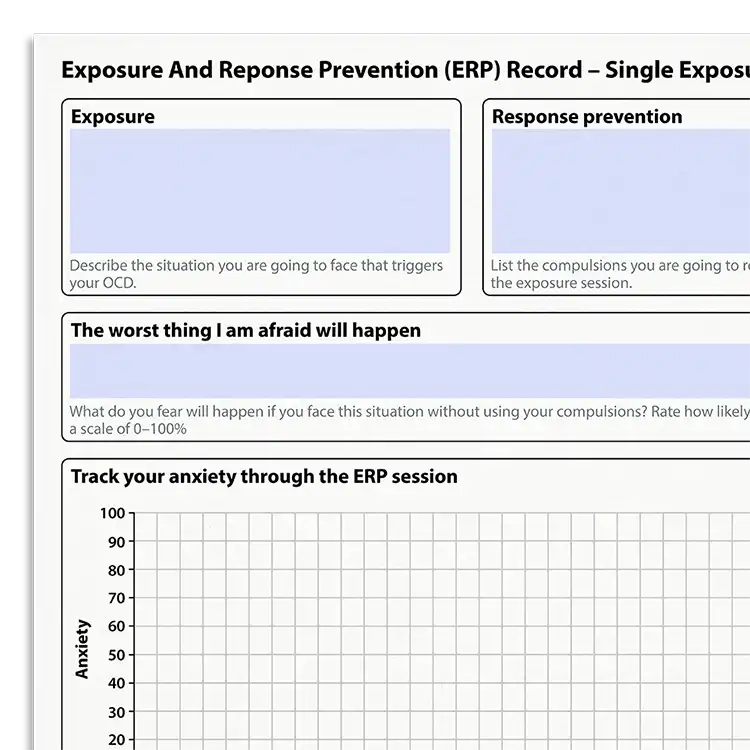
Exposure And Response Prevention (ERP) Record – Single Exposure

This structured worksheet helps clients plan, complete, and reflect on single exposure exercises, supporting the delivery of exposure and response prevention (ERP).

Psychology Tools Resource: Exposure And Response Prevention (ERP) Record – Single Exposure

Download or send

Client version

Includes client-friendly guidance. Downloads are in Fillable PDF format where appropriate.

Professional version

Offers theory, guidance, and prompts for mental health professionals. Downloads are in Fillable PDF format where appropriate.
Psychology Tools Resource: Exposure And Response Prevention (ERP) Record – Single Exposure

Overview

Exposure and response prevention (ERP) is an effective treatment for obsessive compulsive disorder (OCD). This worksheet guides clients through each stage of ERP, from planning an exposure exercise to reflecting on their learning afterwards.

Key benefits

Structured

Guides clients through the process of ERP.

Comprehensive

Includes each stage of ERP, from planning to reflecting.

Accessible

Easy to use and understand.

Flexible

Suitable for in-session and between-session practice.

What difficulties is this for?

Obsessive Compulsive Disorder (OCD)

Clients undertaking ERP.

Integrating it into your practice

01

Select

Choose an exposure from the client's hierarchy.

02

Plan

Identify the compulsions the client will resist during exposure.

03

Predict

Identify the client's worst fears.

04

Track

Monitor the client's anxiety during exposure.

05

Reflect

Review learning after the exercise.

Theoretical background and therapist guidance

Exposure and response prevention (ERP) is an effective treatment for obsessive compulsive disorder (OCD). It is supported by a large evidence base of over 37 randomized controlled trials (Öst et al., 2015; Song et al., 2022) and is recommended by international treatment guidelines (e.g., NICE, 2005). It is as effective in routine clinical care as it is in research trials (Öst et al., 2022).

ERP is typically delivered through a series of repeated exposure exercises, each of which follows a broadly similar structure. Individual sessions are designed to help clients plan, carry out, and reflect on a single exposure in a systematic way, so that learning can accumulate over time.

Through repeated exposure sessions, clients are able to test their fears, learn that anxiety is tolerable and declines naturally, and discover that compulsions are not necessary. This Exposure And Response Prevention (ERP) Record – Single Exposure worksheet is designed to support this process by guiding clients through each stage and capturing key observations.

Psychology Tools Resource: Exposure And Response Prevention (ERP) Record – Single Exposure

What's inside

  • An accessible worksheet for clients.

  • An introduction to ERP for therapists.

  • Guidance for using the resource.

  • Helpful, illustrative examples.

Get access to this resource

FAQs

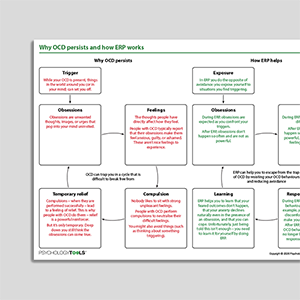
Exposure and response prevention (ERP) is the first-line psychological treatment for OCD. It involves exposure (deliberately facing situations, thoughts, or images that trigger obsessions) and response prevention (refraining from compulsions and avoidance behaviors).
Through repeated practice, ERP teaches clients that anxiety reduces naturally over time, feared outcomes do not occur (or are less likely than expected), intrusive thoughts become less distressing and less frequent, and that compulsions are not necessary.
Yes. It documents a single exposure exercise and can be used throughout treatment.

How this resource helps improve clinical outcomes

The worksheet supports ERP by:

  • Encouraging collaborative planning.

  • Ensuring consistency across ERP exercises.

  • Maximizing learning.

  • Providing a clear record of learning and progress.

References and further reading

  • Jacoby, R. J., & Abramowitz, J. S. (2016). Inhibitory learning approaches to exposure therapy: A critical review and translation to obsessive-compulsive disorder. Clinical Psychology Review, 49, 28-40.

  • Meyer, V. (1966). Modification of expectations in cases with obsessional rituals. Behaviour research and therapy, 4(4), 273-280.

  • Mowrer, O. (1947). On the dual nature of learning---a re-interpretation of conditioning and problem-solving. Harvard Educational Review, 17, 102--148.

  • National Institute for Health and Clinical Excellence (2005). Obsessive--compulsive disorder: core interventions in the treatment of obsessive--compulsive disorder and body dysmorphic disorder CG31. London: National Institute for Health and Clinical Excellence.

  • Öst, L. G., Enebrink, P., Finnes, A., Ghaderi, A., Havnen, A., Kvale, G., ... & Wergeland, G. J. (2022). Cognitive behavior therapy for obsessive-compulsive disorder in routine clinical care: A systematic review and meta-analysis. Behaviour Research and Therapy, 159, 104170.

  • Öst, L. G., Havnen, A., Hansen, B., & Kvale, G. (2015). Cognitive behavioral treatments of obsessive--compulsive disorder. A systematic review and meta-analysis of studies published 1993--2014. Clinical Psychology Review, 40, 156-169.

  • Rachman, S., & Hodgson, R. (1980). Obsessions and Compulsions. Englewood Cliffs, NJ: Prentice-Hall.

  • Salkovskis, P. M. (1985). Obsessional-compulsive problems: A cognitive-behavioural analysis. Behaviour research and therapy, 23(5), 571-583.

  • Song, Y., Li, D., Zhang, S., Jin, Z., Zhen, Y., Su, Y., ... & Li, X. (2022). The effect of exposure and response prevention therapy on obsessive-compulsive disorder: A systematic review and meta-analysis. Psychiatry Research, 317, 114861.

  • Stein, D. J., Ruscio, A. M., Altwaijri, Y., Chiu, W. T., Sampson, N. A., Aguilar-Gaxiola, S., ... & Kessler, R. C. (2025). Obsessive-compulsive disorder in the World Mental Health Surveys. BMC Medicine, 23(1), 416.