Why OCD Persists And How ERP Works

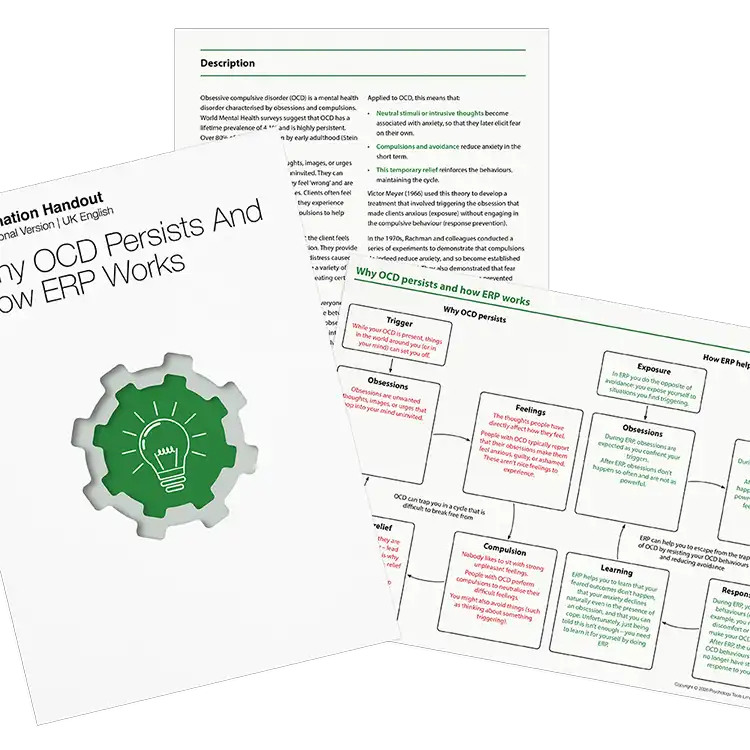
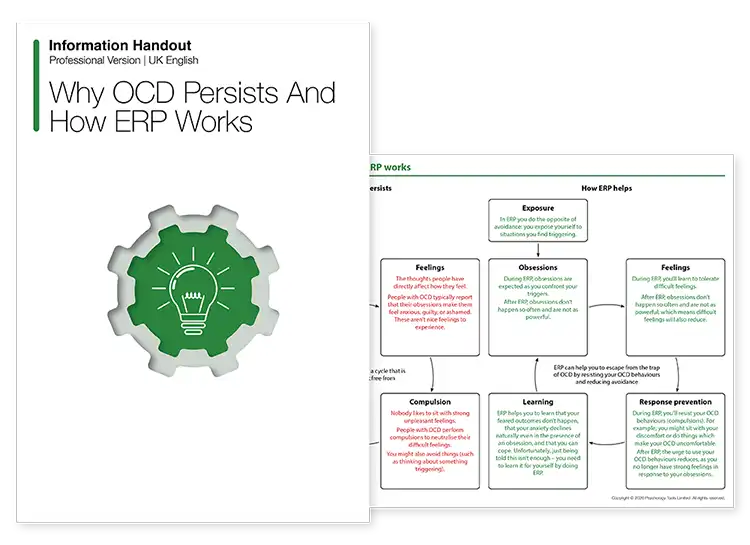
This psychoeducation handout explains what keeps obsessive compulsive disorder (OCD) going and how exposure and response prevention (ERP) can break this cycle.

Psychology Tools Resource: Why OCD Persists And How ERP Helps

Download or send

Client version

Includes client-friendly guidance. Downloads are in Fillable PDF format where appropriate.

Professional version

Offers theory, guidance, and prompts for mental health professionals. Downloads are in Fillable PDF format where appropriate.
Psychology Tools Resource: Why OCD Persists And How ERP Helps

Overview

Obsessive compulsive disorder (OCD) is maintained by a recurring cycle of obsessions, compulsions, and short-term relief. This handout explains why OCD persists and how exposure and response prevention (ERP) is used to address it. It supports psychoeducation, treatment preparation, and motivation enhancement, helping clients make informed decisions about their treatment.

Key benefits

Educational

Uses accessible language to explains why OCD persists.

Informative

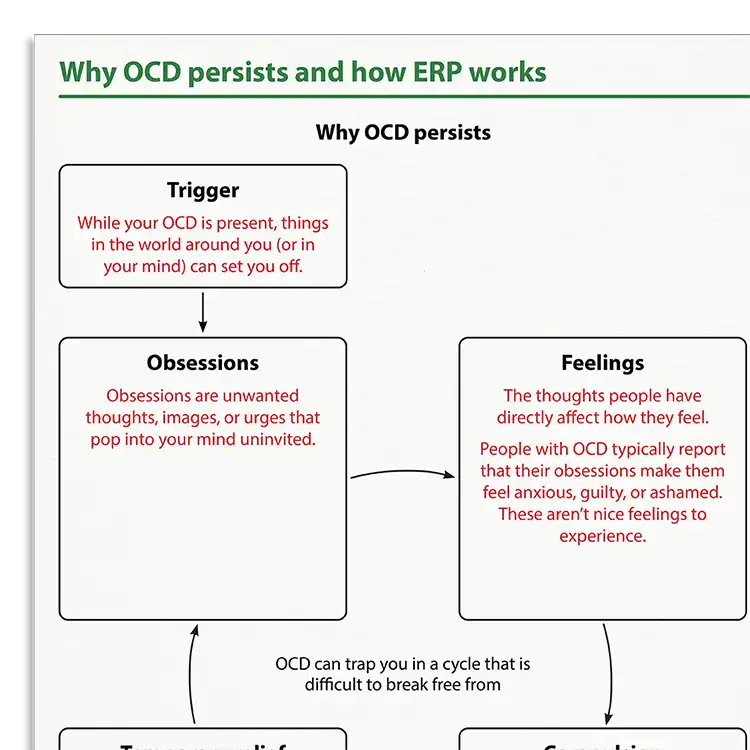
Clearly illustrates the OCD cycle.

Visual

Uses a side-by-side visuals to compare OCD and ERP.

Normalizing

Helps clients make sense of their experiences.

What difficulties is this for?

Obsessive Compulsive Disorder (OCD)

People experiencing obsessions and compulsions.

Integrating it into your practice

01

Introduce

Use the handout to explain what keeps OCD going.

02

Discuss

Highlight how temporary relief can reinforce obsessions and compulsions.

03

Contrast

Compare the OCD maintenance cycle with how ERP works.

04

Prepare

Use the resource to explain what clients can expect during ERP.

05

Encourage

Revisit the handout when needed during treatment.

Theoretical background and therapist guidance

People with OCD are trapped in a cycle characterized by repeated obsessions and compulsions. An effective way to break this cycle is exposing individuals to the situations that triggers their obsessions without engaging in compulsions. This facilitates new learning: anxiety declines naturally, feared disasters don’t happen, obsessions reduce, and compulsions are not needed. In this way exposure (facing the feared situation) and response prevention (not doing the compulsion) break the vicious cycle that maintains OCD.

The Why OCD Persists And How ERP Works handout was developed to help clients understand the vicious cycles that keep OCD going and how ERP can help.

Psychology Tools Resource: Why OCD Persists And How ERP Helps

What's inside

  • A client-facing handout.

  • An introduction to OCD and ERP for therapists.

  • Guidance for how to use the resource.

  • Suggestions for further reading.

Get access to this resource

FAQs

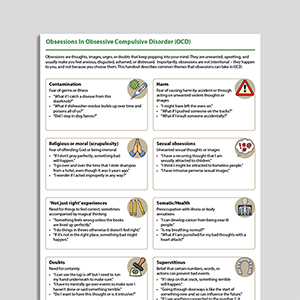
Obsessions are unwanted thoughts, images, or urges that pop into peoples' minds uninvited. They can also take the form of doubts. They usually feel ‘wrong’ and are inconsistent with one's values.
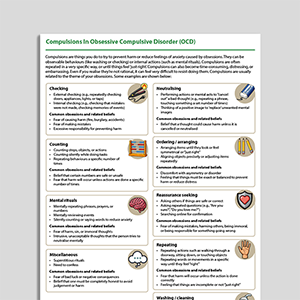
Compulsions are the behaviors that people feel driven to do in response to obsessions. They provide temporary relief from the anxiety and distress caused by the obsession.
It helps clients understand why OCD persists and why exposure and response prevention (ERP) is an effective way to tackle this cycle.

How this resource helps improve clinical outcomes

This handout provides clients with:

  • A clear explanation for why OCD persists.

  • An understanding of ERP and how it works.

  • A motivating rationale for participating in ERP.

References and further reading

  • de Silva, P., & Rachman, S. (1998). Obsessive Compulsive Disorder: The Facts. 2nd Edition. Oxford University Press.

  • Foa, E. B., & Kozak, M. J. (1986). Emotional processing of fear: exposure to corrective information. Psychological bulletin, 99(1), 20.

  • Jacoby, R. J., & Abramowitz, J. S. (2016). Inhibitory learning approaches to exposure therapy: A critical review and translation to obsessive-compulsive disorder. Clinical Psychology Review, 49, 28-40.

  • Koran, L. M., Hanna, G. L., Hollander, E., Nestadt, G., & Simpson, H. B. (2007). Practice guideline for the treatment of patients with obsessive-compulsive disorder. American Journal of Psychiatry, 164(7 Suppl.), 5-53.

  • Meyer, V. (1966). Modification of expectations in cases with obsessional rituals. Behaviour research and therapy, 4(4), 273-280.

  • Mowrer, O. (1947). On the dual nature of learning—a re-interpretation of” conditioning” and” problem-solving.” Harvard educational review, 17, 102–148.

  • National Institute for Health and Clinical Excellence (2005). Obsessive–compulsive disorder: core interventions in the treatment of obsessive–compulsive disorder and body dysmorphic disorder CG31. London: National Institute for Health and Clinical Excellence.

  • Obsessive Compulsive Cognitions Working Group. (2005). Psychometric validation of the obsessive belief questionnaire and interpretation of intrusions inventory—Part 2: Factor analyses and testing of a brief version. Behaviour Research and Therapy, 43(11), 1527-1542.

  • Öst, L. G., Enebrink, P., Finnes, A., Ghaderi, A., Havnen, A., Kvale, G., ... & Wergeland, G. J. (2022). Cognitive behavior therapy for obsessive-compulsive disorder in routine clinical care: A systematic review and meta-analysis. Behaviour Research and Therapy, 159, 104170.

  • Öst, L. G., Havnen, A., Hansen, B., & Kvale, G. (2015). Cognitive behavioral treatments of obsessive–compulsive disorder. A systematic review and meta-analysis of studies published 1993–2014. Clinical psychology review, 40, 156-169.

  • Rachman, S., & de Silva, P. (1978). Abnormal and normal obsessions. Behaviour research and therapy, 16(4), 233-248.

  • Rachman, S., & Hodgson, R. (1980). Obsessions and Compulsions. Englewood Cliffs, NJ: Prentice-Hall.

  • Salkovskis, P. M. (1985). Obsessional-compulsive problems: A cognitive-behavioural analysis. Behaviour research and therapy, 23(5), 571-583.

  • Stein, D. J., Ruscio, A. M., Altwaijri, Y., Chiu, W. T., Sampson, N. A., Aguilar-Gaxiola, S., ... & Kessler, R. C. (2025). Obsessive-compulsive disorder in the World Mental Health surveys. BMC medicine, 23(1), 416.