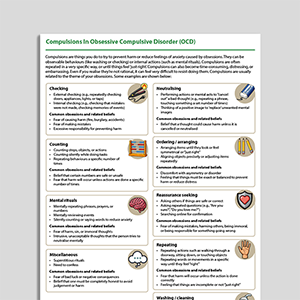
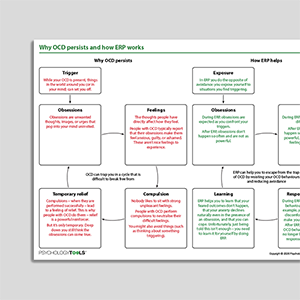
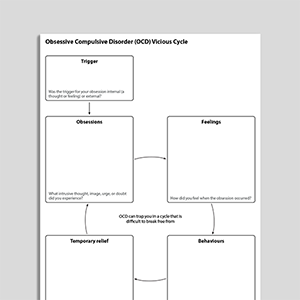
Obsessive Compulsive Disorder (OCD) Ladder

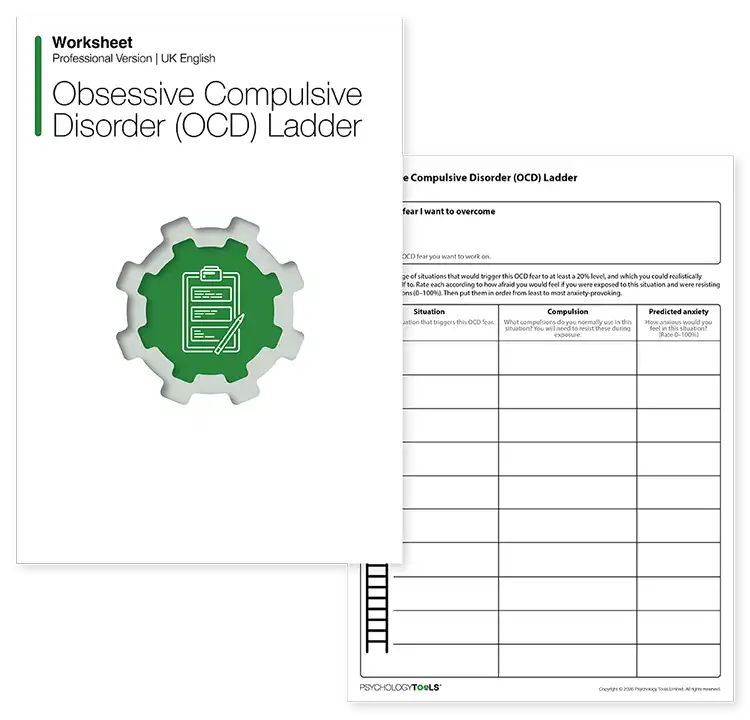
A practical worksheet that helps therapists and clients construct a graded exposure hierarchy for obsessive compulsive disorder (OCD), supporting structured exposure and response prevention (ERP).

Psychology Tools Resource: Obsessive Compulsive Disorder (OCD) Ladder

Download or send

Client version

Includes client-friendly guidance. Downloads are in Fillable PDF format where appropriate.

Professional version

Offers theory, guidance, and prompts for mental health professionals. Downloads are in Fillable PDF format where appropriate.

Psychology Tools Resource: Obsessive Compulsive Disorder (OCD) Ladder

Overview

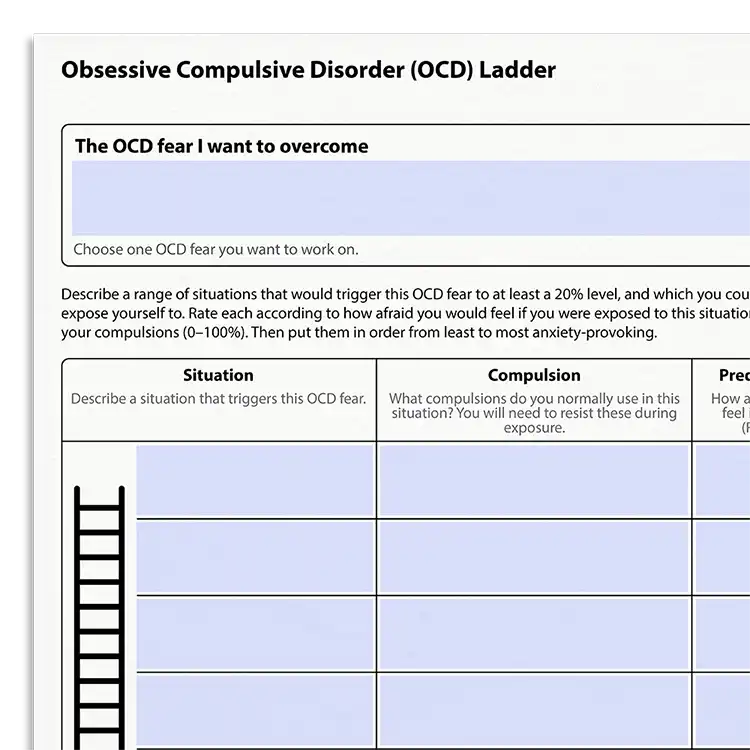
The Obsessive Compulsive Disorder (OCD) Ladder is designed to help clients develop a hierarchy of feared situations that can be used to guide exposure and response prevention (ERP). By organizing situations from least to most anxiety-provoking, the worksheet provides a structured roadmap for treatment.

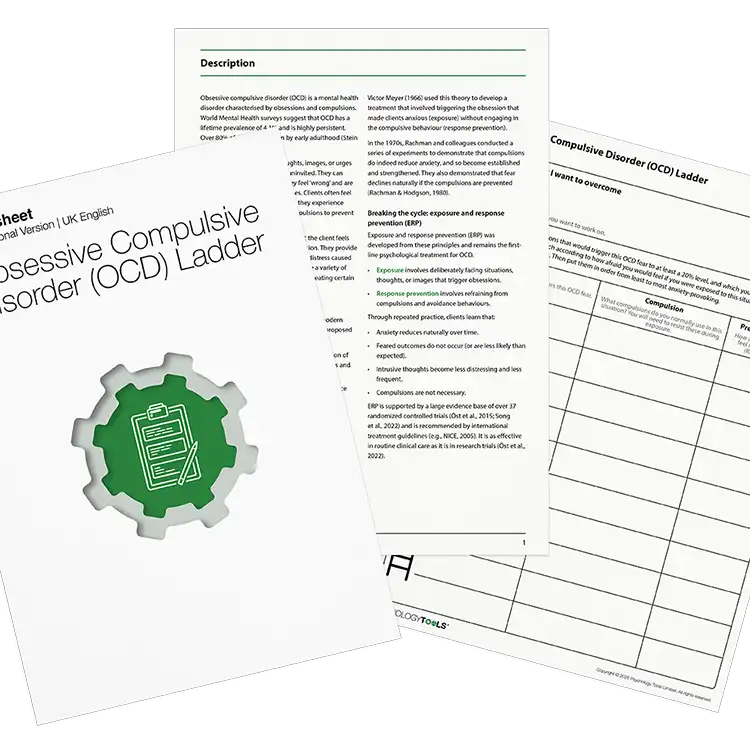
The resource includes therapist guidance, a reusable worksheet and completed examples, making it suitable for use throughout ERP.

Key benefits

Structure

Organizes ERP into achievable steps.

Planning

Identifies feared situations and compulsions.

Collaboration

Supports therapist-client formulation.

Flexibility

Suitable in-session and between sessions.

What difficulties is this for?

Obsessive Compulsive Disorder (OCD)

Clients preparing for ERP.

Integrating it into your practice

01

Target

Choose one OCD fear to target.

02

Generate

List triggering situations.

03

Identify

Establish compulsions and avoidance behaviors.

04

Rate

Estimate predicted anxiety for each situation.

05

Organize

Arrange situations into a graded hierarchy.

06

Review

Revise the ladder as treatment progresses.

Theoretical background and therapist guidance

The worksheet is based on the principles of exposure and response prevention (ERP). Clients identify a specific OCD fear, generate triggering situations, identify the compulsions they normally perform, predict anxiety ratings, and arrange exposures from least to most anxiety-provoking. The completed ladder then serves as the basis for repeated ERP practice, beginning with lower-level items and progressing gradually as confidence and learning increase.

Psychology Tools Resource: Obsessive Compulsive Disorder (OCD) Ladder

What's inside

  • OCD ladder worksheet

  • Therapist guidance

  • Worked examples

  • Reference list

Get access to this resource

FAQs

It helps organize exposure exercises into manageable steps that build confidence over time.
Yes. The hierarchy is designed to evolve throughout treatment.
It is intended for collaborative use by therapists and clients during ERP.

How this resource helps improve clinical outcomes

The worksheet supports consistent delivery of ERP by helping clients approach feared situations systematically rather than avoiding them. It promotes collaborative planning, reinforces response prevention, and provides a practical framework for graded exposure throughout treatment.

References and further reading

  • de Silva, P., & Rachman, S. (1998). Obsessive Compulsive Disorder: The Facts. 2nd Edition. Oxford University Press.

  • Foa, E. B., & Kozak, M. J. (1986). Emotional processing of fear: exposure to corrective information. Psychological bulletin, 99(1), 20.

  • Jacoby, R. J., & Abramowitz, J. S. (2016). Inhibitory learning approaches to exposure therapy: A critical review and translation to obsessive-compulsive disorder. Clinical Psychology Review, 49, 28-40.

  • Koran, L. M., Hanna, G. L., Hollander, E., Nestadt, G., & Simpson, H. B. (2007). Practice guideline for the treatment of patients with obsessive-compulsive disorder. American Journal of Psychiatry, 164(7 Suppl.), 5-53.

  • Meyer, V. (1966). Modification of expectations in cases with obsessional rituals. Behaviour research and therapy, 4(4), 273-280.

  • Mowrer, O. (1947). On the dual nature of learning—a re-interpretation of” conditioning” and” problem-solving.”. Harvard educational review, 17, 102–148.

  • National Institute for Health and Clinical Excellence (2005). Obsessive–compulsive disorder: core interventions in the treatment of obsessive–compulsive disorder and body dysmorphic disorder CG31. London: National Institute for Health and Clinical Excellence.

  • Obsessive Compulsive Cognitions Working Group. (2005). Psychometric validation of the obsessive belief questionnaire and interpretation of intrusions inventory—Part 2: Factor analyses and testing of a brief version. Behaviour Research and Therapy, 43(11), 1527-1542.

  • Öst, L. G., Enebrink, P., Finnes, A., Ghaderi, A., Havnen, A., Kvale, G., ... & Wergeland, G. J. (2022). Cognitive behavior therapy for obsessive-compulsive disorder in routine clinical care: A systematic review and meta-analysis. Behaviour Research and Therapy, 159, 104170.

  • Öst, L. G., Havnen, A., Hansen, B., & Kvale, G. (2015). Cognitive behavioral treatments of obsessive–compulsive disorder. A systematic review and meta-analysis of studies published 1993–2014. Clinical psychology review, 40, 156-169.

  • Rachman, S., & de Silva, P. (1978). Abnormal and normal obsessions. Behaviour research and therapy, 16(4), 233-248.

  • Rachman, S., & Hodgson, R. (1980). Obsessions and Compulsions. Englewood Cliffs, NJ: Prentice-Hall.

  • Salkovskis, P. M. (1985). Obsessional-compulsive problems: A cognitive-behavioural analysis. Behaviour research and therapy, 23(5), 571-583.

  • Stein, D. J., Ruscio, A. M., Altwaijri, Y., Chiu, W. T., Sampson, N. A., Aguilar-Gaxiola, S., ... & Kessler, R. C. (2025). Obsessive-compulsive disorder in the World Mental Health surveys. BMC medicine, 23(1), 416.