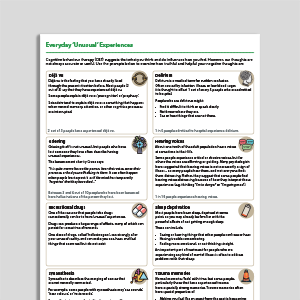
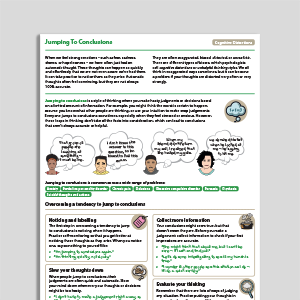
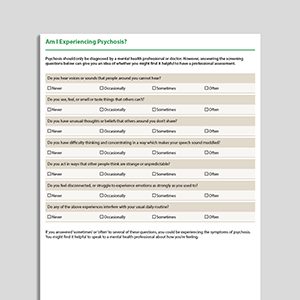
Understanding Paranoid And Suspicious Thoughts

This comprehensive psychoeducational guide helps clients understand paranoid and suspicious thoughts, their impact, the factors that can contribute to the experience, and evidence-based treatment approaches, including cognitive behavioral therapy.
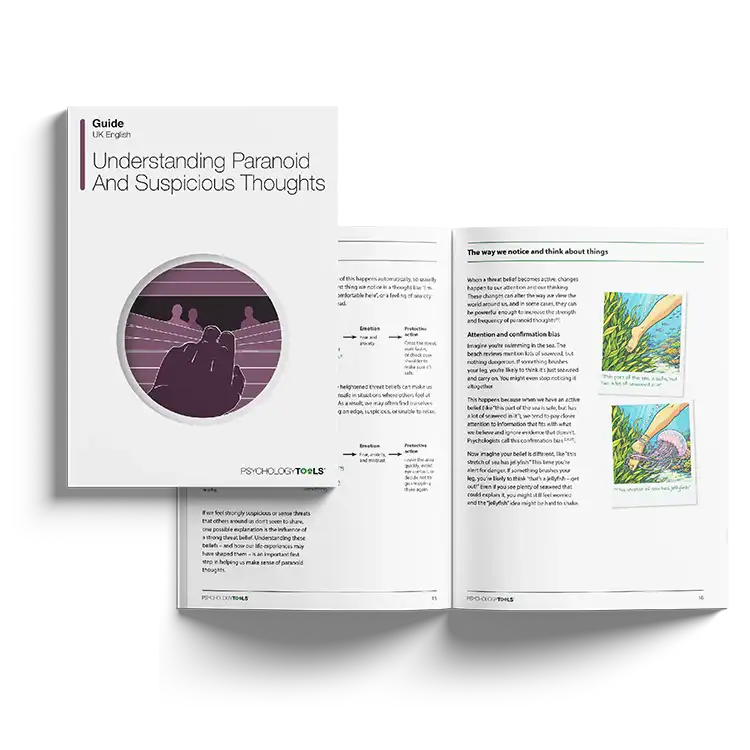
Psychology Tools Resource: Understanding Paranoid And Suspicious Thoughts

Download or send

Workbook (PDF)

A workbook containing elements of psychoeducation and skills-development.
Psychology Tools Resource: Understanding Paranoid And Suspicious Thoughts

Overview

Paranoid and suspicious thoughts exist on a spectrum, ranging from everyday mistrust and vigilance to severe persecutory beliefs that significantly impact wellbeing, relationships, and daily functioning. This guide is designed to be an accessible introduction for helping clients understand paranoia through a cognitive-behavioral lens.

The guide explores the experience of paranoia, the psychological mechanisms that can contribute to and maintain it, and the options for treatment. Through clear explanations and real-world examples, clients are supported in making sense of their experiences without judgment.

Why use this resource?

Paranoia can be distressing, isolating, and difficult for clients to discuss openly. Many people experiencing suspicious thoughts feel misunderstood, ashamed, or uncertain about whether their concerns are justified. This resource provides a compassionate and evidence-based way to normalize these experiences while helping clients develop a deeper understanding of the factors that influence them.

The guide is particularly valuable for psychoeducation and early intervention. It helps clients understand how threat beliefs, attention biases, worry, sleep difficulties, and coping behaviors can contribute to persistent suspicious thinking.

Key benefits

Psychoeducation

Explains paranoia in clear, accessible language without dismissing or challenging clients' experiences prematurely.

Normalization

Demonstrates that suspicious thoughts occur on a continuum and are common across the general population.

Formulation

Helps clients identify the factors that contribute to and maintain their paranoid thinking.

Insight

Introduces concepts such as threat beliefs, confirmation bias, and jumping-to-conclusions.

Engagement

Uses realistic case examples to increase understanding and reduce stigma.

Treatment

Provides a clear overview of evidence-based interventions for paranoid and suspicious thoughts, including CBT.

What difficulties is this for?

Paranoia

Clients experiencing paranoia, persecutory beliefs, or psychotic symptoms.

Post-Traumatic Stress Disorder (PTSD)

Individuals whose trauma-related threat perceptions contribute to suspicious thinking.

Depressive Disorders

Clients whose feelings of vulnerability and negative self-beliefs contribute to paranoia.

Anxiety Disorders

Individuals whose threat monitoring and worry increase suspicious interpretations.

Social Isolation

People whose loneliness and disconnection contribute to increased threat perceptions

Sleep Problems

Individuals whose sleep disruption contributes to unusual experiences and suspicious thinking.

Substance-Related Difficulties

Clients whose paranoia may be exacerbated by alcohol or drug use.

Integrating it into your practice

01

Engagement

Introduce the guide early in therapy to normalize experiences and build understanding.

02

Exploration

Discuss the case examples to help clients recognize similar processes in their own experiences.

03

Formulation

Map threat beliefs, unusual experiences, attentional biases, and coping strategies.

04

Education

Support clients understanding about confirmation bias, threat monitoring, and jumping-to-conclusions reasoning.

Theoretical background and therapist guidance

This guide is grounded in contemporary cognitive models of paranoia, which propose that suspicious thoughts emerge when individuals perceive themselves as vulnerable, other people as threatening, or the world as dangerous. These threat beliefs are often shaped by adverse experiences such as trauma, bullying, abuse, discrimination, social exclusion, or chronic stress.

The guide describes how activated 'threat beliefs' influence attention and interpretation. Individuals become more vigilant for signs of danger, more likely to notice information that confirms their fears, and less likely to attend to evidence suggesting safety. These processes are reinforced by mechanisms such as confirmation bias and a tendency to make rapid judgments under perceived threat.

The guide also highlights the important role of worry, sleep disturbance, unusual experiences, and avoidance behaviors. Worry narrows attention toward potential dangers, poor sleep increases emotional vulnerability and unusual experiences, and safety behaviors can prevent clients from discovering that feared outcomes may not occur. Together, these factors can create self-reinforcing cycles that maintain paranoia over time.

For therapists, the guide offers an excellent foundation for psychoeducation. It can be used to introduce cognitive-behavioral concepts, encourgae the development of individualized maintenance cycles, and prepare clients for interventions such as cognitive restructuring, behavioral experiments, sleep interventions, anxiety management, and relapse prevention planning.
Psychology Tools Resource: Understanding Paranoid And Suspicious Thoughts

What's inside

  • An introduction to paranoid and suspicious thoughts.
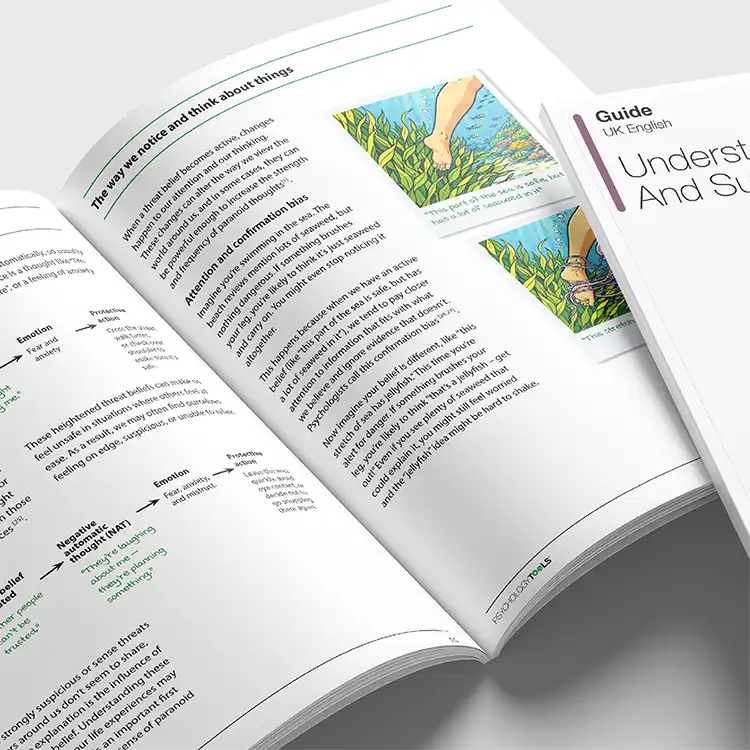
  • Detailed case examples illustrating different presentations of paranoia.
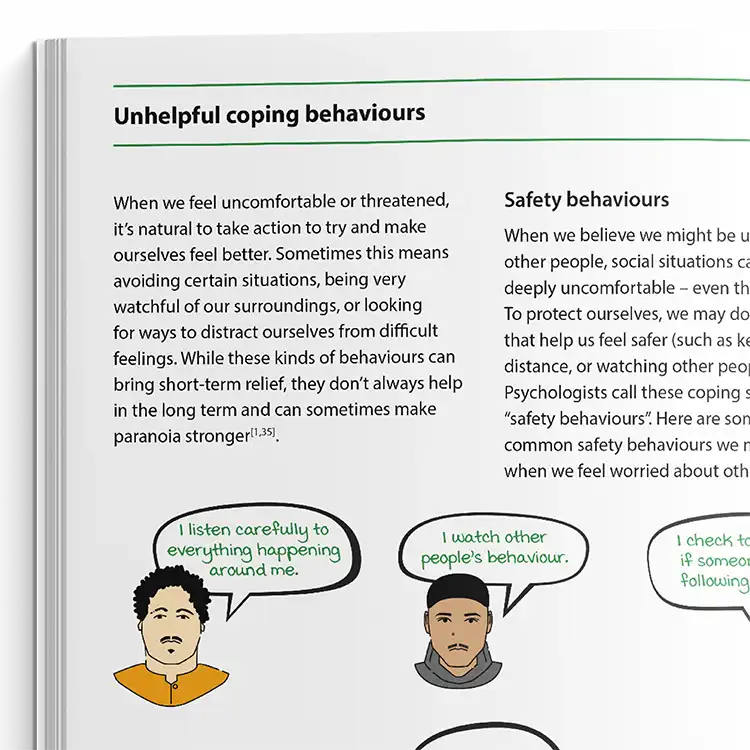
  • Descriptions of common cognitive, emotional, behavioral, and attentional features of paranoia.
  • Key references for learning more about paranoid and suspicious thoughts
Get access to this resource

FAQs

Paranoia involves experiencing a strong suspicion or mistrust, often feeling that other people may intend us harm, that is present even when most other people do not share the same concerns.
No. Paranoia can occur across a range of mental health difficulties, including anxiety, depression, PTSD, and personality difficulties. It exists on a spectrum, and not everyone who experiences paranoid thoughts has psychosis.
Paranoia is usually influenced by multiple factors, including trauma, stressful life events, mood difficulties, cognitive biases, loneliness, sleep problems, substance use, and longstanding threat beliefs.
CBT helps clients understand what maintains paranoia, evaluate alternative explanations, reduce safety behaviors, improve sleep and anxiety management, and test fearful predictions through behavioral experiments.
When threat beliefs become activated, attention becomes focused on signs of danger. This can lead people to notice confirming evidence, overlook contradictory information, and reach conclusions quickly, making suspicious interpretations feel highly believable.
Yes. Many people experience significant improvements through psychological treatment, particularly when interventions address worry, sleep difficulties, threat beliefs, avoidance behaviors, and cognitive biases.

How this resource helps improve clinical outcomes

This guide supports improved outcomes by helping clients understand their experiences through a coherent psychological framework. Increased understanding often reduces confusion, shame, and self-criticism while enhancing engagement in treatment.

Clients gain insight into the relationship between threat beliefs, cognitive biases, emotional distress, and coping behaviors. This understanding creates opportunities for meaningful cognitive and behavioral change.

For clinicians, the resource provides a structured psychoeducational foundation that can strengthen case formulation, improve treatment engagement, and support the implementation of evidence-based CBT interventions for paranoia and related difficulties.

References and further reading

  • Arseneault, L., Cannon, M., Witton, J., & Murray, R. M. (2004). Causal association between cannabis and psychosis: Examination of the evidence. The British Journal of Psychiatry, 184(2), 110–117.
  • Bebbington, P. E., McBride, O., Steel, C., Kuipers, E., Radovanovic, M., Brugha, T., Jenkins, R., Meltzer, H. I., & Freeman, D. (2013). The structure of paranoia in the general population. British Journal of Psychiatry, 202(6), 419-427.
  • Brosschot, J. F., Verkuil, B., & Thayer, J. F. (2018). Generalized unsafety theory of stress: Unsafe environments and conditions, and the default stress response. International journal of environmental research and public health, 15(3), 464.
  • Brown, P., Reeve, S., Hotton, M., Steer, N., & Steel, C. (2024). Sleep and paranoia: A systematic review and meta-analysis. Clinical Psychology Review, 114, 102503.
  • Callcott, P., Standart, S., & Turkington, D. (2004). Trauma within psychosis: Using a CBT model for PTSD in psychosis. Behavioural and Cognitive Psychotherapy, 32(2), 239-244.
  • Contreras, A., Valiente, C., Vázquez, C., Trucharte, A., Peinado, V., Varese, F., & Bentall, R. P. (2022). The network structure of paranoia dimensions and its mental health correlates in the general population: the core role of loneliness. Schizophrenia Research, 246, 65-73.
  • Degenhardt, L., Coffey, C., Hearps, S., Kinner, S. A., Borschmann, R., Moran, P., & Patton, G. (2015). Associations between psychotic symptoms and substance use in young offenders. Drug and alcohol review, 34(6), 673-682.
  • D’Souza, D.C., Perry, E., MacDougall, L., Ammerman, Y., Cooper, T., Wu, Y., Braley, G., Gueorguieva, R., & Krystal, J.H. (2004). The Psychotomimetic effects of intravenous delta-9-tetrahydrocannabinol in healthy individuals: Implications for psychosis. Neuropsychopharmacology, 29, 1558-1572.
  • Freeman, D. (2016). Persecutory delusions: A cognitive perspective on understanding and treatment. Lancet Psychiatry, 3, 685-692.
  • Freeman, D. and Bao Sheng Loe (2023). Explaining paranoia: cognitive and social processes in the occurrence of extreme mistrust. BMJ Mental Health, Nov 9;26(1).
  • Freeman, D., Dunn, G., Startup, H., Pugh, K., Cordwell, J., Mander, H., Cernis, E., Wingham, G., Shirvell, K., & Kingdon, D. (2015). Effects of cognitive behaviour therapy for worry on persecutory delusions in patients with psychosis (WIT): A parallel, single-blind, randomised controlled trial with a mediation analysis. The Lancet Psychiatry, 2(4), 305-313.
  • Freeman, D., Garety, P. A., Bebbington, P. E., Smith, B., Rollinson, R., Fowler, D., Kuipers, E., Ray, K., & Dunn, G. (2005). Psychological investigation of the structure of paranoia in a non-clinical population. British Journal of Psychiatry, 186(5), 427-435.
  • Freeman, D., Garety, P. A., Kuipers, E., Fowler, D., & Bebbington, P. E. (2002). A cognitive model of persecutory delusions. British Journal of Clinical Psychology, 41(4), 331-347.
  • Freeman, D., Loe, B., Kingdon, D., Startup, H., Molodynski, A., Rosebrock, L., . . . Bird, J.C. (2019). The revised Green et al., Paranoid Thoughts Scale (R-GPTS): Psychometric properties, severity ranges, and clinical cut-offs. Psychological Medicine, 1-10. https://doi.org/10.1017/S0033291719003155
  • Freeman, D., McManus, S., Brugha ,T., Meltzer, H., Jenkins, R., Bebbington, P. (2011).Concomitants of paranoia in the general population. Psychological Medicine, 41(5):923-936. doi:10.1017/S0033291710001546
  • Freeman, D., Pugh, K., & Garety, P. (2008). Jumping to conclusions and paranoid ideation in the general population. Schizophrenia research, 102(1-3), 254-260.
  • Freeman, D., Sheaves, B., Goodwin, G. M., Yu, L. M., Nickless, A., Harrison, P. J., ... & Espie, C. A. (2017). The effects of improving sleep on mental health (OASIS): a randomised controlled trial with mediation analysis. The Lancet Psychiatry, 4(10), 749-758.
  • Freeman, D., Stahl, D., McManus, S., Meltzer, H., Brugha, T., Wiles, N., & Bebbington, P. (2012). Insomnia, worry, anxiety and depression as predictors of the occurrence and persistence of paranoid thinking. Social psychiatry and psychiatric epidemiology, 47(8), 1195-1203.
  • Howes, O. D., & Kapur, S. (2009). The dopamine hypothesis of schizophrenia: Version III – The final common pathway. Schizophrenia Bulletin, 35(3), 549–562.
  • Leamon, M. H., Flower, K., Salo, R. E., Nordahl, T. E., Kranzler, H. R., & Galloway, G. P. (2010). Methamphetamine and paranoia: the methamphetamine experience questionnaire. The American Journal on Addictions, 19(2), 155-168.
  • Lincoln, T. M., Lange, J., Burau, J., Exner, C., & Moritz, S. (2010). The effect of state anxiety on paranoid ideation and jumping to conclusions: An experimental investigation. Schizophrenia Bulletin, 36(6), 1140-1148.
  • Ludtke, T., Pfuhl, G., Moritz, S., Rüegg, N. L., Berger, T., & Westermann, S. (2021). Sleep problems and worrying precede psychotic symptoms during an online intervention for psychosis. British Journal of Clinical Psychology, 60(1), 48-67.
  • Mankiewicz, P.D. (2019). Cognitive restructuring and graded behavioural exposure for persecutory paranoia and agoraphobic anxiety in complex psychosis. Clinical Case Studies, 18(2), 143-158.
  • Mehl, S., Werner, D., & Lincoln, T. M. (2018). Does Cognitive Behavior Therapy for psychosis (CBTp) show symptom-specific effects? A meta-analysis. Schizophrenia Research, 201, 102–113. https://doi.org/10.1016/j.schres.2017.08.037
  • Moritz, S., Göritz, A. S., McLean, B., Westermann, S., & Brodbeck, J. (2017). Do depressive symptoms predict paranoia or vice versa? Journal of Behavior Therapy and Experimental Psychiatry, 56, 113‑121. https://doi.org/10.1016/j.jbtep.2016.10.002
  • Moritz, S., Van Quaquebeke, N., & Lincoln, T. M. (2012). Jumping to conclusions is associated with paranoia but not general suspiciousness: a comparison of two versions of the probabilistic reasoning paradigm. Schizophrenia research and treatment, 2012(1), 384039.
  • Morrison, A. P. (2017). A manualised treatment protocol to guide delivery of evidence-based cognitive therapy for people with distressing psychosis: learning from clinical trials. Psychosis, 9(3), 271-281.
  • Morton, W. A. (1999). Cocaine and psychiatric symptoms. Primary care companion to the Journal of clinical psychiatry, 1(4), 109.
  • Moutoussis, M., Bentall, R. P., Williams, J., & Dayan, P. (2007). Threat perception and the attributional model. (Gatsby / UCL).
  • National Institute for Health and Care Excellence. (2014). Psychosis and schizophrenia in adults: Prevention and management (NICE Clinical Guideline No. CG178). https://www.nice.org.uk/guidance/cg178
  • Raihani, N. J., & Bell, V. (2019). An evolutionary perspective on paranoia. Nature Human Behaviour, 3(2), 114–121. https://doi.org/10.1038/s41562-018-0495-0
  • Sanchez, C, & Dunning, D. (2020). Jumping to conclusions: Implications for reasoning errors, false belief, knowledge corruption, and impeded learning. Journal of Personality and Social Psychology, 120(3), 789-815.
  • Savulich, G., Edwards, A., Assadi, S., Guven, H., Leathers-smith, E., Shergill, S., & Yiend, J. (2020). Biased interpretation in paranoia and its modification. Journal of Behavior Therapy and Experimental Psychiatry, 69, 101575. Article 101575. https://doi.org/10.1016/j.jbtep.2020.101575
  • Schönig, S. N., Thompson, E., Kingston, J., Gaudiano, B. A., Ellett, L., & Krkovic, K. (2023). The apple doesn’t fall far from the tree? Paranoia and safety behaviours in adolescent-parent dyads. Research on Child and Adolescent Psychopathology, 52, 267–275. https://doi.org/10.1007/s10802-023-01128-y
  • Shakoor, S., McGuire, P., Cardno, A. G., Freeman, D., Plomin, R., & Ronald, A. (2015). A shared genetic propensity underlies experiences of bullying victimization in late childhood and self-rated paranoid thinking in adolescence. Schizophrenia bulletin, 41(3), 754-763.
  • Tammayan, M., Jantaratnotai, N., & Pachimsawat, P. (2021). Differential responses of salivary cortisol, amylase, and chromogranin A to academic stress. PLoS One, 16(8), e0256172.
  • Tavares, S. (2017). Severe mental disorders from a cognitive-behavioural perspective: a comprehensive review from conceptualization to intervention. Current Psychiatry Reviews, 13(3), 176-183.
  • van der Vleugel, B. M., Libedinsky, I., de Bont, P. A., de Roos, C., van Minnen, A., de Jongh, A., ... & van den Berg, D. (2020). Changes in posttraumatic cognitions mediate the effects of trauma-focused therapy on paranoia. Schizophrenia Bulletin Open, 1(1), sgaa036.
  • Vîslă, A., Stadelmann, C., Watkins, E., Zinbarg, R. E., & Flückiger, C. (2022). The relation between worry and mental health in nonclinical population and individuals with anxiety and depressive disorders: A meta-analysis. Cognitive therapy and research, 46(3), 480-501.
  • Waite, F., Evans, S., Rebello, A., Sharpe, T., Otaiku, J., Iredale, E., Kabir, T., Černis, E., & Freeman, D. (2025). Sleep disruption and its psychological treatment in young people at risk of psychosis: A peer methods qualitative evaluation. British Journal of Clinical Psychology. Advance online publication. https://doi.org/10.1111/bjc.70002
  • Wells, A., Clark, D. M., Salkovskis, P., Ludgate, J., Hackmann, A., & Gelder, M. (1995). Social phobia: The role of in-situation safety behaviors in maintaining anxiety and negative beliefs. Behavior Therapy, 26(1), 153-161.
  • Wiers, R. W., & Stacy, A. W. (2010). Memory systems of the addicted brain: The underestimated role of drug-induced cognitive biases in addiction and its treatment. Frontiers in Psychiatry, 1, 12. https://doi.org/10.3389/fpsyt.2010.00012
  • Yiend J et al (2023). Cognitive bias modification for paranoia (CBM-pa): a randomised controlled feasibility study in patients with distressing paranoid beliefs. Psychological Medicine 53, 4614–4626. https:// doi.org/10.1017/S0033291722001520