Uncertainty Beliefs – Experiment Record
The Uncertainty Beliefs – Experiment Record is a structured worksheet designed to help clients challenge unhelpful beliefs about uncertainty using behavioral experiments.
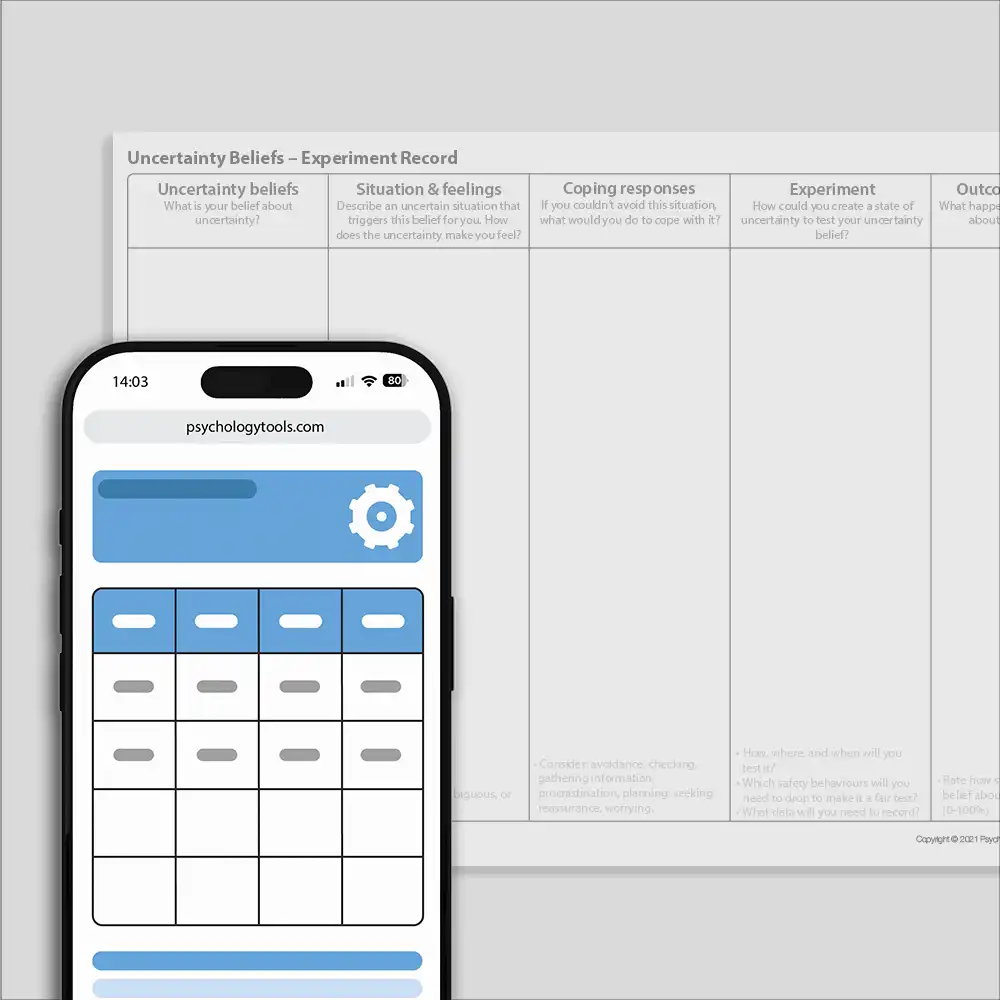
Uncertainty Beliefs – Experiment Record
Life is uncertain – nobody can ever be 100% sure of what’s going to happen next. Some people are OK with this, but others find it unpleasant. If you have negative beliefs about uncertainty, it can play a role in difficulties like worry or anxiety. But what if these beliefs aren’t completely true?
A helpful comparison is how scientists test their beliefs. Scientists try to hold their beliefs ‘lightly’ – they treat them as ideas or guesses about how the world works rather than facts. Then they test whether these guesses are accurate by setting up experiments.
This Uncertainty Beliefs – Experiment Record tool allows you to:
- Identify a the belief about uncertainty that you’d like to test.
- Design an experiment to test this belief.
- Record what happened and learn from your experiment.
Overview
Intolerance of uncertainty (IU) is a disposition which develops from one’s beliefs about uncertainty and its consequences (Dugas & Robichaud, 2007). IU has long been part of cognitive models of generalized anxiety disorder (GAD; e.g. Dugas, Gagnon, Ladouceur, Freeston, 1998) and is also increasingly recognized as a transdiagnostic risk factor for many clinical conditions, including anxiety, depression, obsessive-compulsive disorder, and eating disorders (Carleton et al, 2012; Toffolo et al, 2014; Renjan et al, 2016).
Two categories of beliefs about uncertainty are believed to be clinically important: (1) beliefs that uncertainty has negative implications for oneself and one’s behavior, and (2) beliefs that uncertainty is unfair and spoils everything (Hebert & Dugas, 2018). The Uncertainty Beliefs – Experiment Record worksheet helps clients to identify these beliefs and to design behavioral experiments to address them.
Also available as:
PDF ToolUse this tool with your clients
Support therapeutic work between sessions.
Assign
Send the tool securely to your client.
Client completes
Your client works through it on any device, at their own pace.
Review
Review their responses before the next session.
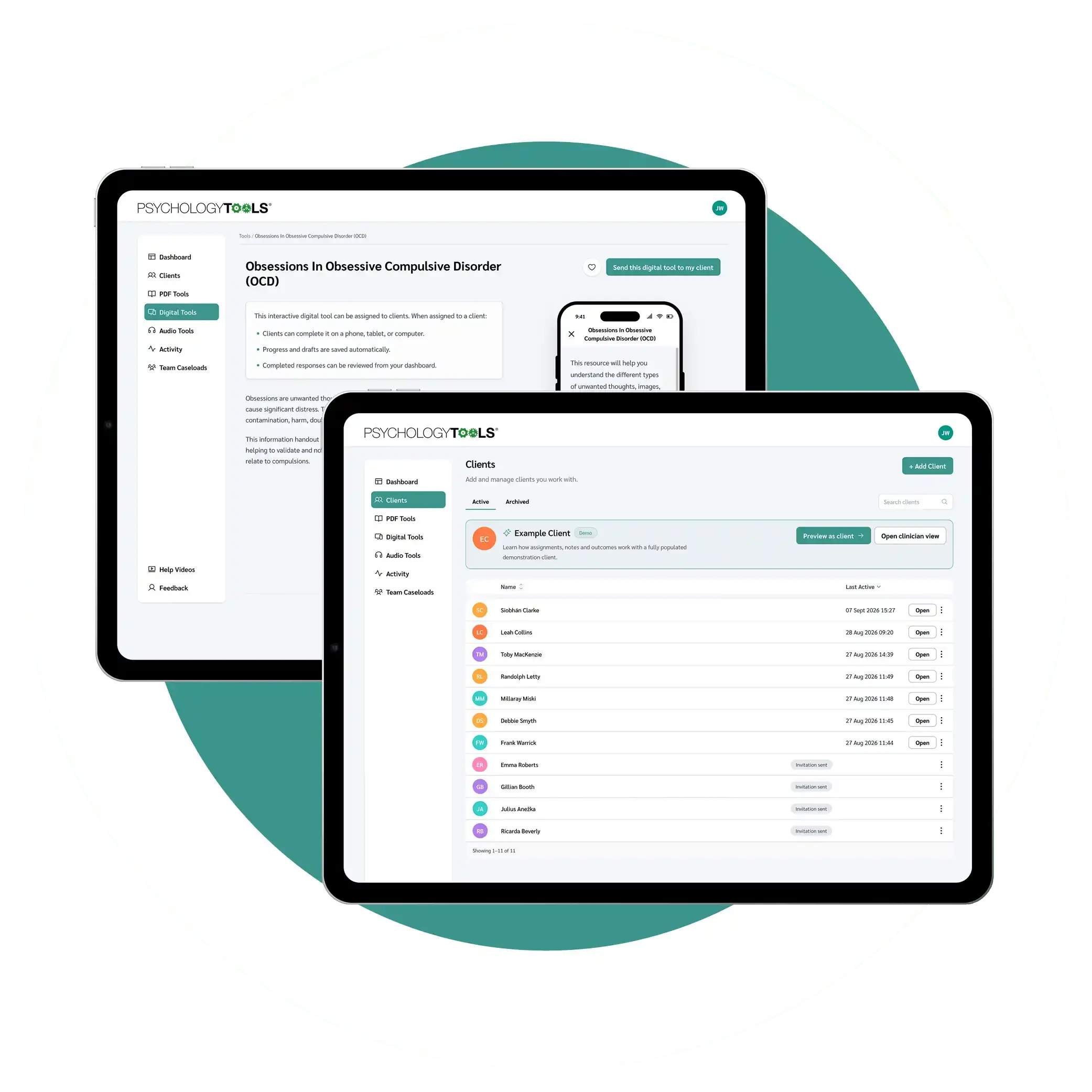
Part of a complete library of evidence-based tools
Worksheets, guides, audio resources and interactive digital tools for mental health professionals.