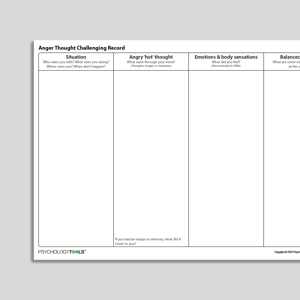
Anger Thought Challenging Record
Worksheets
Anger Thought Challenging Record
application/pdf
•
316.32 KB
What Are CBT Thought Records?
Types of CBT Thought Records
Self-monitoring records are a simple form of thought record. They are often used to gather information about thoughts in the context of a particular situation, as well as exploring any emotions elicited, and any coping responses (behaviors). Self-monitoring records enable a clinician to gather information relevant for a cross-sectional formulation.
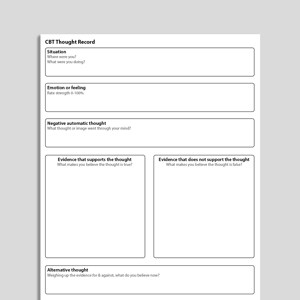
Thought-challenging records, often just called thought records, are used to help people to evaluate their automatic thoughts or to dispute their negative thinking. Thought records exist in numerous different formats: popular methods involve training users to identify the presence of cognitive distortions, or to evaluate the evidence for and against a negative automatic thought.
Disorder-specific thought records are used to gather information relevant to a particular condition. For example, patients prone to worry might be encouraged to focus on the automatic predictions they make, and clients with health anxiety might be encouraged to focus on negative thoughts relating to their health.
References
Beck, A. T., Rush, A. J., Shaw, B. F., & Emery, G. (1979). Cognitive therapy of depression. New York: Guilford Press.
Links to external resources
Psychology Tools makes every effort to check external links and review their content. However, we are not responsible for the quality or content of external links and cannot guarantee that these links will work all of the time.
Please login to view our external resources.