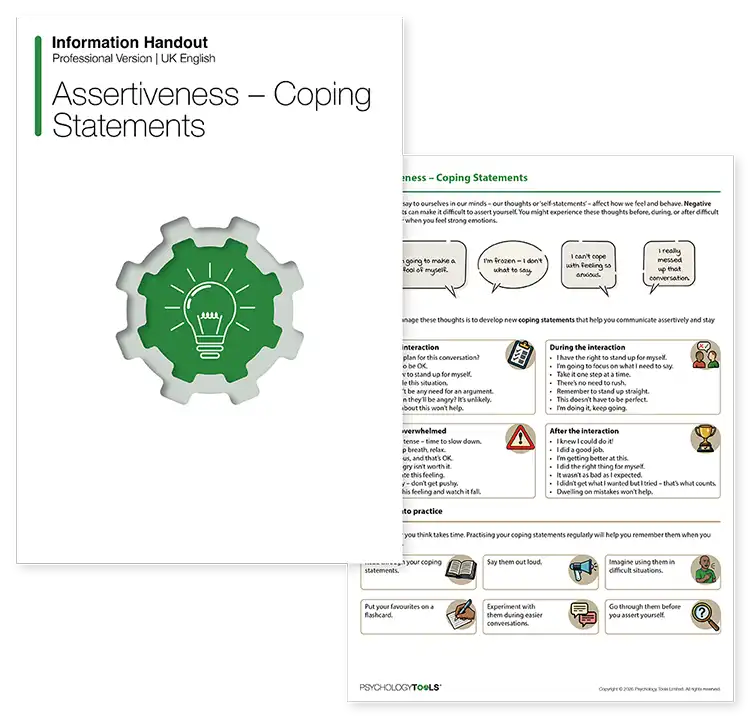
Assertiveness – Coping Statements

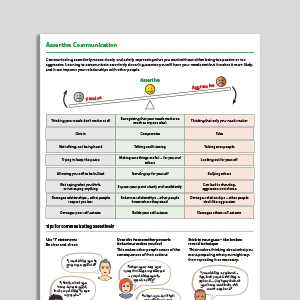
This information handout explains how negative self-talk can make it hard to communicate assertively, and offers helpful coping statements that support assertiveness.

Psychology Tools Resource: Assertiveness – Coping Statements

Download or send

Client version

Includes client-friendly guidance. Downloads are in Fillable PDF format where appropriate.

Professional version

Offers theory, guidance, and prompts for mental health professionals. Downloads are in Fillable PDF format where appropriate.

Psychology Tools Resource: Assertiveness – Coping Statements

Overview

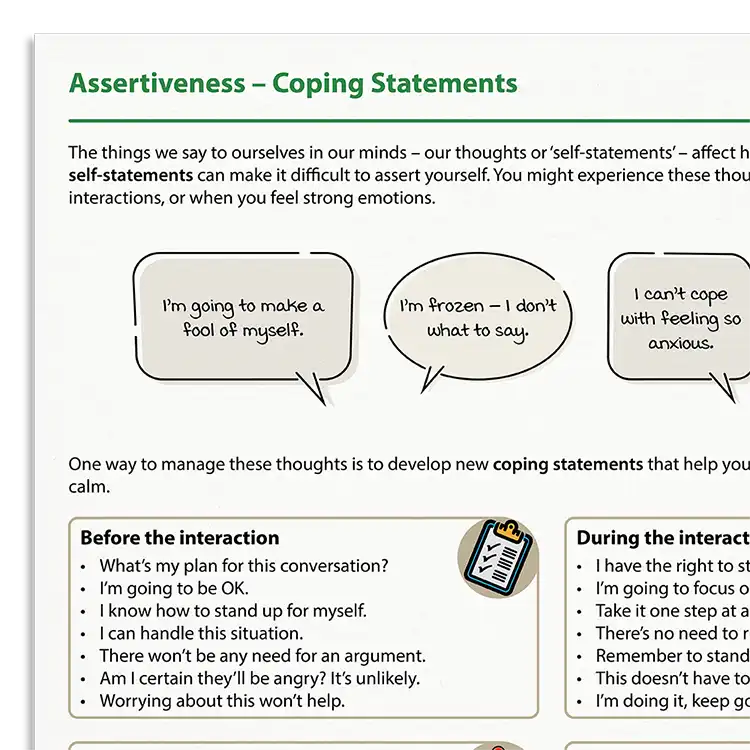
Negative thoughts or 'self-statements' can interfere with a person’s ability to communicate effectively. Informed by self-instructional training (SIT), the Assertiveness – Coping Statements handout explains how self-statements influence emotional and behavioral responses and shows clients how to develop more helpful coping statements.

Key benefits

Informative

Helps clients become more aware of their negative self-statements.

Illustrative

Outlines a range of alternative coping statements that support assertive communication.

Practical

Explains how to put coping statements to use.

Accessible

Easy for clients to understand and use.

What difficulties is this for?

Social Anxiety Disorder

Testing beliefs about judgment, rejection, or negative evaluation during assertive interactions.

Generalized Anxiety Disorder

Identifying worries and concerns about self-expression.

Depression

Addressing beliefs that contribute to passivity, low confidence, or difficulty expressing needs.

Low Self-Esteem

Helping clients identify beliefs about burdening others, appearing selfish, or not being entitled to one's needs.

Interpersonal Difficulties

Clarifying beliefs that interfere with direct, honest, and respectful communication in relationships.

Integrating it into your practice

01

Introduce

Explain how self-statements influence feelings and behavior during interactions.

02

Identify

Help the client notice the negative self-statements that arise before, during, or after assertive situations.

03

Select

Review the example coping statements and choose ones that feel credible, relevant, and personally meaningful.

04

Rehearse

Encourage the client to use the handout guidance to put their coping statements into action.

Theoretical background and therapist guidance

Research indicates that self-statements can play a role in assertive communication. For example, non-assertive individuals typically experience more negative and less positive self-statements than assertive individuals (e.g., Schwartz & Gottman 1976; see also, Bruch, 1981). Consequently, addressing maladaptive self-statements is sometimes included in assertiveness training programs (Craighead, 1979: Linehan, 1979; Rakos, 1991).

Self-instructional training (SIT; Meichenbaum, 1977; Meichenbaum & Goodman, 1971) aims to bring maladaptive self-statements into awareness and develop alternative self-instructions (‘coping statements’) that support more adaptive responses (Dowd, 2002; Valerio & Stone, 1982). Research indicates SIT is an effective intervention for assertiveness. For example, Craighead (1979) found SIT to be significantly more effective than no treatment or placebo control on several outcome measures. In a direct comparison of SIT plus assertiveness skills training, a rational-emotive intervention (focused on identifying and challenging maladaptive self-statements) plus assertiveness skills training, and behavioral assertiveness training, all three training groups produced similar outcomes. Additionally, Kazdin and Mascitelli (1982) found that individuals who engaged in self-instructions experienced greater improvements in assertive communication at post-treatment than those who only used behavioral rehearsal.

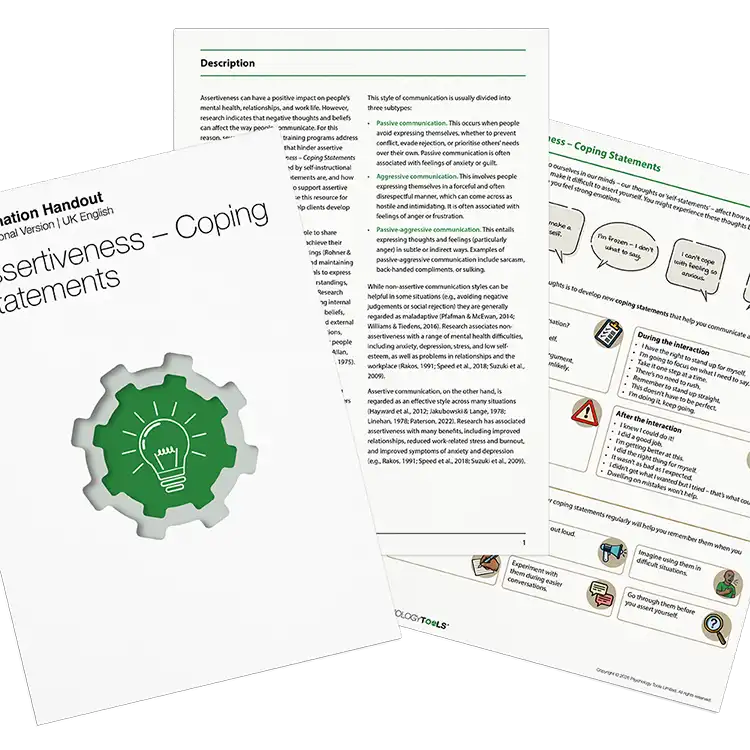
The Assertiveness – Coping Statements information handout is informed by SIT. It introduces clients to self-statements and explains how coping statements can be used to support assertive communication. Therapists can use this resource for psychoeducation or as a tool to help clients develop their own coping statements.

Psychology Tools Resource: Assertiveness – Coping Statements

What's inside

  • An explanation of what self-statements are.

  • Examples of coping statements that support assertive communication.

  • Practical suggestions for rehearsing and strengthening coping statements.

  • Therapist guidance for introducing the handout and helping clients personalize it.

  • Recommendations for further reading.

Get access to this resource

FAQs

Self-statements (also known as ‘self-instructions’ or ‘self talk') are repetitive internal sentences that can support or disrupt adaptive functioning. They are considered a form of automatic thought, similar to other spontaneous cognitive processes like mental imagery.
Coping statements are intended to be realistic, personalized, and useful in specific situations. They are not simply broad positive affirmations. Their purpose is to help clients prepare, regulate themselves, and act more effectively in challenging situations.
Clients can use them before difficult conversations, during interactions, when they feel overwhelmed, and afterwards when reflecting on how things went.
Not necessarily. The examples can be adopted directly, but clients may benefit from adapting them so they feel credible and natural.

How this resource helps improve clinical outcomes

This resource helps clients:

  • Become more aware of their negative self-talk.

  • Develop adaptive coping statements that help them be assertive.

  • Put these coping statements into practice.

References and further reading

  • Alberti, R. E., & Emmons, M. L. (2017). Your perfect right: Assertiveness and equality in your life and relationships (10th ed.). Impact Publishers

  • Alden, L., & Cappe, R. (1981). Nonassertiveness: Skill deficit or selective self-evaluation? Behavior Therapy, 12, 107-114. DOI: 10.1016/S0005-7894(81)80111-6.

  • Alden, L., & Safran, J. (1978). Irrational beliefs and nonassertive behavior. Cognitive Therapy and Research, 2, 357-364. DOI: 10.1007/BF01172652.

  • Bruch, M. A. (1981). A task analysis of assertive behavior revisited: Replication and extension. Behavior Therapy, 12, 217-230. DOI: 10.1016/S0005-7894(81)80074-3.

  • Carmody, T. P. (1978). Rational, emotive, self-instructional, and behavioral assertion training: Facilitating maintenance. Cognitive Therapy and Research, 2, 241-253. DOI: 10.1007/BF01185786.

  • Chłopicki, W. (2017). Communication styles: An overview. Styles of Communication, 9, 9-25.

  • Craighead, L. W. (1979). Self-instructional training for assertive-refusal behavior. Behavior Therapy, 10, 529-542. DOI: 10.1016/S0005-7894(79)80054-4.

  • Dowd, E. T. (2002). Self-statement modification. In Hersen, M., & Sledge, M. (Eds.), Encyclopedia of psychotherapy (pp.625-628). Elsevier Science.

  • Duckworth, M. P. (2009). Assertiveness skills and the management of related factors. In W. T. O’Donohue & J. E. Fisher (Eds.), General principles and empirically supported techniques of cognitive behavior therapy (pp. 124–132). John Wiley and Sons.

  • Gilbert, P., & Allan, S. (1994). Assertiveness, submissive behaviour and social comparison. British Journal of Clinical Psychology, 33, 295-306. DOI: 10.1111/j.2044-8260.1994.tb01125.x.

  • Glass, C. R., Merluzzi, T. V., Biever, J. L., & Larsen, K. H. (1982). Cognitive assessment of social anxiety: Development and validation of a self-statement questionnaire. Cognitive Therapy and Research, 6, 37-55. DOI: 10.1007/BF01185725.

  • Hagberg, T., Manhem, P., Oscarsson, M., Michel, F., Andersson, G., & Carlbring, P. (2023). Efficacy of transdiagnostic cognitive-behavioral therapy for assertiveness: A randomized controlled trial. Internet Interventions, 32, 100629. DOI: 10.1016/j.invent.2023.100629.

  • Hayward, M., Strauss, C., & Kingdon, D. (2012). Overcoming distress voices: A self-help guide using cognitive behavioral techniques. Robinson.

  • Heimberg, R. G., & Becker, R. E. (1981). Cognitive and behavioral models of assertive behavior: Review, analysis and integration. Clinical Psychology Review, 1, 353-373. DOI: 10.1016/0272-7358(81)90011-8.

  • Jacobs, M. K., & Cochran, S. D. (1982). The effects of cognitive restructuring on assertive behavior. Cognitive Therapy and Research, 6, 63-76. DOI: 10.1007/BF01185727.

  • Jakubowski, P., & Lange, A. J. (1978). The assertive option: Your rights and responsibilities. Research Press Company.

  • Kaplan, D. A. (1982). Behavioral, cognitive, and behavioral-cognitive aprroaches to group assertion training therapy. Cognitive Therapy and Research, 6, 301-314. DOI: 10.1007/BF01173578.

  • Kazdin, A. E., & Mascitelli, S. (1982). Behavioral rehearsal, self-instructions, and homework practice in developing assertiveness. Behavior Therapy, 13, 346-360. DOI: 10.1016/S0005-7894(82)80043-9.

  • Linehan, M. M. (1979). Structured cognitive-behavioral treatment of assertion problems. In P. C. Kendall & S. V. Hollon (Eds.), Cognitive-behavioral interventions: Theory, research, and procedures (pp. 205-240). Academic Press.

  • Luria, A. (1961). The role of speech in the regulation of normal and abnormal behavior. Liveright.

  • McKay, M., Davis, M., & Fanning P. (1981). Thoughts and feelings: The art of cognitive stress intervention. New Harbinger Publications.

  • Meichenbaum, D. (1977). Cognitive-behavior modification: An integrative approach. Plenum Press.

  • Meichenbaum, D. (2007). Stress inoculation training: A preventative and treatment approach. In P. M. Lehrer, R. L. Woolfolk, & W. S. Sime (Eds.), Principles and practice of stress management (3rd ed., pp. 497–518). Guilford Press.

  • Meichenbaum, D. H., & Goodman, J. (1971). Training impulsive children to talk to themselves: A means of developing self-control. Journal of Abnormal Psychology, 77, 115-126. DOI: 10.1037/h0030773

  • Orenstein, H., Orenstein, E., & Carr, J. E. (1975). Assertiveness and anxiety: A correlational study. Journal of Behavior Therapy and Experimental Psychiatry, 6, 203-207. DOI: 10.1016/0005-7916(75)90100-7.

  • Paterson, R. J. (2022). The assertiveness workbook: How to express your ideas and stand up for yourself at work and in relationships (2nd ed.). New Harbinger Publications.

  • Pfafman, T. M., & McEwan, B. (2014). Polite women at work: Negotiating professional identity through strategic assertiveness. Women’s Studies in Communication, 37, 202-219. DOI: 10.1080/07491409.2014.911231.

  • Rakos, R. F. (1991). Assertive behavior: Theory, research, and training. Routledge.

  • Rohner, J., & Schutz, A. (2024). Psychology of communication. Springer.

  • Schwartz, R. M., & Gottman, J. M. (1976). Toward a task analysis of assertive behavior. Journal of Consulting and Clinical Psychology, 44, 910-920. DOI: 10.1037/0022-006X.44.6.910

  • Speed, B. C., Goldstein, B. L., & Goldfried, M. R. (2018). Assertiveness training: A forgotten evidence-based treatment. Clinical Psychology: Science and Practice, 25, e12216. DOI: 10.1111/cpsp.12216.

  • Suzuki, E., Saito, M., Tagaya, A., Mihara, R., Maruyama, A., Azuma, T., & Sato, C. (2009). Relationship between assertiveness and burnout among nurse managers. Japan Journal of Nursing Science, 6, 71-81. DOI: 10.1111/j.1742-7924.2009.00124.x.

  • Vagos, P., & Pereira, A. (2016). A cognitive perspective for understanding and training assertiveness. European Psychologist, 21, 109–121. DOI: 10.1027/1016-9040/a000250.

  • Valerio, H. P., & Stone, G. L. (1982). Effects of behavioral, cognitive, and combined treatments for assertion as a function of differential deficits. Journal of Counseling Psychology, 29, 158-168. DOI: 10.1037/0022-0167.29.2.158.

  • Vygotsky, L. (1962). Thought and language. Wiley.