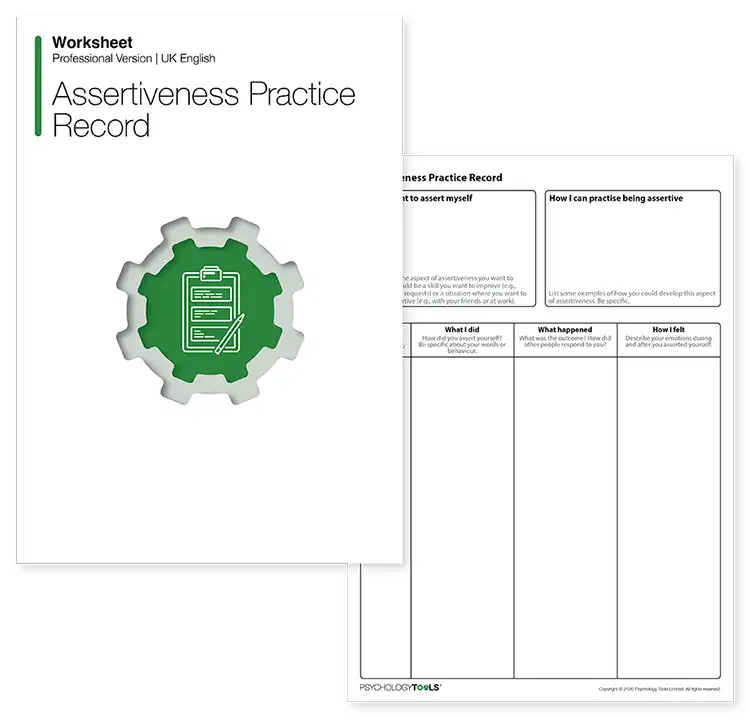
Assertiveness Practice Record

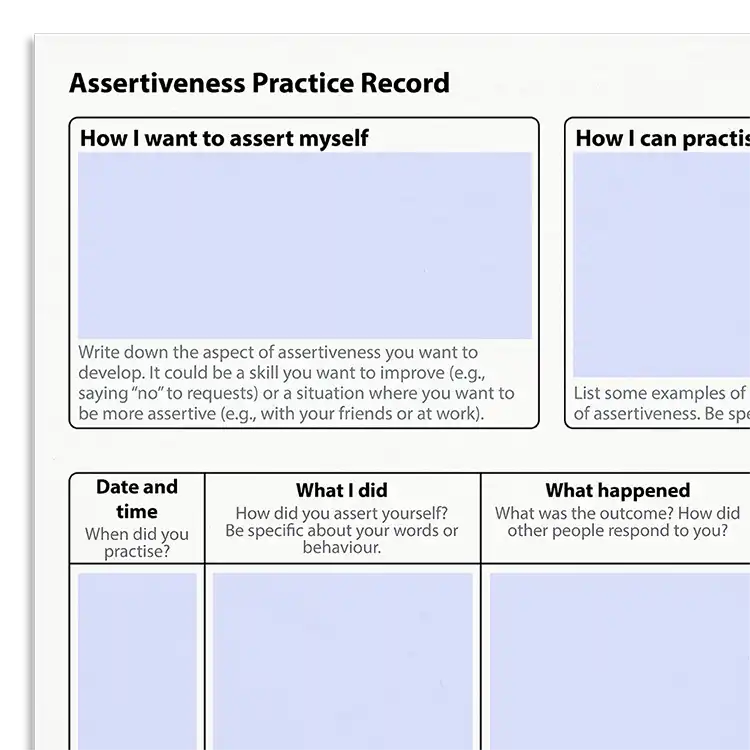
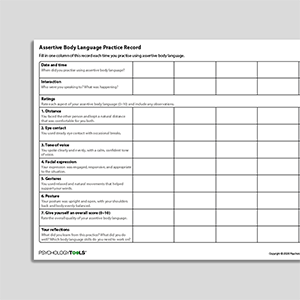
This worksheet helps clients plan, practice, and reflect on assertive communication in real-world situations, supporting skill development and the transfer of assertiveness skills into everyday life.

Psychology Tools Resource: Assertiveness Practice Record

Download or send

Client version

Includes client-friendly guidance. Downloads are in Fillable PDF format where appropriate.

Professional version

Offers theory, guidance, and prompts for mental health professionals. Downloads are in Fillable PDF format where appropriate.

Psychology Tools Resource: Assertiveness Practice Record

Overview

Assertiveness is an important interpersonal skill that helps people communicate honestly, directly, and respectfully. This Assertiveness Practice Record helps clients plan, practice, and learn from assertive communication in their daily life.

Key benefits

Structured

Helps clients plan and review their assertiveness skills practice.

Practical

Encourages real-world behavioral rehearsal.

Reflective

Promotes learning and skills refinement.

Accessible

Easy for clients to understand and use.

What difficulties is this for?

Social Anxiety Disorder (SAD)

Testing beliefs about judgment, rejection, or negative evaluation during assertive interactions.

Generalized Anxiety Disorder (GAD)

Identifying worries and concerns about self-expression.

Depression

Addressing beliefs that contribute to passivity, low confidence, or difficulty expressing needs.

Low Self-Esteem

Helping clients identify beliefs about burdening others, appearing selfish, or not being entitled to one's needs.

Interpersonal difficulties

Clarifying beliefs that interfere with direct, honest, and respectful communication in relationships.

Integrating it into your practice

01

Identify

Help the client choose an assertiveness skill or interpersonal situation to work on.

02

Plan

List ways the client can practice the skill.

03

Practice

Encourage the client to implement assertive communication in everyday situations.

04

Record

Log what happened and how the interaction unfolded.

05

Reflect

Review the outcome and what has been learned.

06

Refine

Adjust future practice based on these outcomes.

Theoretical background and therapist guidance

Strategies that help clients generalize, refine, and maintain clients’ assertiveness skills are central to effective assertiveness skills training (Rakos, 1991). Useful approaches include practicing assertive communication in realistic settings (e.g., role-plays that mimic real-life situations), varying practice contexts, and involving significant others in the training process (Kanfer & Schefft, 1988; Stokes & Osnes, 1989).

Homework tasks are particularly important for transferring assertiveness skills to everyday situations (Rakos, 1991). Typical tasks include self-monitoring, identifying interactions that require assertiveness, and evaluating assertive responses. Practising assertive communication in real-world situations has been shown to be especially effective (e.g., Kazdin & Mascitelli, 1982). In terms of implementation, Rakos (1991) recommends assigning homework practice only once the client has acquired a basic level of proficiency in a given skill, and the situations chosen for practicing assertiveness are likely to occur.

This Assertiveness Practice Record is designed to help clients plan, implement, and reflect on their assertiveness practice, supporting their skill development and learning generalization.

Psychology Tools Resource: Assertiveness Practice Record

What's inside

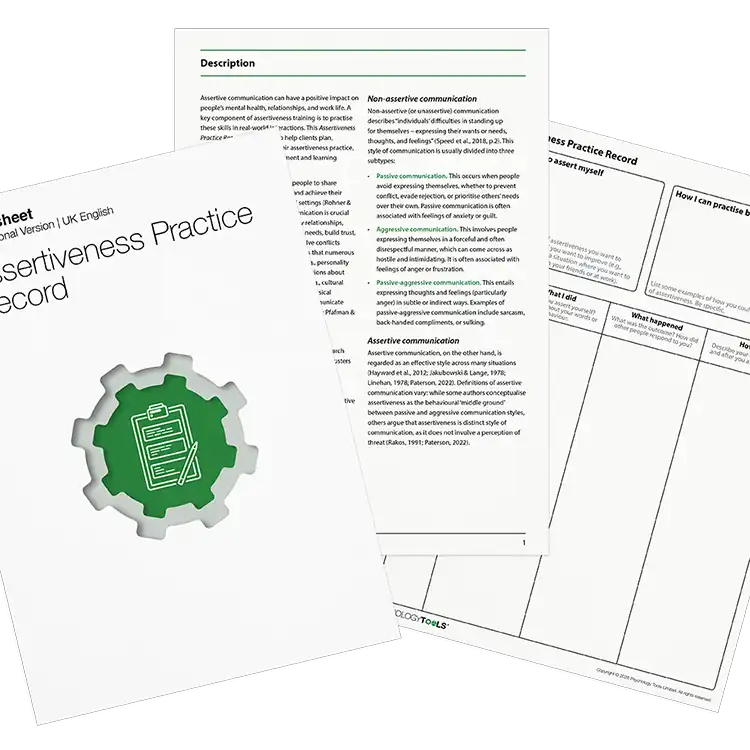
  • A detailed introduction to assertiveness.

  • Step-by-step instructions for using the worksheet with clients.

  • Suggested therapist questions and prompts.

  • Recommendations for further reading.

Get access to this resource

FAQs

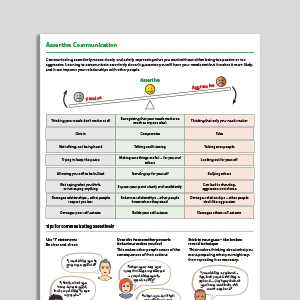
Assertive communication is a clear, honest, and respectful way of communicating that is effective in many situations.
After they have developed a basic understanding of assertive communication and have practiced key skills during therapy.
Yes. It is specifically designed to support between-session practice and learning generalization.

How this resource helps improve clinical outcomes

This worksheet helps clients:

  • Plan ways to develop their assertiveness skills.

  • Practice and refine assertive communication.

  • Apply it more consistently in daily life.

  • Learn from these experiences.

References and further reading

  • Alden, L., & Cappe, R. (1981). Nonassertiveness: Skill deficit or selective self-evaluation? Behavior Therapy, 12, 107-114. DOI: 10.1016/S0005-7894(81)80111-6.

  • Birtchnell, J. (1996). How humans relate: A new interpersonal theory. Psychology Press.

  • Birtchnell, J. (2002). Relating in psychotherapy: The application of a new theory. Brunner Routledge. DOI: 10.1002/cpp.615.

  • Bonham-Carter, D. (2012). Assertiveness: A practical guide. Icon Books.

  • Chłopicki, W. (2017). Communication styles: An overview. Styles of Communication, 9, 9-25.

  • Duckworth, M. P. (2009). Assertiveness skills and the management of related factors. In W. T. O’Donohue & J. E. Fisher (Eds.), General principles and empirically supported techniques of cognitive behavior therapy (pp. 124–132). John Wiley and Sons.

  • Hall, E. T. (1966). The hidden dimension. Doubleday.

  • Gilbert, P., & Allan, S. (1994). Assertiveness, submissive behaviour and social comparison. British Journal of Clinical Psychology, 33, 295-306. DOI: 10.1111/j.2044-8260.1994.tb01125.x.

  • Hagberg, T., Manhem, P., Oscarsson, M., Michel, F., Andersson, G., & Carlbring, P. (2023). Efficacy of transdiagnostic cognitive-behavioral therapy for assertiveness: A randomized controlled trial. Internet Interventions, 32, 100629. DOI: 10.1016/j.invent.2023.100629.

  • Hansford, B. C., & Hattie, J. A. (1987). Perceptions of communicator style and self-concept. Communication Research, 14, 189-203. DOI: 10.1177/009365087014002003.

  • Hayward, M., Strauss, C., & Kingdon, D. (2012). Overcoming distress voices: A self-help guide using cognitive behavioral techniques. Robinson.

  • Jakubowski, P., & Lange, A. J. (1978). The assertive option: Your rights and responsibilities. Research Press Company.

  • Kanfer, F. H., & Schefft, B. K. (1988). Guiding the process of therapeutic change. Research Press.

  • Kazdin, A. E., & Mascitelli, S. (1982). Behavioral rehearsal, self-instructions, and homework practice in developing assertiveness. Behavior Therapy, 13, 346-360. DOI: 10.1016/S0005-7894(82)80043-9.

  • Linehan, M. M. (1979). Structured cognitive-behavioral treatment of assertion problems. In P. C. Kendall & S. V. Hollon (Eds.), Cognitive-behavioral interventions: Theory, research, and procedures (pp. 205-240). Academic Press.

  • McFall, M. E., Winnett, R. L., Bordewick, M. C., & Bornstein, P. H. (1982). Nonverbal components in the communication of assertiveness. Behavior Modification, 6, 121-140. DOI: 10.1177/01454455820061008.

  • McKay, M., Davis, M., & Fanning, P. (2018). Messages: The communication skills workbook (4th ed.). New Harbinger Publications.

  • Norton, R. W. (1978). Foundation of a communicator style construct. Human Communication Research, 4, 99-112. DOI: 10.1111/j.1468-2958.1978.tb00600.x.

  • Orenstein, H., Orenstein, E., & Carr, J. E. (1975). Assertiveness and anxiety: A correlational study. Journal of Behavior Therapy and Experimental Psychiatry, 6, 203-207. DOI: 10.1016/0005-7916(75)90100-7.

  • Paterson, R. J. (2022). The assertiveness workbook: How to express your ideas and stand up for yourself at work and in relationships (2nd ed.). New Harbinger Publications.

  • Pfafman, T. M., & McEwan, B. (2014). Polite women at work: Negotiating professional identity through strategic assertiveness. Women’s Studies in Communication, 37, 202-219. DOI: 10.1080/07491409.2014.911231.

  • Rakos, R. F. (1991). Assertive behavior: Theory, research, and training. Routledge.

  • Rohner, J., & Schutz, A. (2024). Psychology of communication. Springer.

  • Speed, B. C., Goldstein, B. L., & Goldfried, M. R. (2018). Assertiveness training: A forgotten evidence-based treatment. Clinical Psychology: Science and Practice, 25, e12216. DOI: 10.1111/cpsp.12216.

  • Stokes, T. F., & Osnes, P. G. (1989). An operant pursuit of generalization. Behavior Therapy, 20, 337-355. DOI: 10.1016/S0005-7894(89)80054-1.

  • Suzuki, E., Saito, M., Tagaya, A., Mihara, R., Maruyama, A., Azuma, T., & Sato, C. (2009). Relationship between assertiveness and burnout among nurse managers. Japan Journal of Nursing Science, 6, 71-81. DOI: 10.1111/j.1742-7924.2009.00124.x.

  • Vagos, P., & Pereira, A. (2016). A cognitive perspective for understanding and training assertiveness. European Psychologist, 21, 109–121. DOI: 10.1027/1016-9040/a000250.

  • Williams, M. J., & Tiedens, L. Z. (2016). The subtle suspension of backlash: A meta-analysis of penalties for women’s implicit and explicit dominance behavior. Psychological Bulletin, 142, 165–197. DOI: 10.1037/bul0000039.