Workbook (PDF)
A workbook containing elements of psychoeducation and skills-development.
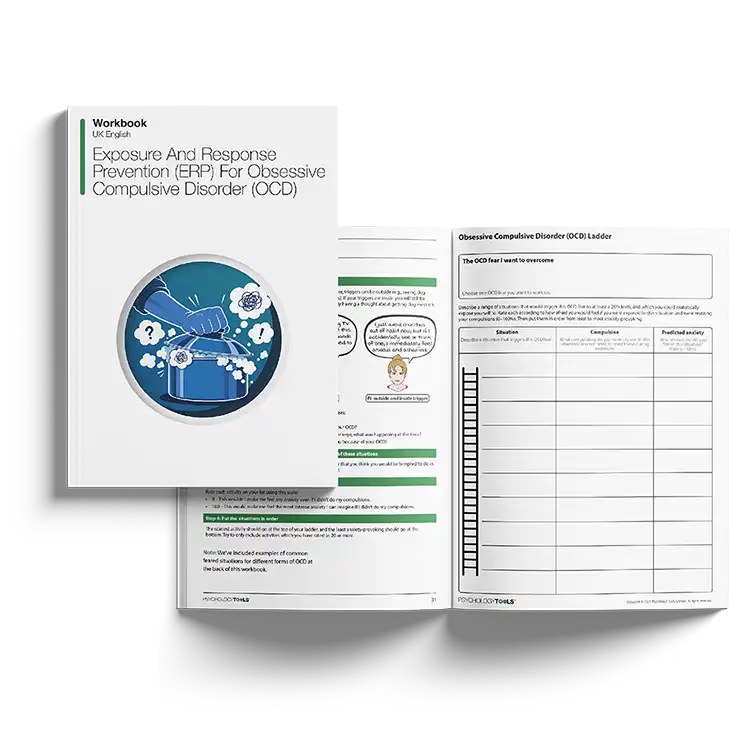
This comprehensive workbook helps clients understand obsessive compulsive disorder (OCD), prepare for exposure and response prevention (ERP), complete graded exposure exercises, troubleshoot difficulties, and maintain progress over time.
A workbook containing elements of psychoeducation and skills-development.
Exposure and response prevention (ERP) is a highly effective treatment for obsessive compulsive disorder (OCD). It involves gradually facing the thoughts, images, urges, situations, or sensations that trigger obsessions while resisting the compulsions and avoidance behaviors that usually follow.
This workbook provides a structured, practical guide to understanding OCD and applying ERP. It begins with psychoeducation about obsessions, compulsions, avoidance, and the vicious cycle that maintains OCD. Clients then learn how ERP interrupts this cycle, why repeated exposure creates new learning, and how to plan and complete exposure exercises in a gradual and manageable way.
The workbook includes motivation and goal-setting exercises, an OCD vicious cycle formulation, an OCD ladder, single- and multiple-exposure ERP records, troubleshooting guidance, relapse-prevention material, and worked examples covering different OCD presentations.


.svg)
Clients experiencing obsessions, compulsions, avoidance, and significant distress or interference in daily life.
Use the opening sections to explain obsessions, compulsions, avoidance, triggers, and the OCD maintenance cycle.
Help the client map a recent episode using the vicious cycle exercise and identify short-term relief processes that reinforce OCD.
Create an OCD ladder by brainstorming triggers, identifying compulsions, rating predicted anxiety, and ordering situations from less to more difficult.
Carry out the planned exposure while reducing avoidance, physical compulsions, mental rituals, and other neutralizing behaviors. Record anxiety, duration, what happened, and what the client learned during each ERP session.
Practice exposures repeatedly within and across sessions so learning becomes stronger and more durable. Vary the context, mood, timing, and details of practice to help learning generalize.
Review difficulties such as persistent anxiety, strong urges, hidden neutralizing, avoidance, or loss of motivation and adjust the plan as needed.
Use the staying-well section to review progress, identify warning signs, plan responses to setbacks, and continue ERP when needed.
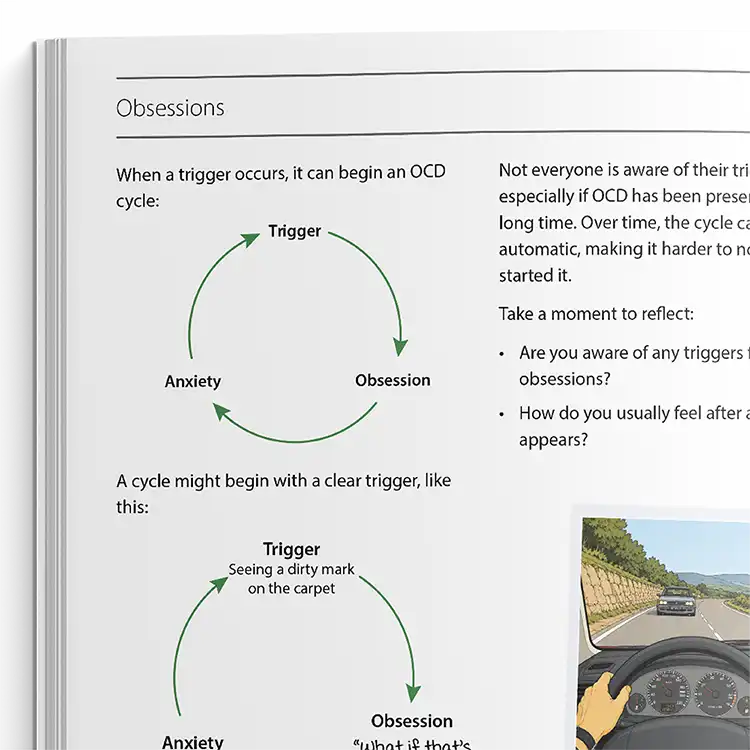
Obsessive compulsive disorder is characterized by obsessions and compulsions that become time-consuming, distressing, or disruptive to daily life. Obsessions are unwanted thoughts, images, doubts, or urges that occur repeatedly and often evoke anxiety, disgust, guilt, shame, or a heightened sense of responsibility. Compulsions are actions or mental acts performed to prevent harm or reduce distress. Avoidance can serve a similar function as compulsions, by reducing contact with triggers. ERP interrupts this cycle by combining exposure with response prevention.
Several learning processes are used to explain why ERP can be effective. Habituation describes the way anxiety can reduce with repeated and sustained exposure. ERP also creates opportunities for new information to be learned, such as discovering that feared outcomes do not occur as expected or that distress can be tolerated. The workbook also describes the formation of new memories that compete with older fear-based learning, so that adaptive learning becomes easier to access during future triggers.
The workbook also incorporates inhibitory-learning principles. Clients are advised to practice across different moods, contexts, times, and versions of feared situations, and to use reminder cues that help retrieve what they learned. This can strengthen generalization and make new learning more accessible across everyday life.
Clients review what they have learned, identify achievements and remaining goals, watch for early warning signs such as renewed avoidance or “just in case” compulsions, and continue ERP practice when needed. The resource emphasizes gradual, sustainable change and the importance of responding to setbacks with kindness rather than treating them as failure.
Troubleshooting guidance addresses common difficulties such as anxiety not decreasing, overwhelming urges, reduced motivation, fears about future outcomes, and uncertainty about the relationship between ERP and CBT. The workbook frames setbacks as expected and encourages clients to return to the ladder, adjust difficulty, and continue practicing without self-criticism.
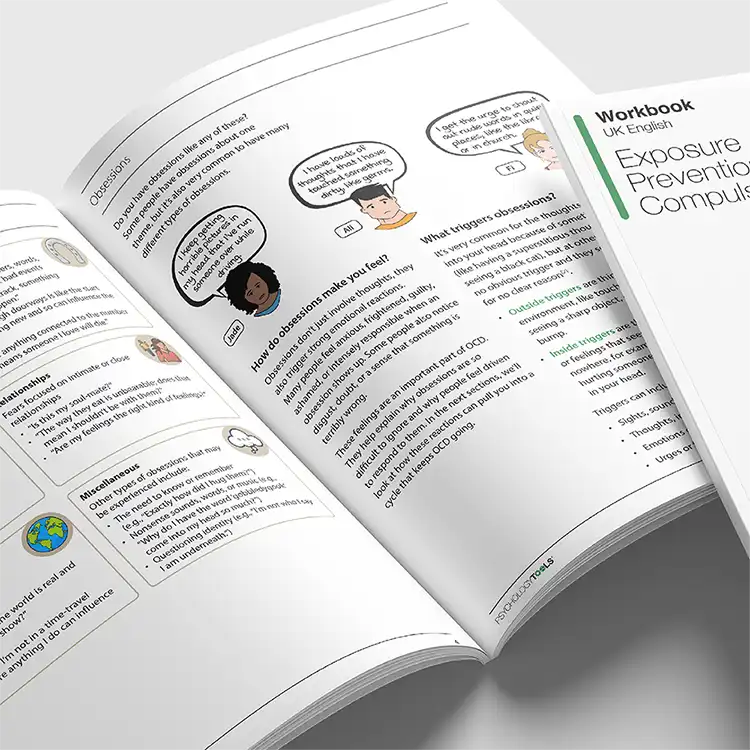
Psychoeducation about obsessions, compulsions, avoidance, and OCD triggers.
Accessible explanations for why OCD persists, how short-term relief reinforces the obsession–compulsion cycle, and how ERP breaks the cycle.
A vicious cycle diagrammatical formulation with worked example and a blank client version.
A structured OCD ladder with step-by-step instructions, worked example, and blank worksheet.
Guidance and troubleshooting for common ERP difficulties, progressing through the ladder, adjusting difficulty and strengthening learning across contexts and variations.
ERP single and multiple exposure records, with step-by-step guidance, worked examples and blank worksheets.
Staying-well, relapse-prevention, planning, and guidance.
This workbook supports treatment engagement by helping clients understand why their symptoms persist and why ERP requires repeated practice. The combination of psychoeducation, formulation, graded planning, structured exposure records, and troubleshooting guidance gives clients a clear pathway from understanding OCD to actively changing the patterns that maintain it.
For clinicians, the workbook provides a coherent framework for moving from assessment and formulation into treatment. It supports collaborative goal setting, identification of compulsions and avoidance, development of individualized exposure hierarchies, monitoring of ERP sessions, consolidation of learning, and relapse prevention.
By emphasizing repeated practice, response prevention, new learning, and generalization across contexts, the resource is designed to help clients reduce reliance on compulsions and avoidance, increase tolerance of uncertainty and distress, and improve day-to-day functioning and quality of life.
Ferrando, C., & Selai, C. (2021). A systematic review and meta-analysis on the effectiveness of exposure and response prevention therapy in the treatment of obsessive-compulsive disorder. Journal of Obsessive Compulsive and Related Disorders, 31, 100684.
Lee, H. J., & Kwon, S. M. (2003). Two different types of obsession: autogenous obsessions and reactive obsessions. Behaviour Research and Therapy, 41(1), 11–29.
Rachman, S., & de Silva, P. (1978). Abnormal and normal obsessions. Behaviour Research and Therapy, 16(4), 233–248.
Benito, K. G., & Walther, M. (2015). Therapeutic process during exposure: Habituation model. Journal of Obsessive-Compulsive and Related Disorders, 6, 147–157.
Song, Y., Li, D., Zhang, S., Jin, Z., Zhen, Y., Su, Y., … & Li, X. (2022). The effect of exposure and response prevention therapy on obsessive-compulsive disorder: A systematic review and meta-analysis. Psychiatry research, 317, 114861.
International OCD Foundation. (n.d.). OCD treatment guide: Best evidence-based therapies, medications, and new advances. International OCD Foundation. https://iocdf.org/about-ocd/ocd-treatment-guide/
Meyer, V. (1966). Modification of expectations in cases with obsessional rituals. Behaviour Research and Therapy, 4(4), 273–280.
Rachman, S. (2015). The evolution of behaviour therapy and cognitive behaviour therapy. Behaviour Research and Therapy, 64, 1–8.
Mao, L., Hu, M., Luo, L., Wu, Y., Lu, Z., & Zou, J. (2022). The effectiveness of exposure and response prevention combined with pharmacotherapy for obsessive-compulsive disorder: A systematic review and meta-analysis. Frontiers in psychiatry, 13, 973838.
Craske, M. G., Treanor, M., Zbozinek, T. D., & Vervliet, B. (2022). Optimizing exposure therapy with an inhibitory retrieval approach and the OptEx Nexus. Behaviour Research and Therapy, 152, 104069.
Working...