Grounding Skills And The Window Of Tolerance


Psychology Tools
Published
07 Sep 2026
Trauma therapists frequently encounter clients who experience overwhelming emotional states, flashbacks, dissociation, or feelings of numbness and disconnection.
Clients often struggle to make sense of these distressing experiences, and engagement in therapy can be hampered by them.
The ‘window of tolerance’ metaphor, coined by Dan Siegel in 1999, describes the range of emotional intensity that a person can comfortably experience, process, and act flexibly within. It can be a useful framework for understanding dissociative experiences and their impact.
Grounding techniques, meanwhile, are skills designed to bring attention back to the present moment, thereby helping clients to manage and reduce emotional intensity.
Both concepts are commonly used when working with survivors of trauma and clients who experience dissociation and often go hand in hand.
This article explores why the window of tolerance metaphor and grounding skills are clinically useful when working with dissociative experiences, and how therapists can incorporate them into treatment.
Understanding dissociation
Psychologists use the term ‘dissociation’ to describe a range of unusual experiences often associated with trauma. This may encompass flashbacks, intrusive unwanted memories, intrusive thoughts and feelings, depersonalization and derealization, unexplained physical or medical symptoms, identity confusion, or a reduced awareness of one’s surroundings.
Holmes et al. (2005) proposed a clinically useful distinction between different types of dissociation, a model which was further built upon by Kennerly (2009).
Detachment can be described as ‘tuning out’, where people describe feeling cut off from the world, or from themselves. Detachment often occurs peri-traumatically with experiences such as depersonalization or derealization and may lead to reduced recollection of certain aspects of the trauma. Post-traumatic experiences such as flashbacks are also considered examples of detachment.
Compartmentalization refers to a temporary disruption in the voluntary control of mental processes that would normally be accessible, such as aspects of memory or voluntary movement (Holmes et al., 2005). Examples include dissociative amnesia for certain aspects of an experience, unawareness of pain, conversion symptoms such as those associated with functional neurological disorder (FND) and fugue symptoms.
Overall, dissociation can be described as a shift of a person’s attention away from the present moment.
When working with traumatized clients, this shift often occurs away from safety in the present moment, and toward distressing memories and feelings of threat associated with the trauma.
The window of tolerance
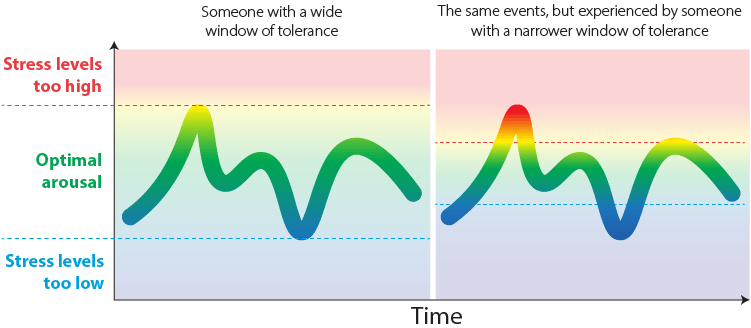
The window of tolerance concept proposes that everyone has a range of emotional intensities that they can comfortably experience, process, and integrate.
This range is sometimes referred to as a zone of optimal arousal.
Some people have relatively wide windows of tolerance and can continue to think, feel, and behave flexibly despite high levels of emotional intensity. Others have narrower windows and become overwhelmed more easily.
Every window of tolerance has an upper and lower boundary.
Hyperarousal
Above the upper boundary is a zone of hyperarousal.
Siegel describes how a flood of energy may overwhelm mental processes, leading to emotional flooding, loss of voluntary control, intense emotional experiences, and disrupted thinking. In this state, behavior may no longer feel fully volitional, and thoughts may feel out of control.
Ogden, Minton, and Pain (2006) associate this state with sympathetic nervous system activation and mobilization responses.
Hypoarousal
Below the lower boundary is a zone of hypoarousal.
This state is associated with reduced physiological activation and experiences such as numbness, shutting down, disconnection, and immobilization. Excessive activity in the parasympathetic nervous system may contribute to these experiences.
What impacts someone’s window of tolerance?
Windows of tolerance are not fixed, and their width can be influenced by:
Temperament.
Trauma history and neglect.
Social context and the presence of safe attachment figures.
Physiological states such as hunger, thirst, and tiredness.
Current stress levels and state of mind.
Any of these factors, or a combination of them, can temporarily narrow an individual’s window of tolerance, making it more difficult to remain within a zone of optimal arousal.
When someone’s window of tolerance has been narrowed, for example, by the experience of trauma, hyperarousal or hypoarousal can occur more frequently. The resulting feelings of anxiety or numbness can trigger reminders of the traumatic experience and associated dissociative symptoms.
As dissociative symptoms themselves are also stressful, such experiences can keep an individual’s window of tolerance narrowed, meaning that distressing dissociative experiences can continue to occur frequently.
What is grounding?
Grounding is widely used by trauma therapists, often introduced as a stabilization skill when clients experience dissociation, intrusive memories, or emotional overwhelm.
One of the earliest descriptions appears in Blake-White and Kline’s (1985) work with survivors of childhood sexual abuse.
Grounding was described as strategies that keep a person in touch with reality, including touching the ground with their feet, rubbing their hands on a chair, holding a cold or hot drink, or repeating orienting information about themselves and their current circumstances.
By teaching grounding as a skills-development exercise, therapists can help clients manage dissociative reactions (Kennerley, 1996).
Grounding techniques can be divided into:
Sensory grounding techniques: which use the senses to ground attention in the present moment.
Cognitive grounding techniques: which help individuals reassure themselves that they are safe in the present moment.
How grounding supports the window of tolerance
When trauma memories are activated too strongly, they can overwhelm a client’s ability to think clearly, verbalize, and update their thoughts and feelings.
The relationship between grounding and the window of tolerance is straightforward: grounding techniques help clients return to their optimal zone of arousal, so they can think more clearly, reflect on emotions, make decisions, connect with others, and process experiences.
Murray and El-Leithy (2022) note the importance of helping clients re-experience emotions without becoming overwhelmed by them or losing track of the fact that they are in a safe environment.
Grounding can help clients orient themselves to the present and reconnect with safety. It therefore plays an important role in stabilization work and in helping clients remain within, or return to, their window of tolerance.
Categories of grounding skills
There is a variety of grounding techniques that are commonly utilized by therapists. These can be organized into the following categories:
Sensory grounding
Using sight, sound, touch, smell, and taste can bring attention back to the present moment.
Examples include:
The 5-4-3-2-1 technique.
Splashing the face with cold water.
Strong pleasant smells.
Carrying grounding objects with pleasing sensory properties.
Physical grounding
Physical movement can help reconnect attention with the present moment.
Examples include:
Changing position.
Exercise.
Stretching.
Dancing.
Pressing feet firmly into the floor.
Curling and releasing fingers or toes.
Physiological self-soothing
Body-based soothing strategies can support regulation.
Examples include:
Relaxed breathing.
Progressive muscle relaxation.
Yoga.
Exercise.
Physical connection such as hugging a trusted person or stroking a pet.
Present safety reminders
Cognitive grounding techniques help distinguish present safety from past threats.
Examples include:
Carrying proof of survival.
Writing reminder letters.
Using coping statements such as “I survived”, “This too shall pass”, “This is just a memory”, and “I am safe now”.
Focusing on differences between then and now.
Orientation
Dissociation can disrupt awareness of place and time.
Grounding can include:
Reminding oneself where one is.
Reminding oneself of the current date and time.
Reflecting on how the present differs from the traumatic situation.
5 Clinical tips for therapists
1. Normalize dissociation as a human survival mechanism
Clients might hold beliefs that dissociative experiences mean there is something seriously ‘wrong’ or ‘broken’ for them.
Normalizing dissociation as on a spectrum of normal human experiences can be very helpful; for example, daydreaming and intense concentration can also be viewed as forms of dissociation.
Framing dissociation as a survival mechanism during traumatic experiences may also reduce shame.
2. Introduce grounding as a skill-development exercise
Grounding requires practice to work effectively and often benefits from repetition across settings.
3. Encourage experimentation
Different clients respond differently to sensory, cognitive, physical, and imaginative grounding strategies.
4. Combine grounding with careful exposure to triggers
Carefully graded exposure can provide opportunities for clients to practice grounding skills while remaining connected to the present.
5. Focus on widening the window of tolerance
Education about arousal states and practice regulating them may help clients develop a broader range of tolerable emotional experience.
Clinical implications
The window of tolerance offers therapists a practical way of conceptualizing emotional regulation difficulties in clients with post-traumatic presentations, while grounding provides concrete methods for helping clients regain present-moment awareness and a sense of safety.
When working with survivors of trauma, two complementary goals emerge: helping clients remain within their window of tolerance during therapeutic work, and helping them gradually widen that window over time. Together, these approaches support emotional regulation and help clients remain engaged when distress or dissociative experiences arise, increasing the likelihood that traumatic memories can be explored and processed in a regulated and meaningful way.
At Psychology Tools, we have an extensive collection of evidence-based psychology resources that can be used to support clinical practice and patient care.
Frequently asked questions
What is the window of tolerance?
The window of tolerance refers to the range of emotional intensity that a person can comfortably experience, process, and integrate without becoming overwhelmed or shutting down.
What happens when someone moves outside their window of tolerance?
Above the window, people may experience hyperarousal, emotional flooding, and disrupted thinking. Below the window, they may experience hypoarousal, numbness, disconnection, or shutting down.
What is grounding?
Grounding refers to methods that bring attention back to the present moment and help people remain connected with reality and current safety.
How does grounding help with dissociation?
Grounding techniques direct attention toward present-moment sensory experiences, current surroundings, and reminders of safety, helping individuals reconnect with the here and now.
Can the window of tolerance change over time?
Yes. The width of a person’s window of tolerance can be influenced by factors such as stress, tiredness, social support, physiological state, trauma history, and the development of new regulation skills.
References
Blake-White, J., & Kline, C. M. (1985). Treating the dissociative process in adult victims of childhood incest. Social Casework, 66(7), 394–402.
Corrigan, F. M., Fisher, J. J., & Nutt, D. J. (2011). Autonomic dysregulation and the window of tolerance model of the effects of complex emotional trauma. Journal of Psychopharmacology, 25(1), 17–25.
Ehlers, A., & Clark, D. M. (2000). A cognitive model of posttraumatic stress disorder. Behaviour Research and Therapy, 38(4), 319–345.
Ehlers, A., Hackmann, A., & Michael, T. (2004). Intrusive re-experiencing in post-traumatic stress disorder: Phenomenology, theory, and therapy. Memory, 12(4), 403–415.
Herman, J. L. (1992). Trauma and Recovery. New York: Basic Books.
Holmes, E. A., Brown, R. J., Mansell, W., Fearon, R. P., Hunter, E. C., Frasquilho, F., & Oakley, D. A. (2005). Are there two qualitatively distinct forms of dissociation? A review and some clinical implications. Clinical Psychology Review, 25(1), 1–23.
Kennerley, H. (1996). Cognitive therapy of dissociative symptoms associated with trauma. British Journal of Clinical Psychology, 35(3), 325–340.
Kennerley, H. (2009). Cognitive therapy for post-traumatic dissociation. In N. Grey (Ed.) A Casebook of Cognitive Therapy for Traumatic Stress Reactions (pp. 109–126). Routledge.
Lowen, A. (1976). Bioenergetics. Penguin Books.
Lowen, A. (1993). Depression and the Body. New York, NY: Penguin Compass.
Murray, H., & El-Leithy, S. (2022). Working with Complexity in PTSD: A Cognitive Therapy Approach. Routledge.
Ogden, P., Minton, K., & Pain, C. (2006). Trauma and the Body: A Sensorimotor Approach to Psychotherapy. WW Norton & Company.
Siegel, D. J. (1999). The Developing Mind: Toward a Neurobiology of Interpersonal Experience. Guilford Press.
Keep learning with Psychology Tools
Join thousands of mental health professionals who receive our newsletter.
Stay up to date with new articles, practical therapy ideas, reviews of important research, and the latest Psychology Tools resources.
Free. Unsubscribe at any time.