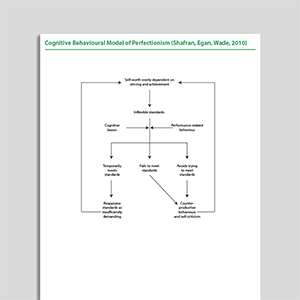
Cognitive Behavioral Model of Perfectionism (Shafran, Egan, Wade, 2010)
Information Handouts
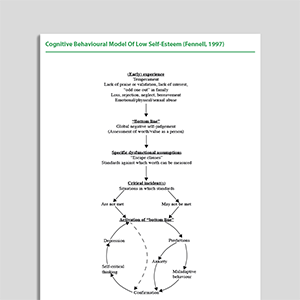
Cognitive Behavioral Model Of Low Self-Esteem (Fennell, 1997)
Information Handouts
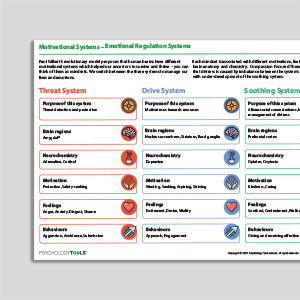
Motivational Systems (Emotional Regulation Systems)
Information Handouts
Motivational Systems (Emotional Regulation Systems)
application/pdf
•
193.09 KB

Challenging Your Negative Thinking (Archived)
Archived
Challenging Your Negative Thinking (Archived)
application/pdf
•
1.51 MB
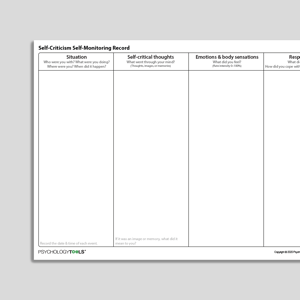
Self-Criticism Self-Monitoring Record (Archived)
Archived
Self-Criticism Self-Monitoring Record (Archived)
application/pdf
•
26.6 KB
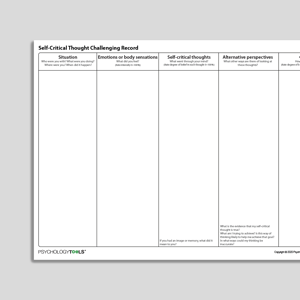
Self Critical Thought Challenging Record
Worksheets
Self Critical Thought Challenging Record
application/pdf
•
308.58 KB
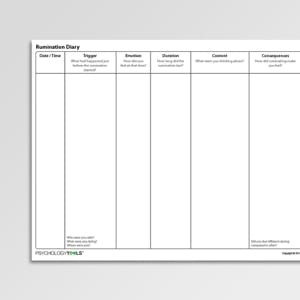
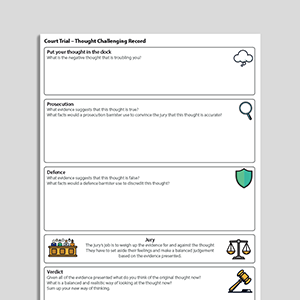
Court Trial Thought Challenging Record (Archived)
Archived
Court Trial Thought Challenging Record (Archived)
application/pdf
•
356.2 KB
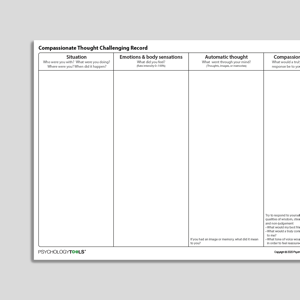
Compassionate Thought Challenging Record
Worksheets
Compassionate Thought Challenging Record
application/pdf
•
262.82 KB
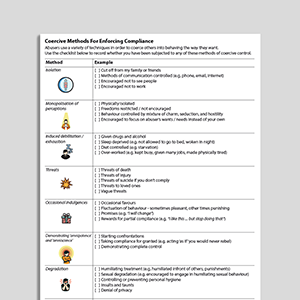
Coercive Methods For Enforcing Compliance
Exercises
Coercive Methods For Enforcing Compliance
application/pdf
•
401.4 KB
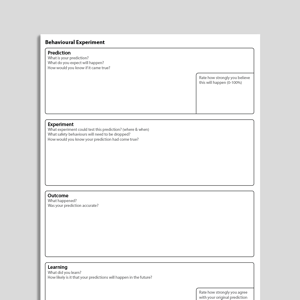
Behavioral Experiment (Portrait Format)
Worksheets
Behavioral Experiment (Portrait Format)
application/pdf
•
274.3 KB
What Is Low Self-Esteem?
Signs and Symptoms of Low Self-Esteem
Low self-esteem can be associated with the following behaviors or experiences:high levels of self-criticism
ignoring or downplaying positive qualities
comparison of self to others and negative self-judgment
use of negative words to describe self
dismissal of positive achievements as ‘luck’ or ‘fluke’
difficulty accepting compliments
Psychological Models and Theory of Low Self-Esteem
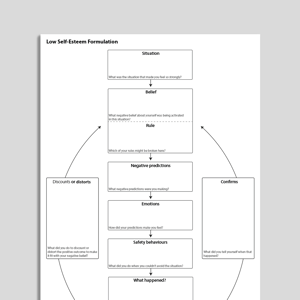
Melanie Fennell published a cognitive behavioral protocol for low self-esteem in 1997. The model is grounded in Aaron Beck’s cognitive model of emotional disorders. It assumes that, based upon what they have experienced, people form beliefs or assumptions about themselves, others, and the world. When activated, these beliefs and assumptions give rise to negative automatic thoughts which in turn lead to negative affect, and behavior. Fennell describes a self-perpetuating vicious circle whereby negative thoughts lead to painful affect and self-defeating behaviors such as avoidance or withdrawal, which act to maintain and reinforce the thoughts and underlying beliefs.Kees Korrelboom has developed a protocol for increasing self-esteem through a program of Competitive Memory Training (COMET: Korrelboom, van der Weele, Gjaltema, & Hoogstraten; 2009; Korrelboom, de Jong, Huijbrechts, & Daansen, 2009; Korrelboom, Maarsingh, & Huijbrechts, 2012). The COMET protocol is intended for people who know that their negative self-judgment is too severe but who nevertheless continue to view themselves negatively. The model draws upon Brewin’s retrieval competition theory of memory (Brewin, 2006, 2015) where information to be retrieved ‘competes’ for attention. A less accurate negative version of the self (e.g.,‘I’m pathetic’) might ‘win’ a competition against an alternative view (‘I’m kind and competent’) by nature of being reinforced/practiced. COMET aims to assist accurate views of the self to ‘win’ the retrieval competition by systematically building up and rehearsing an accurate view of the self.Evidence-Based Psychological Approaches for Working with Low Self-Esteem
Cognitive behavioral interventions for low self-esteem have been tested in a number of small trials and indicate generally favorable results (Hall & Tarrier, 2003; Morton, Roach, Reid, & Stewart, 2012; Waite, McManus, & Shafran, 2012).The COMET protocol has been used to improve self-esteem in a variety of conditions including depression, eating disorders, personality disorders, and schizophrenia. The trials indicate generally positive results with medium to large effect sizes on indices of self-esteem (Korrelboom et al., 2009, 2009, 2012).Resources for Working with Low Self-Esteem
Psychology Tools resources available for working therapeutically with low self-esteem include:psychological models of low self-esteem
information handouts for low self-esteem
self esteem exercises
References
Brewin, C. R. (2006). Understanding cognitive behaviourtherapy: A retrieval competition account. BehaviourResearch and Therapy, 44(6), 765–784.
Brewin, C. R. (2015). Reconsolidation versus retrieval competition: Rival hypotheses to explain memory change in psychotherapy. Behavioral and Brain Sciences, 38, e4. doi: 10.1017/S0140525X14000144
Fennell, M. J. V. (1997). Low self-esteem: A cognitive perspective. Behavioral and Cognitive Psychotherapy, 25(1), 1–26.
Hall, P. L., & Tarrier, N. (2003). The cognitive-behavioral treatment of low self-esteem in psychotic patients: A pilot study. BehaviourResearch and Therapy, 41(3), 317–332.
Harter, S. (1999). The construction of the self: A developmental perspective. New York: Guilford Press.
Korrelboom, K., van der Weele, K., Gjaltema, M., & Hoogstraten, C. (2009). Competitive memory training for treating low self-esteem: A pilot study in a routine clinical setting. The Behavior Therapist,32, 3–8.
Korrelboom, K., de Jong, M., Huijbrechts, I., & Daansen, P. (2009). Competitive memory training (COMET) for treating low self-esteem in patients with eating disorders: A randomized clinical trial. Journal of Consulting and Clinical Psychology,77(5), 974–980.
Korrelboom, K., Maarsingh, M., & Huijbrechts, I. (2012). Competitive memory training (COMET) for treating low self‐esteem in patients with depressive disorders: A randomized clinical trial.Depression and Anxiety, 29(2), 102–110.
Markus, H., & Nurius, P. (1986). Possible selves. American Psychologist, 41(9), 954–969.
Morton, L., Roach, L., Reid, H., & Stewart, S. H. (2012). An evaluation of a CBT group for women with low self-esteem.Behavioral and Cognitive Psychotherapy,40(2), 221–225.
Rogers, T. B. (1981). A model of the self as an aspect of the human information processing system. In N. Cantor & J. F. Kihlstrom (Eds.), Personality, cognition, and social interaction(pp. 193–213). Hillsdale, NJ: Erlbaum.
Waite, P., McManus, F., & Shafran, R. (2012). Cognitive behaviourtherapy for low self-esteem: A preliminary randomized controlled trial in a primary care setting. Journal of Behavior Therapy and Experimental Psychiatry, 43(4), 1049–1057.
Links to external resources
Psychology Tools makes every effort to check external links and review their content. However, we are not responsible for the quality or content of external links and cannot guarantee that these links will work all of the time.
Please login to view our external resources.