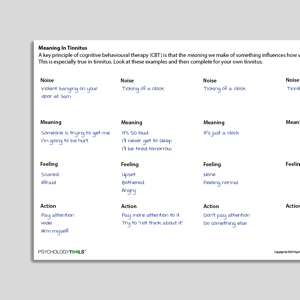
Overcoming Your Eating Disorder: Workbook
Evaluating Unhelpful Automatic Thoughts
Demanding Standards – Living Well With Your Personal Rules
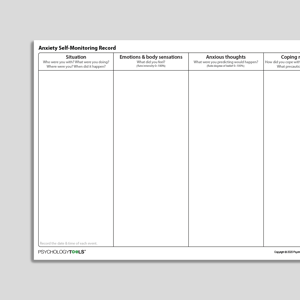
Anxiety - Self-Monitoring Record
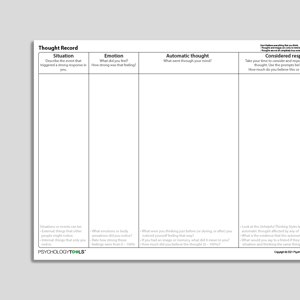
Thought Record (Considered Response)
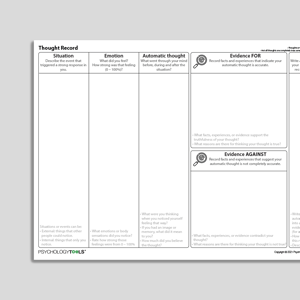
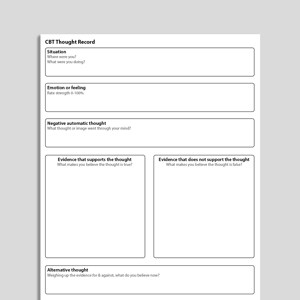
Thought Record (Evidence For And Against)
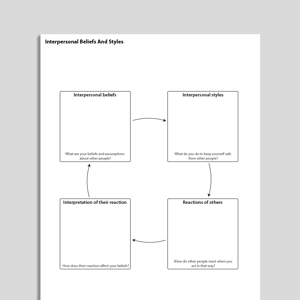
Interpersonal Beliefs And Styles
Challenging Your Negative Thinking (Archived)
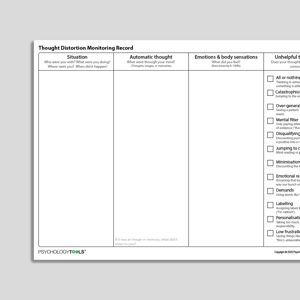
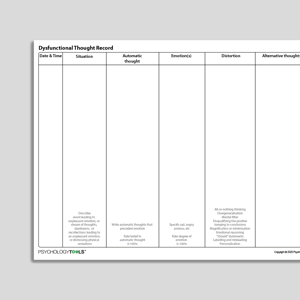
Thought Distortion Monitoring Record (Archived)
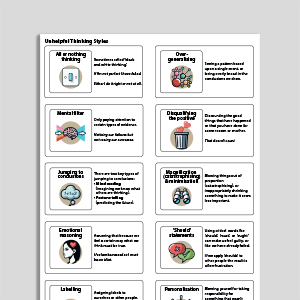
Unhelpful Thinking Styles (Archived)
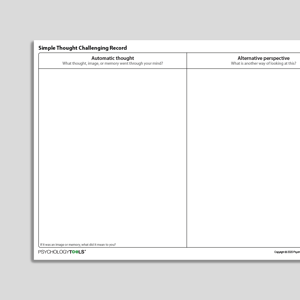
Simple Thought Challenging Record
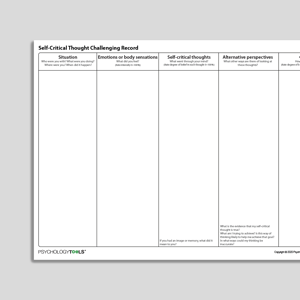
Self Critical Thought Challenging Record
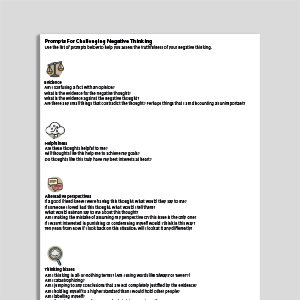
Prompts For Challenging Negative Thinking (Archived)
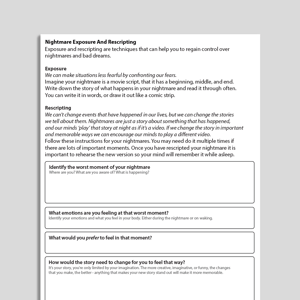
Nightmare Exposure And Rescripting
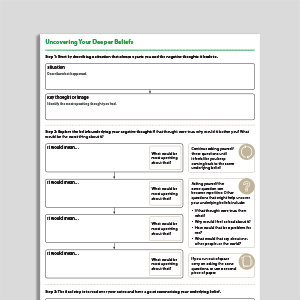
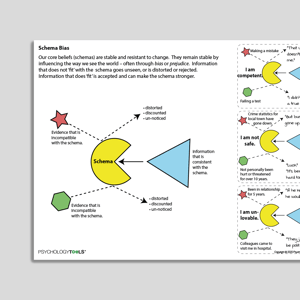
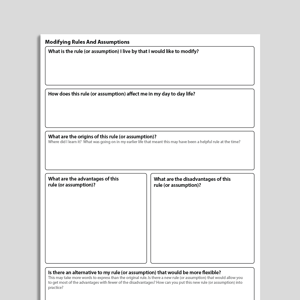
Modifying Rules And Assumptions
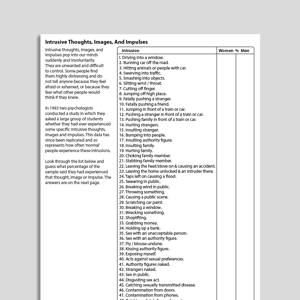
Intrusive Thoughts Images And Impulses
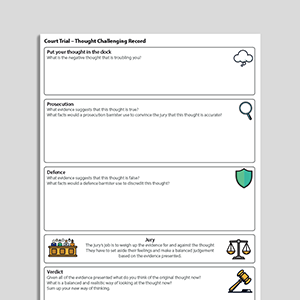
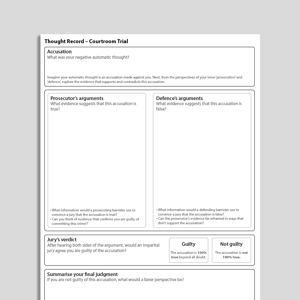
Court Trial Thought Challenging Record (Archived)
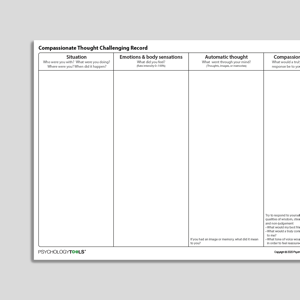
Compassionate Thought Challenging Record
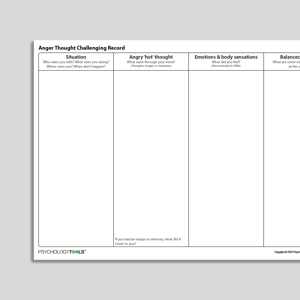
Anger Thought Challenging Record
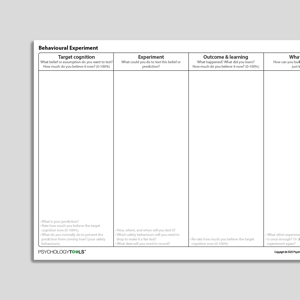
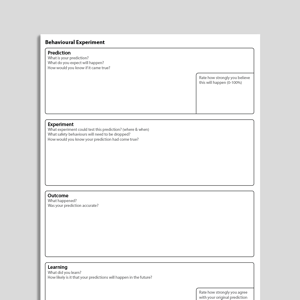
Behavioral Experiment (Portrait Format)
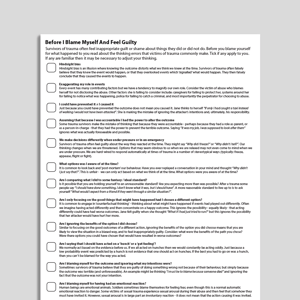
Before I Blame Myself And Feel Guilty
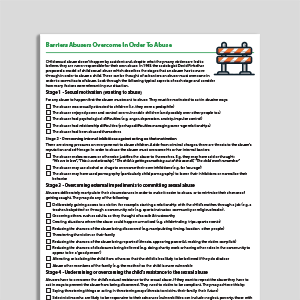
Barriers Abusers Overcome In Order To Abuse
What Is Cognitive Restructuring?
Techniques for Cognitive Restructuring
Behavioral experiments (including hypothesis testing and surveys) have been a fundamental CBT technique since the publication of the first treatment manual: “a powerful method with which to investigate the validity of a specific assumption consists of designing an experiment or task to test the assumption empirically” (Beck et al., 1979). Bennett-Levy et al. (2004) define behavioral experiments as:
“planned experiential activities, based on experimentation or observation, which are undertaken by patients in or between cognitive therapy sessions … their primary purpose is to obtain new information which may help to: test the validity of the patients’ existing beliefs …; construct and/or test new, more adaptive beliefs; contribute to the development and verification of the cognitive formulation.”
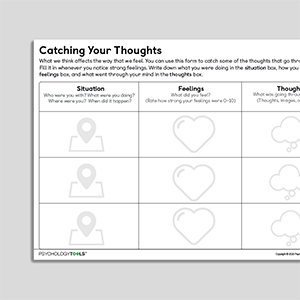
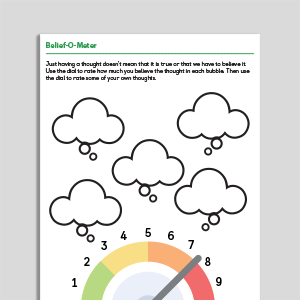
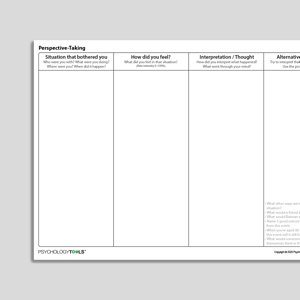
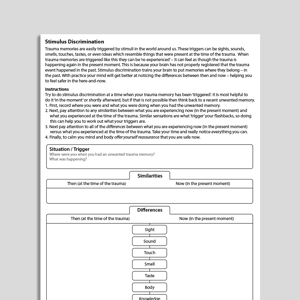
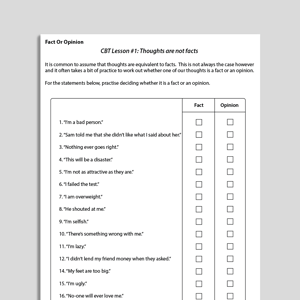
Examining and reality-testing automatic thoughts and images, popularly known as ‘thought challenging’ or ‘disputing thoughts’ is a technique by which patients are encouraged to examine the accuracy of and validity of their negative automatic thoughts and images.
Psychoeducation in therapy refers to information-giving. Many patients experience psychological distress because they lack critical information. Information can be given directly in the form of handouts or reading, or indirectly in the form of information-gathering exercises.
Socratic dialogue is “a method of guided discovery in which the therapist asks a series of carefully sequenced questions to help define problems, assist in the identification of thoughts and beliefs, examine the meaning of events, or assess the ramifications of particular thoughts or behaviors” (Beck & Dozois, 2011). The Socratic method can help patients to reflect upon how they think and the assumptions they make, and can promote cognitive change.
References
Beck, A. T., & Dozois, D. J. (2011). Cognitive therapy: Current status and future directions. Annual Review of Medicine, 62, 397–409.
Beck, A. T., Rush, A. J., Shaw, B. F., & Emery, G. (1979). Cognitive therapy of depression. New York: Guilford Press.
Bennett-Levy, J., Butler, G., Fennell, M., Hackmann, A., Mueller, M., & Westbrook, D. (2004). Oxford guide to behaviouralexperiments in cognitive therapy. New York: Oxford University Press.
Leahy, R. L., & Rego, S. A. (2012). Cognitive restructuring. In W. T. O’Donohue & J. E. Fisher (Eds.), Cognitive behavior therapy: Core principles for practice(pp. 113–158). Hoboken, NJ: Wiley.
Links to external resources
Psychology Tools makes every effort to check external links and review their content. However, we are not responsible for the quality or content of external links and cannot guarantee that these links will work all of the time.
Please login to view our external resources.