All-Or-Nothing Thinking Workbook

A structured CBT workbook designed to help clients recognize, understand, and address all-or-nothing (black-and-white) thinking patterns that contribute to emotional distress and unhelpful behavior.
Download or send

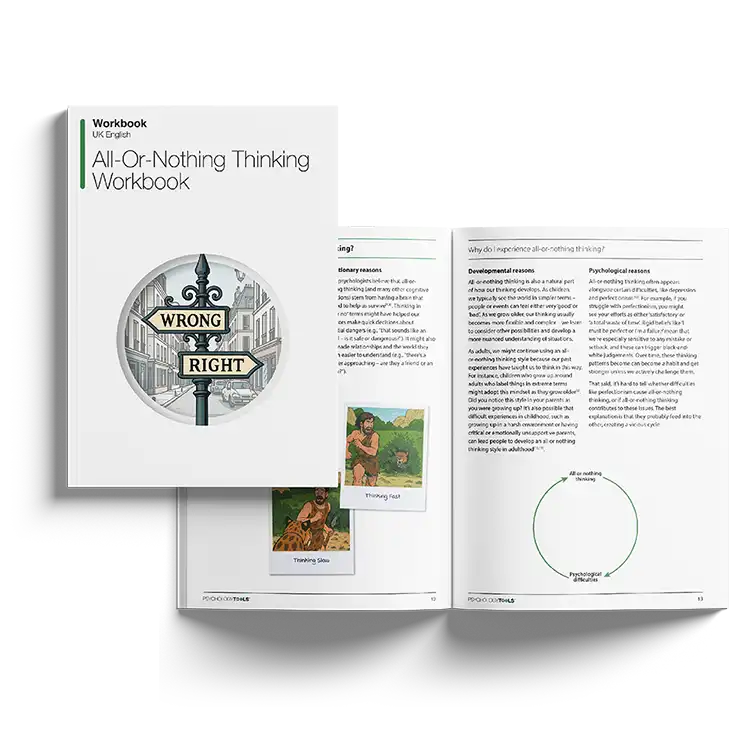
Workbook (PDF)

A workbook containing elements of psychoeducation and skills-development.
Overview

All-or-nothing thinking is a common cognitive distortion in which the self, other people, and experiences are judged in extreme, either/or terms. This cognitive behavioral workbook is designed to help clients understand where all-or-nothing thinking comes from, and develop more balanced and flexible perspectives. Suitable for clients with a range of difficulties, it combines psychoeducation, practical tools, and reflective exercises.

Why use this resource?

All-or-nothing thinking is associated with a variety of mental health difficulties and problematic behaviours. Addressing this thinking style can help reduce emotional distress, encourage flexible thinking, and support relapse prevention.

This resource supports clients by providing useful information and practical exercises that are engaging and easy to apply.

Key benefits

Insightful

Helps clients notice and understand all-or-nothing patterns in their lives.

Practical

Offers effective strategies for addressing all-or-nothing thoughts and behaviors.

Structured

Provides step-by-step exercise and worksheets that support change.

Broad

Suitable for a variety of difficulties where all-or-nothing thinking is a feature, such as eating disorders and perfectionism.

What difficulties is this for?

Depression

Addressing rigid self-judgments.

Anxiety disorders

Challenging polarized threat appraisals.

Eating disorders

Targeting extreme beliefs about shape, weight, and eating.

Perfectionism

Reducing rigid standards and dichotomous performance evaluations.

Low self-esteem

Modifying extreme self-labels.

Other difficulties

Suitable for other presentations where all-or-nothing thinking is a feature.

Integrating it into your practice

01

Identify

Identify clients who struggle with all-or-nothing thinking.

02

Assess

Explore the nature of clients' all-or-nothing patterns.

03

Educate

Discuss how all-or-nothing thinking tends to manifest in people's lives.

04

Intervene

Encourage clients to work through the workbook, highlighting exercises that are likely to be most helpful.

05

Review

Reflect on clients' progress and address blocks that might arise.

Theoretical background and therapist guidance

All-or-nothing thinking (also known as dichotomous or black-and-white thinking) is a cognitive distortion in which people interpret themselves, others, or events in extreme, mutually exclusive categories. This style of thinking can amplify emotional distress, restrict behavioral flexibility, and maintain difficulties such as depression, eating disorders, perfectionism, and relationship difficulties.

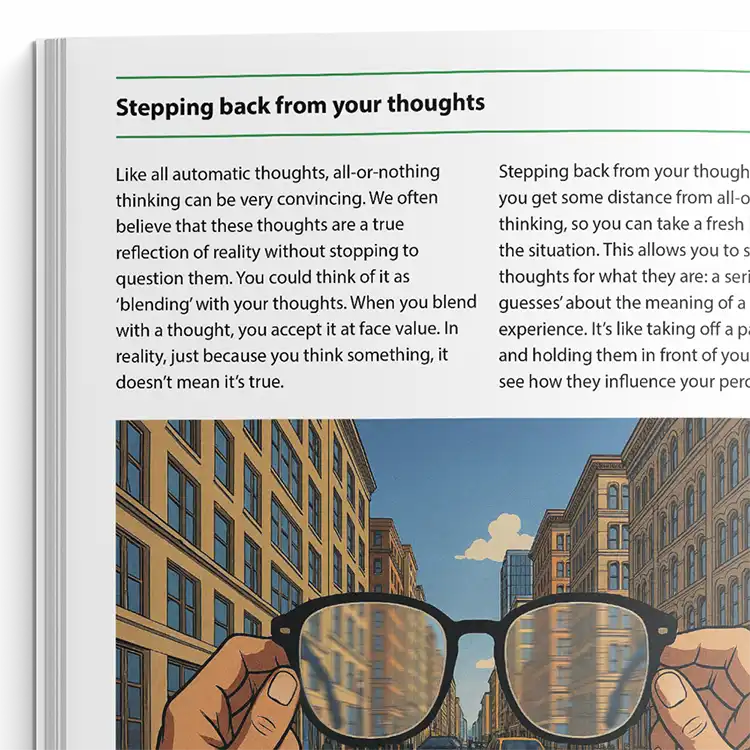
This workbook is grounded in cognitive behavioral theory. It outlines a variety of practical exercises to address all-or-nothing thinking include self-monitoring, decentring and distancing, scaling judgments, dialectical (“both-and”) thinking, and conducting surveys to test assumptions in real-world contexts.
What's inside

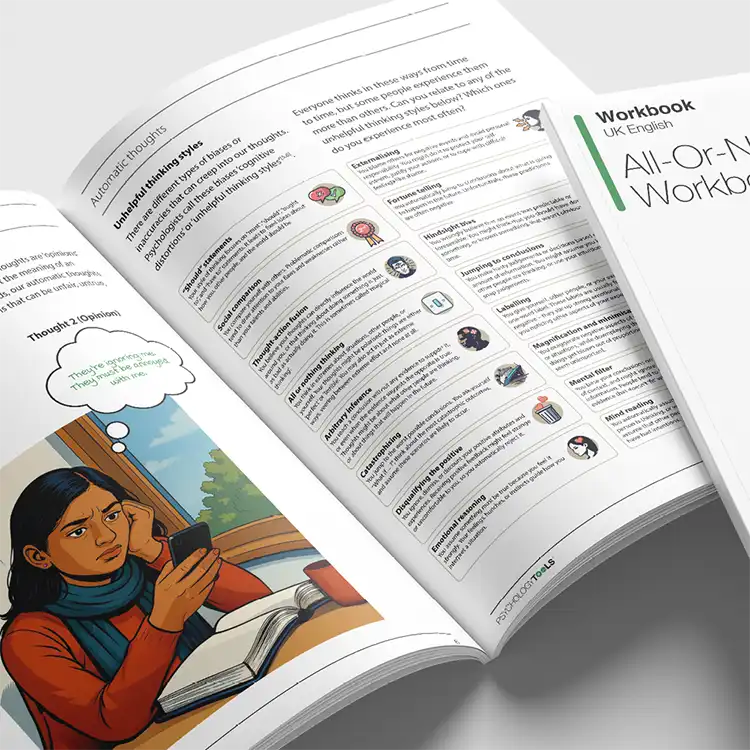
  • Psychoeducation about all-or-nothing thinking
  • Self-assessment and reflection exercises
  • Practical exercises including self-monitoring, scaling, dialectical thinking, and surveys
  • Tools and information that support relapse prevention and continued progress
Get access to this resource

FAQs

All-or-nothing thinking is a cognitive distortion in which situations, people, or the self are evaluated in extreme, polarised terms.
All-or-nothing thinking is associated with heightened emotional distress, reduced behavioural flexibility, and difficulties such as depression, anxiety, perfectionism, anger, and strained relationships.
Yes. The exercises are designed for individual use and can be completed collaboratively in-session or as between-session tasks.

How this resource helps improve clinical outcomes

By targeting all-or-nothing thinking, this workbook supports reduced emotional distress and rigid behaviour patterns. Clients will learn how to tolerate ambiguity, develop balanced evaluations, and respond more flexibly to setbacks.

References and further reading

  • Beck, A. T. (1979). Cognitive therapy and the emotional disorders. Penguin.
  • Beck, A. T. (1991). Cognitive therapy: A 30-year retrospective. American psychologist, 46(4), 368.
  • Kahneman, D. (2011). Thinking, fast and slow. Farrar, Straus and Giroux.
  • Gilbert, P. (1998). The evolved basis and adaptive functions of cognitive distortions. British Journal of Medical Psychology, 71(4), 447-463.
  • Beck, A. T. (1964). Thinking and depression: II. Theory and therapy. Archives of general psychiatry, 10(6), 561-571.
  • Burns, D. D., & Good, M. F. (1980). Feeling Good: The new mood therapy. New York: William Morrow and Company.
  • Bonfá-Araujo, B., & Hauck Filho, N. (2021). “All or nothing”: Extreme responding, dichotomous thinking, and the dark triad of personality. Psico, 52(1), e35441-e35441.
  • Haselton, M., Nettle, D., & Andrews, P. (2005). The evolution of cognitive bias. In D. M. Buss (Ed.), The handbook of evolutionary psychology (pp. 724–746). John Wiley & Sons.
  • Bandura, A., & Walters, R. H. (1977). Social learning theory (Vol. 1, pp. 141-154). Englewood Cliffs, NJ: Prentice hall.
  • Mieda, T., Taku, K., & Oshio, A. (2020). Dichotomous thinking and cognitive ability. Personality and Individual Differences, 110008. doi:10.1016/j.paid.2020.110008
  • Linehan, M. M. (1993). Cognitive-behavioral treatment of borderline personality disorder. New York: Guilford Press.
  • Egan, S. J., Piek, J. P., Dyck, M. J., & Rees, C. S. (2007). The role of dichotomous thinking and rigidity in perfectionism. Behaviour research and therapy, 45(8), 1813-1822.
  • Linehan, M. M., & Wilks, C. R. (2015). The course and evolution of dialectical behavior therapy. American journal of psychotherapy, 69(2), 97-110.