What Are Eating Disorders?
Signs and Symptoms of Eating Disorders
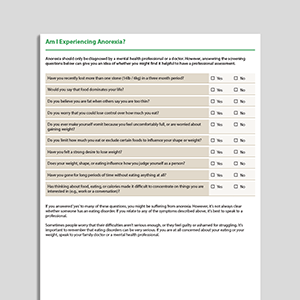
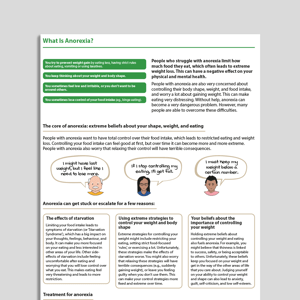
Common to many of the eating disorders are a preoccupation with weight and body shape, significant anxiety about gaining weight, and behaviors intended to mitigate the anxiety.Symptoms of anorexia nervosa may include:
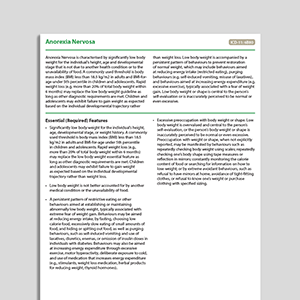
restriction of energy intake leading to weight that is less than minimally normal or expected in the context of age, sex, developmental trajectory, and physical health;
an intense fear of gaining weight, an intrusive dread of fatness, or persistent behavior that interferes with weight gain;
disturbed perception of one’s body weight (e.g., a self-perception of being too fat);
self-evaluation is unduly influenced by body weight or shape;
a persistent lack of insight regarding the seriousness of low body weight;
endocrine disorder resulting in amenorrhea or loss of sexual interest or potency.
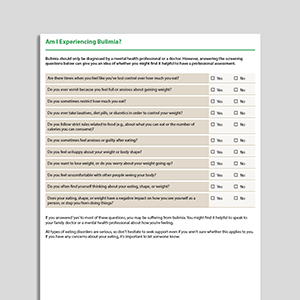
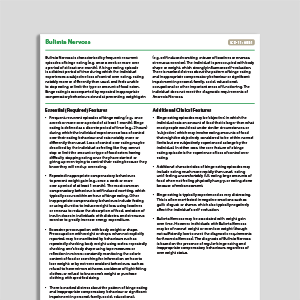
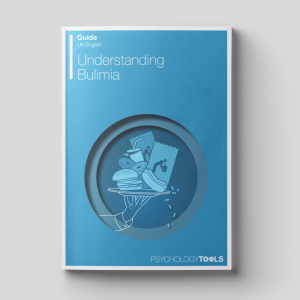
Symptoms of bulimia nervosa include:
recurrent episodes of binge eating (overeating) where excessively large amounts of food are consumed in a discrete period of time;
a feeling of lack of self-control over eating during a binge-eating episode;
recurrent behaviors to counteract weight gain such as self-induced vomiting, purging, fasting, use of drugs, diuretics, or excessive exercise;
self-evaluation is unduly influenced by body weight or shape;
a self-perception of being too fat and an intrusive dread of fatness.
Psychological Models and Theory of Eating Disorders
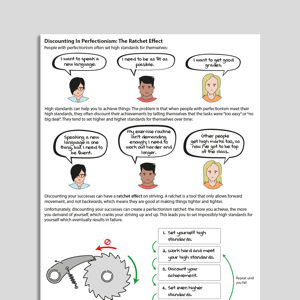
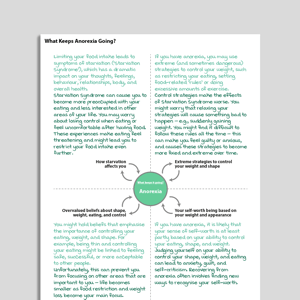
Fairburn, Cooper, and Shafran (2003) proposed a transdiagnostic cognitive behavioral model of eating disorders that describes the maintenance of both anorexia nervosa and bulimia nervosa. Central to the model is the individual’s judgment of their self-worth in terms of body weight or shape. Disordered eating behaviors are understood as a consequence of these self-beliefs.
Evidence-Based Psychological Approaches for Working with Eating Disorders
Enhanced Cognitive Behavior Therapy for Eating Disorder (CBT-E)
In 2003, Fairburn et al. argued for value in viewing eating disorders from a transdiagnostic perspective. They say that common mechanisms, such as a restricted assessment of self-worth, underpinned both anorexia and bulimia. CBT-E includes elements that focus on modification of eating habits, weight-control behavior, and concerns about eating, shape, and weight.
Family-Based Treatment (FBT) / Maudsley Family Therapy
FBT is an outpatient, intensive treatment in which the family is used as the primary resource to renourish the affected child or adolescent. It is described as a highly practical approach that attempts to modify problems in family structure that make refeeding more difficult (Lock and le Grange, 2005). Average length of treatment is 9–12 months. A 2013 meta-analysis indicated that individual therapy and FBT were equivalently effective at the end of treatment, but that FBT was superior at 6–12 month follow-up (Couturier, Kimber, & Szatmari, 2013).
Resources for Working with Eating Disorders
Psychology Tools resources available for working therapeutically with eating disorders may include:
psychological models of eating disorders including anorexia and bulimia
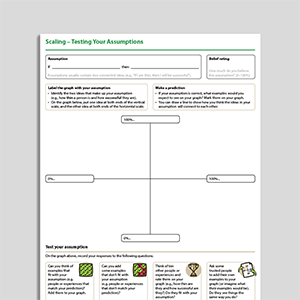
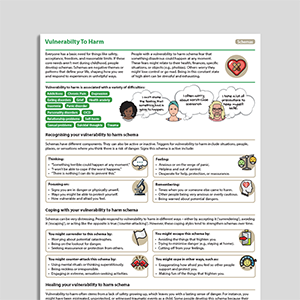
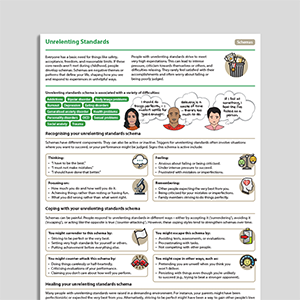
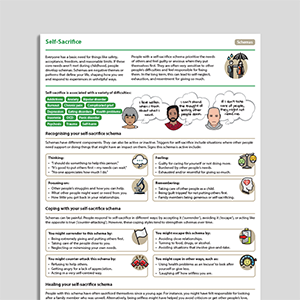
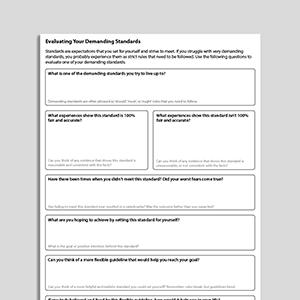
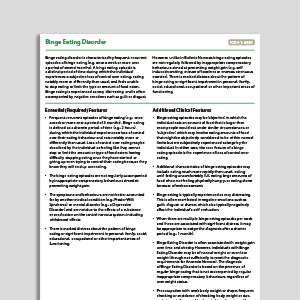
information handouts for eating disorders including anorexia and bulimia
exercises for eating disorders including anorexia and bulimia
CBT worksheets for eating disorders including anorexia and bulimia
self-help programs for eating disorders including anorexia and bulimia
References
Couturier, J., Kimber, M., & Szatmari, P. (2013). Efficacy of family‐based treatment for adolescents with eating disorders: A systematic review and meta‐analysis. International Journal of Eating Disorders, 46(1), 3–11.
Fairburn, C. G., Cooper, Z., & Shafran, R. (2003). Cognitive behaviourtherapy for eating disorders: A ‘transdiagnostic’ theory and treatment. BehaviourResearch and Therapy, 41(5), 509–528.
Lock, J., & le Grange, D. (2005). Family‐based treatment of eating disorders. International Journal of Eating Disorders, 37(S1), S64–S67.