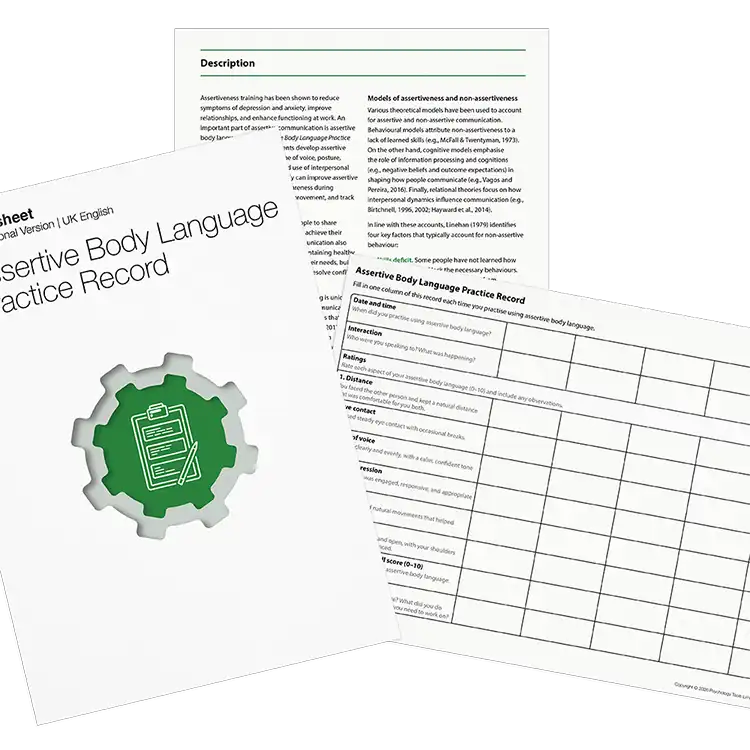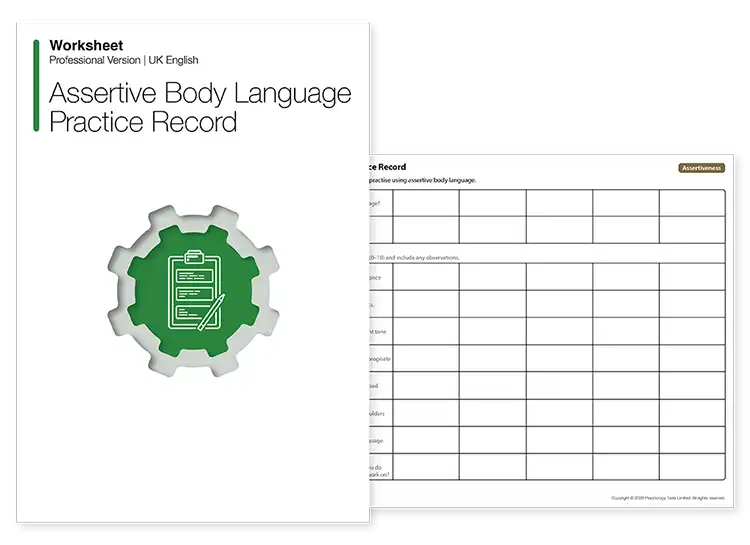
Assertive Body Language Practice Record

This CBT-based worksheet helps clients develop assertive body language through structured self-reflection, targeted practice, and progress tracking.

Download or send

Professional version

Offers theory, guidance, and prompts for mental health professionals. Downloads are in Fillable PDF format where appropriate.
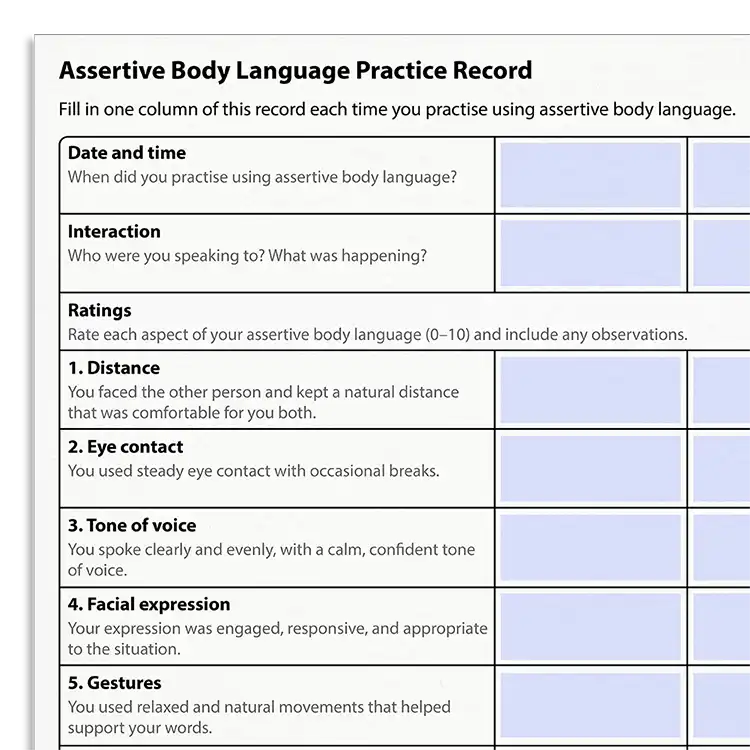
Client version

Includes client-friendly guidance. Downloads are in Fillable PDF format where appropriate.

Overview

Assertive communication involves more than words – it includes the non-verbal cues that accompany our speech. This resource is designed to help clients build awareness of their body language and intentionally practice assertive non-verbal behaviors such as eye contact, tone of voice, gestures, and interpersonal space.

The Assertive Body Language Practice Record enables clients to reflect on their communication style, evaluate key components of assertive body language, and identify areas for growth. Rooted in evidence-based assertiveness training models, it promotes self-monitoring, experiential learning, and behavior change over time.

Why use this resource?

Many clients who struggle with assertiveness may be unaware of how their body language contributes to how they are perceived. This resource addresses common barriers to assertive communication – such as anxiety, unhelpful beliefs, or underdeveloped skills – by encouraging intentional practice and structured reflection.

  • Targets specific non-verbal behaviors linked to assertive communication.  
  • Increases self-awareness through post-interaction ratings and reflection.  
  • Supports skill generalization by encouraging repeated, real-world use.  
  • Facilitates therapeutic discussion about body language and social anxiety.

Key benefits

Awareness

Helps clients identify and track their use of assertive body language.

Clarity

Breaks assertiveness into clear, observable skills.

Practice

Encourages repeated application across different contexts.

Feedback

Provides an opportunity for structured self-reflection and therapist input.

What difficulties is this for?

Low self-esteem

Reinforcing non-verbal behaviors that signal competence and self-worth.

Depression

Enhancing social engagement through positive behavioral activation.

Personality disorders

Supporting effective interpersonal boundaries and presence.

Interpersonal disorders

Replacing passive or aggressive patterns with confident expression.

Social anxiety disorder

Reducing self-consciousness and avoidance of eye contact or speech.

Generalized anxiety disorder

Improving confidence and control in interactions.

Autism spectrum disorder

Teaching specific non-verbal communication skills.

Integrating it into your practice

01

Introduce

Use the worksheet as part of psychoeducation about assertive communication.

02

Guide

Help clients select real-life situations where they can practice assertiveness.

03

Reflect

Review completed records in-session to explore beliefs, reactions, and changes.

04

Rate

Support clients in identifying successes and areas for development using the 0–10 scale.

05

Reinforce

Use as a between-session task to consolidate work from assertiveness training or behavioral experiments.

06

Generalize

Encourage clients to apply these skills across different people and settings.

Theoretical background and therapist guidance

Assertiveness training has been shown to reduce symptoms of anxiety and depression, and to improve interpersonal functioning. Non-verbal behaviors – including voice, facial expression, posture, gestures, and proximity – play a crucial role in how assertive a person is perceived to be.

The resource integrates behavioral, cognitive, and relational models of assertiveness. From a behavioral standpoint, some clients may lack the specific skills required. Cognitive models highlight the role of beliefs (e.g., “If I make eye contact, people will think I’m rude.”), while relational perspectives emphasize how interpersonal dynamics shape communication patterns.

The practice record supports clients across these domains by encouraging planned, intentional use of body language in specific contexts, followed by structured reflection. This aligns with empirical evidence showing that assertive non-verbal behaviors (such as steady eye contact, calm tone of voice, and relaxed posture) contribute to perceptions of confidence and competence independently of verbal content.

Therapists can use this tool to normalize difficulties, scaffold skill development, and monitor change over time.

What's inside

  • Psychoeducation on assertiveness and communication styles.  
  • Overview of common non-verbal assertiveness skills.  
  • Step-by-step instructions for recording practice.  
  • Prompts and questions to guide post-interaction reflection.  
  • A worksheet suitable for repeated use.
Get access to this resource

FAQs

To help clients improve their awareness and use of assertive body language through structured observation, practice, and feedback.
It works well during the intervention phase of assertiveness training, especially after introducing the concepts of communication styles and alongside other behavioral skills training.
Ideally, clients should complete one row after each practice opportunity. Encourage frequent use to build skill fluency and self-efficacy.
Yes. Clients can reflect on their interpersonal experiences in group settings and share learning, which fosters accountability and support.
Use this as an opportunity to explore barriers, validate the challenge, and reinforce the value of gradual progress. Low scores can offer valuable clinical insight.

How this resource helps improve clinical outcomes

This tool supports the transition from insight to action by facilitating repeated practice of assertive communication skills. Over time, clients become more confident, intentional, and effective in social interactions.

  • Increases emotional and behavioral self-regulation.
  • Improves interpersonal effectiveness.
  • Reduces anxiety associated with social performance.
  • Reinforces behavioral activation and exposure to feared interactions.
  • Supports therapeutic alliance through collaborative goal setting.

References and further reading

  • Alberti, R. E., & Emmons, M. L. (2017). Your perfect right: Assertiveness and equality in your life and relationships (10th ed.). Impact Publishers.
  • Birdwhistell, R. (1970). Kinesics in context. University of Pennsylvania Press.
  • Bonaccio, S., O’Reilly, J., O’Sullivan, S. L., & Chiocchio, F. (2016). Nonverbal behavior and communication in the workplace: A review and an agenda for research. Journal of Management, 42, 1044–1074. https://doi.org/10.1177/0149206315621146
  • Bonham-Carter, D. (2012). Assertiveness: A practical guide. Icon Books.
  • Chłopicki, W. (2017). Communication styles: An overview. Styles of Communication, 9, 9–25.
  • Duckworth, M. P. (2009). Assertiveness skills and the management of related factors. In O’Donohue, W. T., & Fisher, J. E. (Eds.), General principles and empirically supported techniques of cognitive behavior therapy (pp. 124–132). John Wiley & Sons.
  • Hall, E. T. (1966). The hidden dimension. Doubleday.
  • Hall, J. A., Horgan, T. G., & Murphy, N. A. (2019). Nonverbal communication. Annual Review of Psychology, 70, 271–294. https://doi.org/10.1146/annurev-psych-010418-103145
  • Linehan, M. M. (1979). Structured cognitive-behavioral treatment of assertion problems. In Kendall, P. C., & Hollon, S. V. (Eds.), Cognitive-behavioral interventions: Theory, research, and procedures (pp. 205–240). Academic Press.
  • McKay, M., Davis, M., & Fanning, P. (2018). Messages: The communication skills workbook (4th ed.). New Harbinger Publications.
  • Rakos, R. F. (1991). Assertive behavior: Theory, research, and training. Routledge.
  • Speed, B. C., Goldstein, B. L., & Goldfried, M. R. (2018). Assertiveness training: A forgotten evidence-based treatment. Clinical Psychology: Science and Practice, 25, e12216. https://doi.org/10.1111/cpsp.12216
  • Sorokowska, A., et al. (2017). Preferred interpersonal distances: A global comparison. Journal of Cross-Cultural Psychology, 48, 577–592. https://doi.org/10.1177/0022022117698039