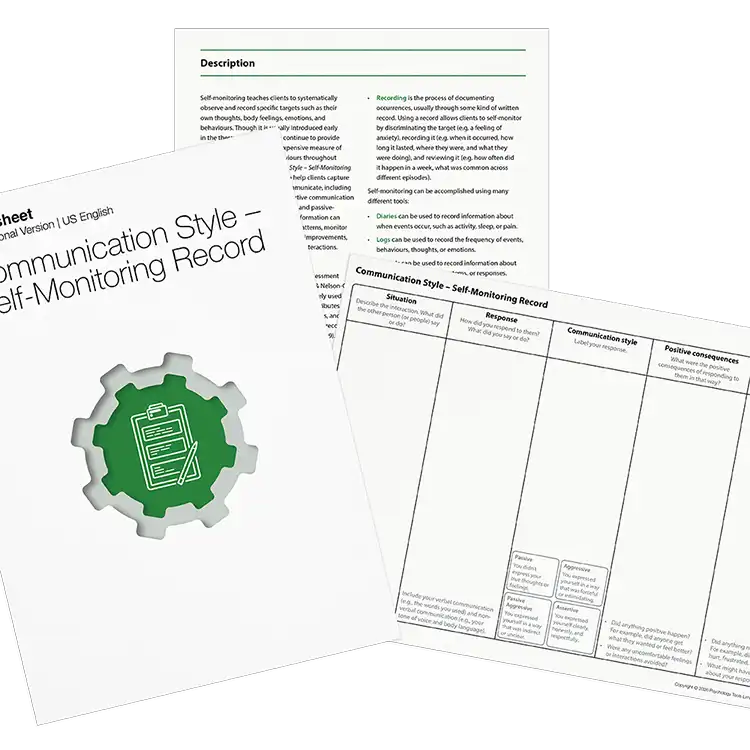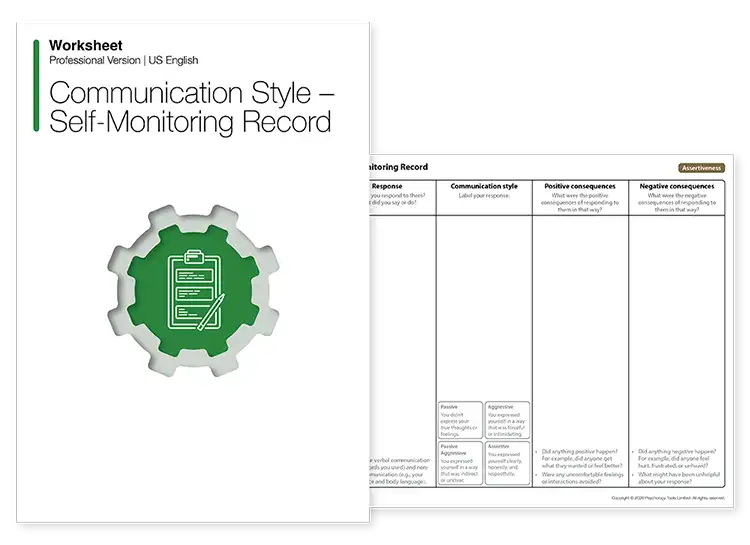
Communication Style – Self-Monitoring Record

This structured tool helps clients identify, track, and reflect on their communication styles across different situations.

Download or send

Professional version

Offers theory, guidance, and prompts for mental health professionals. Downloads are in Fillable PDF format where appropriate.
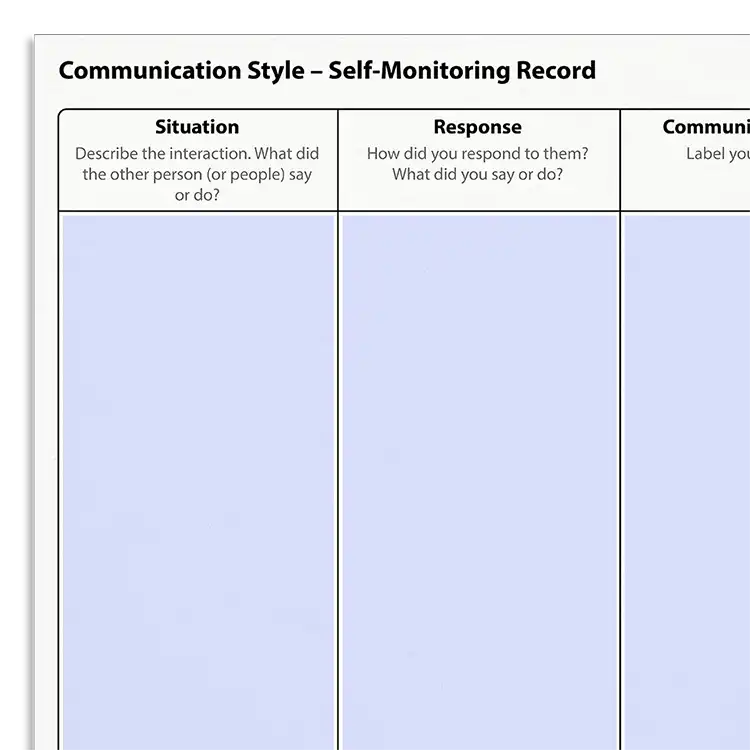
Client version

Includes client-friendly guidance. Downloads are in Fillable PDF format where appropriate.

Overview

Self-monitoring teaches clients to systematically observe and record specific targets, such as their thoughts, body feelings, emotions, and behaviors. This Communication Style – Self-Monitoring Record worksheet is designed to help clients capture information about how they communicate, including the use of assertive and non-assertive communication styles (such as passive, aggressive, and passive-aggressive communication). This information can be used to assess communication patterns, monitor changes during treatment, reinforce improvements, and enhance self-awareness during interactions.

Why use this resource?

Effective communication is central to psychological wellbeing and social functioning. Many clients are unaware of their communication style or the impact it has on others. This worksheet enhances awareness and promotes behavior change.

  • Helps clients become more aware of their communication style.
  • Highlights problematic patterns of interaction.
  • Explores the positive and negative consequences of particular communication styles.
  • Useful for clients who struggle with assertiveness or interpersonal difficulties.

Key benefits

Insightful

Helps clients become more aware of their communication styles.

Simple

Easy-to-use format that supports self-monitoring.

Reflective

Encourages reflection on communication styles and their consequences.

Flexible

Can be used for treatment planning, goal-setting, and assertiveness training.

What difficulties is this for?

Social Anxiety Disorder (SAD)

For clients who fear judgment and avoid speaking up.

Generalized Anxiety Disorder (GAD)

For individuals who struggle with expressing concerns or saying no.

Depression

For clients who find it difficult to advocate for themselves.

Anger

For clients who tend to communicate in aggressive or hostile ways.

Borderline Personality Disorder (BPD)

As part of DBT skills training for interpersonal effectiveness.

Low Self-Esteem

Helps clients confidently express their thoughts, feelings, and needs.

Relationship Problems

For clients struggling with patterns of avoidance, conflict, or submission.

Workplace Stress

For difficulties with boundaries, conflict, or assertiveness at work.

Integrating it into your practice

01

Educate

Provide information about different communication styles.

02

Monitor

Ask clients to complete the record daily or after difficult interactions.

03

Review

Use completed records in therapy to identify themes and communication patterns.

04

Discuss

Reflect on what worked, what didn’t, and how clients felt after they communicated in particular ways.

05

Plan

Set goals and plan interventions to address problematic communication styles and support assertiveness.

Theoretical background and therapist guidance

Self-monitoring is a recommended component of assertiveness skills training (Rakos, 1991). Assertive communication is typically associated with better psychological outcomes, while passive or aggressive styles often maintain interpersonal conflict, emotional distress, and impaired functioning. Drawing from cognitive-behavioral and interpersonal frameworks, this worksheet helps clients become more aware of their communication style and its consequences.

The form categorizes communication into four styles:

  • Assertive: Clear, direct, respectful.
  • Passive: Avoidant, inhibited, yielding.
  • Aggressive: Hostile, controlling, dominating.
  • Passive-aggressive: Indirect, resentful, obstructive.

The record encourages clients to observe their communication in context – who they spoke to, what happened, and how they felt – and then reflect on the positive and negative consequences of their responses.

Therapists can use the resource to support goal-setting, treatment planning, and assertiveness training.

What's inside

  • A detailed overview of the role of self-monitoring in talking therapies.
  • An introduction to communication styles and assertiveness.
  • Guidance for using the record with clients, including therapist prompts.
  • Recommendations for further reading related to the resource.   
Get access to this resource

FAQs

Communication styles are groups of conversational behaviors that form recognizable patterns.
Assertive communication is a clear, honest, and respectful way of communicating that is effective in many situations.
Daily use or following difficult interactions is recommended to maximise awareness and learning.

How this resource helps improve clinical outcomes

This resource supports self-awareness, reflection, and assertiveness skills practice:

  • Supports self-monitoring and self-awareness.
  • Helps clients reflect on their communication style and its impact.
  • Can be used to plan treatment, set goals, and guide assertiveness skills training.
  • Increases engagement with therapy through practical between-session work. 

References and further reading

  • Alberti, R. E., & Emmons, M. L. (2017). Your perfect right: Assertiveness and equality in your life and relationships (10th ed.). Impact Publishers.
  • Bonham-Carter, D. (2012). Assertiveness: A practical guide. Icon Books.
  • Speed, B. C., Goldstein, B. L., & Goldfried, M. R. (2018). Assertiveness training: A forgotten evidence-based treatment. Clinical Psychology: Science and Practice, 25, e12216. https://doi.org/10.1111/cpsp.12216
  • McKay, M., Davis, M., & Fanning, P. (2018). Messages: The communication skills workbook (4th ed.). New Harbinger Publications.