LACE – Using Empathy Assertively

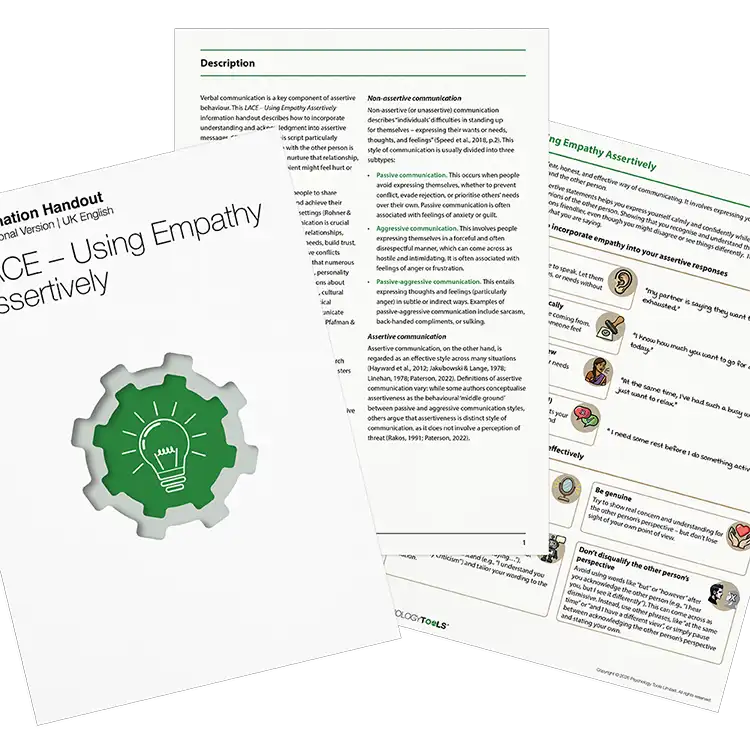
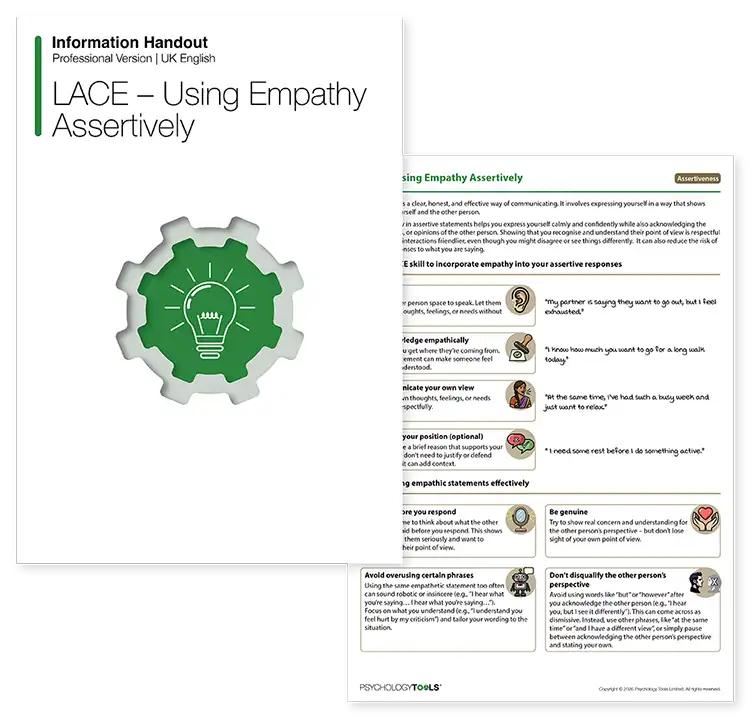
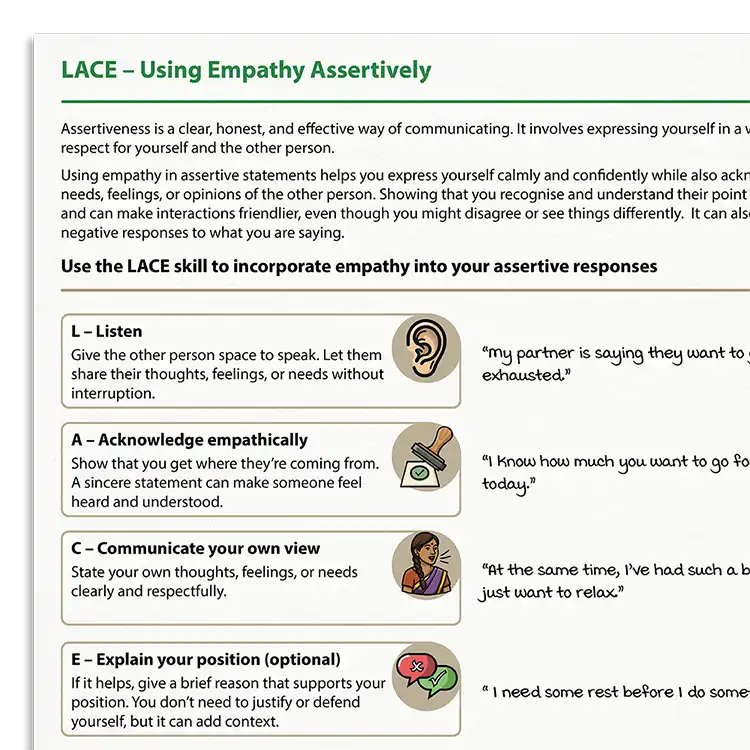
This information handout introduces 'LACE' – a structured approach that supports empathic assertive communication.

Download or send

Professional version

Offers theory, guidance, and prompts for mental health professionals. Downloads are in Fillable PDF format where appropriate.
Client version

Includes client-friendly guidance. Downloads are in Fillable PDF format where appropriate.

Overview

Combining assertive messages with additional ‘considerations’ or ‘elaborations’ (such as acknowledging the other person’s experience) can enhance how assertive communication is perceived. LACE is a framework that helps clients strike a balance between empathy for others and assertive self-expression ('empathic assertion'). It describes how to incorporate understanding and acknowledgment into assertive messages. Clients will find this script particularly helpful when the relationship with the other person is important, when they want to nurture that relationship, or if there is a risk that the recipient might feel hurt or offended.

Why use this resource?

Empathic assertive messages can be highly effective. LACE explains how to communicate in this way.

  • It provides a memorable communication model.
  • It explains how to use empathic assertion.
  • It includes scripted examples.
  • It includes tips for using empathic assertion most effectively.

Key benefits

Structured

Provides a four-step process that is simple to remember.

Practical

Includes tips and concrete examples and guided rehearsal opportunities.

Accessible

Easy to understand and apply.

Versatile

Suitable for a wide range of clients.

What difficulties is this for?

Generalized Anxiety Disorder (GAD)

For anxious clients who struggle to express themselves.

Social Anxiety Disorder (SAD)

To encourage confident, respectful social interactions.

Depression

Supports clients whose communication is hindered by guilt, hopelessness, or low self-worth.

Relationship Issues

For clients experiencing interpersonal difficulties that are impacted by communication problems.

Low Self-Esteem

Encourages development of self-respect and clear expression of needs.

Workplace Difficulties

Supports effective communication with colleagues.

Integrating it into your practice

01

Introduce

Present the LACE model during sessions focused on interpersonal skills or assertiveness.

02

Explore

Use examples to discuss where clients might apply the model in their relationships.

03

Rehearse

Role-play conversations using the LACE steps.

04

Assign

Encourage clients to use the model during real-world interactions.

05

Reflect

Review outcomes and refine communication strategies in follow-up sessions.

Theoretical background and therapist guidance

Effective communication allows people to share information, coordinate actions, and achieve their goals in personal and professional settings (Rohner & Schutz, 2024). Importantly, communication is crucial for forming and maintaining healthy relationships, enabling individuals to express their needs, build trust, address misunderstandings, and resolve conflicts (McKay et al., 2018).

Assertiveness is regarded as an effective style of communication many situations (Hayward et al., 2012; Jakubowski & Lange, 1978; Linehan, 1978; Paterson, 2022). Definitions of assertive communication vary: while some authors conceptualise assertiveness as the behavioural ‘middle ground’ between passive and aggressive communication styles, others argue that assertiveness is distinct style of communication, as it does not involve a perception of threat (Rakos, 1991; Paterson, 2022).

Several writers agree that simply asserting one’s views or rights can be inadequate in many situations (Jakubowski & Lange, 1978; Rakos, 1991). Accordingly, it is sometimes recommended that assertive messages are combined with additional ‘considerations’ or ‘elaborations’, such as acknowledging the other person’s experience. This approach shows respect for the rights and views of other people, helps maintain positive relationships, and enhances how assertive communication is perceived (e.g., Holland & Ward, 1990; Woolfolk & Dever, 1979).

Assertive messages that include explanations, acknowledgements, and understanding are referred to as empathic assertion (Jakubowski & Lange, 1978). Research indicates that empathic elaborations, such as recognizing the feelings of the other person and providing reasons for an assertive message, are viewed as socially skilled and effective. Additionally, they can help minimize negative reactions (e.g., Rakos, 1991; Romano & Bellack, 1980; Twentyman et al., 1981).

What's inside

  • A comprehensive introduction to assertiveness for therapists.
  • Explanation of the LACE framework.
  • Sample dialogue illustrating the model in action.
  • Therapist notes to support in-session use and practice.
Get access to this resource

FAQs

Listen, Acknowledge, Communicate, and Explain – a structured model for assertive empathy.
LACE makes use of empathic statements, which can make assertive communication more effective.
Combine the script with in-session modeling, role-plays, and constructive feedback before using in real-world situations.

How this resource helps improve clinical outcomes

  • Builds communication skills.
  • Maximizes the effectiveness of assertive communication.
  • Helps increase self-confidence.

References and further reading

  • Alberti, R. E., & Emmons, M. L. (2017). Your perfect right: Assertiveness and equality in your life and relationships (10th ed.). Impact Publishers.
  • Hayward, M., Strauss, C., & Kingdon, D. (2012). Overcoming distress voices: A self-help guide using cognitive behavioral techniques. Robinson.
  • Jakubowski, P., & Lange, A. J. (1978). The assertive option: Your rights and responsibilities. Research Press Company.
  • Rakos, R. F. (1991). Assertive behavior: Theory, research, and training. Routledge.
  • Speed, B. C., Goldstein, B. L., & Goldfried, M. R. (2018). Assertiveness training: A forgotten evidence-based treatment. Clinical Psychology: Science and Practice, 25, e12216. https://doi.org/10.1111/cpsp.12216