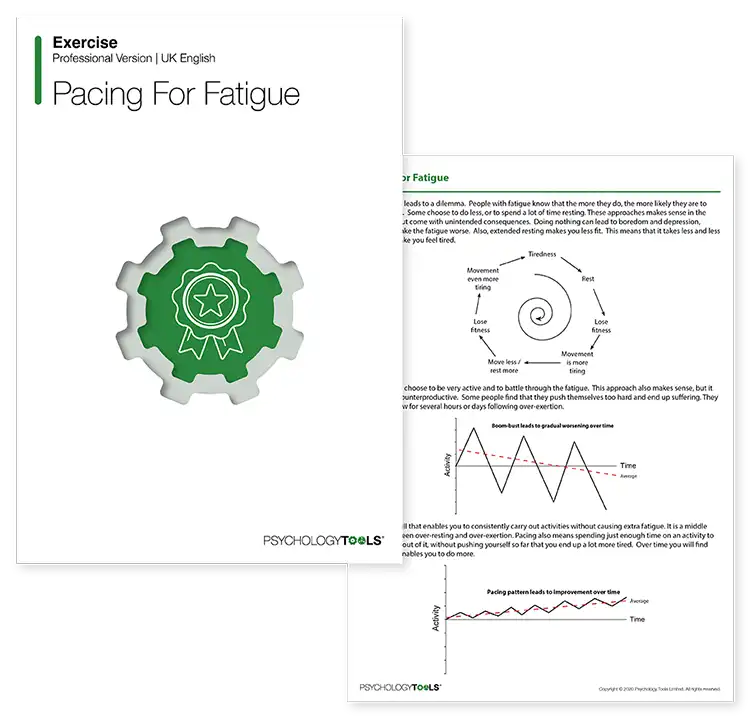
Pacing For Fatigue

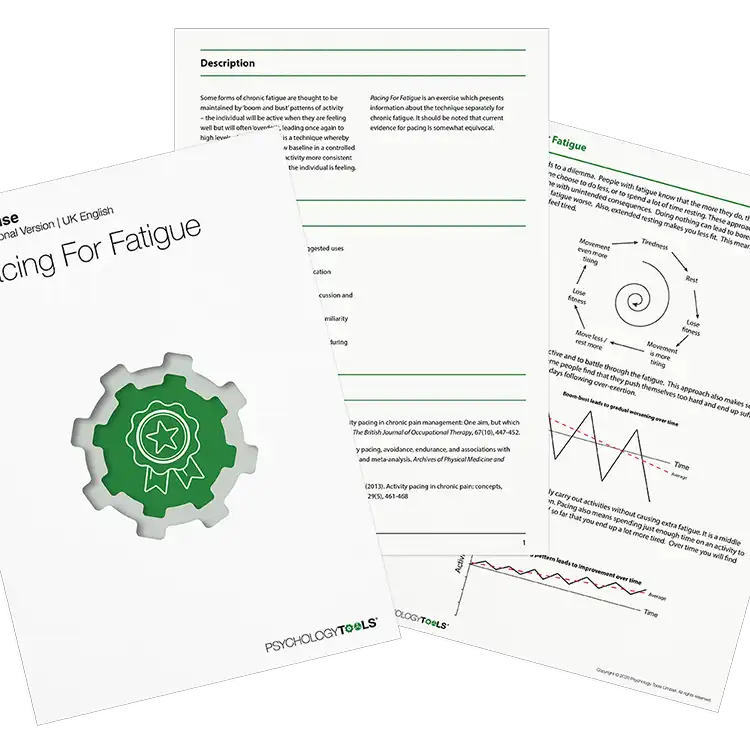
This structured worksheet introduces a pacing technique designed to help clients manage chronic fatigue through consistency and reduced overexertion.

Download or send

Professional version

Offers theory, guidance, and prompts for mental health professionals. Downloads are in Fillable PDF format where appropriate.
Client version

Includes client-friendly guidance. Downloads are in Fillable PDF format where appropriate.

Overview

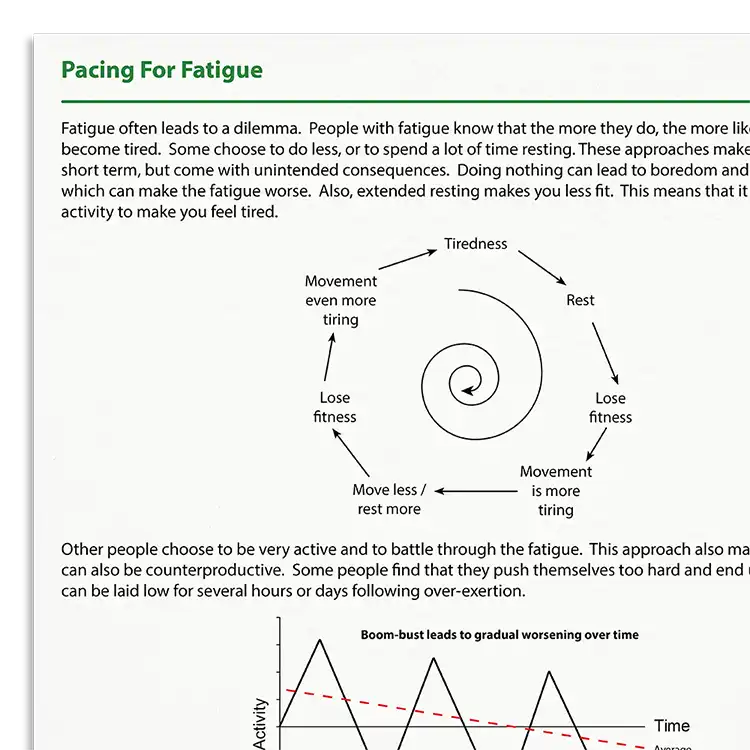
Many individuals with chronic fatigue fall into 'boom and bust' cycles — doing too much on good days and requiring excessive rest on bad days. This pattern can contribute to reduced activity tolerance and, in some cases, physical deconditioning. The Pacing For Fatigue resource introduces a middle-ground strategy to help clients regulate activity levels consistently, while taking symptom fluctuations into account.

This resource includes guidance for establishing a baseline of activity, practical pacing instructions, and common pitfalls to avoid. It is ideal for psychoeducation, therapist learning, or as a training tool in fatigue-related interventions.

Why use this resource?

Pacing is a widely used behavioral technique within chronic pain and fatigue management.

  • Teaches a balanced strategy between overexertion and excessive rest.
  • Promotes sustainable activity patterns.
  • Provides clear, step-by-step pacing instructions.
  • Addresses common barriers and misconceptions about fatigue management.

Key benefits

Structure

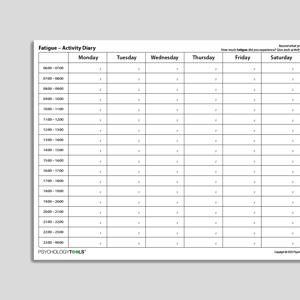
Offers a clear baseline-setting method and tracking guidance.

Insight

Helps clients understand the relationship between overexertion and worsening fatigue.

Motivation

Empowers clients with a sense of control over energy levels.

Integration

Complements broader cognitive-behavioral approaches to fatigue.

What difficulties is this for?

Chronic Fatigue

Clients experiencing activity-related fatigue.

Chronic Pain

When pacing is used to help reduce activity-triggered pain flares and support function.

Depression

When fatigue and low motivation reduce activity levels.

Integrating it into your practice

01

Introduce

Explain the pacing rationale – trying not to overdo it on good days and crash on bad ones.

02

Identify

Choose a specific activity to pace (e.g., walking, sitting, housework).

03

Measure

Track the length of time the activity can be sustained on several occasions.

04

Calculate

Establish a baseline by averaging these times and subtracting one-fifth.

05

Practice

Encourage consistent activity at the baseline level on both good and bad days.

06

Breaks

Teach how to take restorative breaks and identify what helps them feel refreshed.

07

Adjust

Increase activity slowly over time once tolerance builds.

Theoretical background and therapist guidance

Pacing is rooted in operant and graded activity models used in chronic pain and fatigue management. It encourages clients to adopt a consistent pattern of activity based primarily on time rather than moment-to-moment symptom fluctuations. The goal is to reduce avoidance patterns and activity fluctuations that can contribute to loss of tolerance over time.

The technique opposes two extremes: complete rest and “pushing through.” Instead, it teaches measured, consistent activity based on time — not driven solely by perceived energy or pain. Over time, this can improve function and activity tolerance, and may reduce the disruptiveness of symptoms.

Therapists may find it helpful to work with clients on cognitive barriers to pacing (e.g., guilt about resting, perfectionism), and to frame pacing as a skill that builds long-term resilience.

What's inside

  • A handout explaining pacing.
  • Instructions for establishing a personalized activity baseline.
  • Example pacing calculations and practical guidance.
  • Advice for common difficulties (e.g., overdoing it on good days).
  • Psychoeducational and clinical implementation tips.
Get access to this resource

FAQs

Pacing is designed to reduce activity-triggered pain flare-ups.
Clients should maintain baseline levels until activity becomes easier, then increase incrementally – usually by small amounts depending on tolerance.
Use the handout’s explanation to reinforce the risks of overexertion and support consistent routine through time-based goals.
Yes. Pacing complements CBT for fatigue, pain, and mood-related conditions.

How this resource helps improve clinical outcomes

  • Helps reduce the likelihood of overexertion.
  • Supports gradual return to functional activities.
  • Can help reduce distress associated with unpredictable activity patterns.
  • Builds behavioral consistency and a sense of control.
  • Enhances engagement in therapy through self-efficacy and skill-building.

References and further reading

  • Andrews, N. E., Strong, J., & Meredith, P. J. (2012). Activity pacing, avoidance, endurance, and associations with patient functioning in chronic pain: a systematic review and meta-analysis. Archives of Physical Medicine and Rehabilitation, 93(11), 2109-2121.  
  • Birkholtz, M., Aylwin, L., & Harman, R. M. (2004). Activity pacing in chronic pain management: One aim, but which method? Part one: Introduction and literature review. The British Journal of Occupational Therapy, 67(10), 447–452.  
  • Nielson, W. R., Jensen, M. P., Karsdorp, P. A., & Vlaeyen, J. W. (2013). Activity pacing in chronic pain: concepts, evidence, and future directions. The Clinical Journal of Pain, 29(5), 461–468.