Pacing For Pain

This practical worksheet introduces pacing as a behavioral strategy to help clients with chronic pain engage in consistent, manageable activity.

Download or send

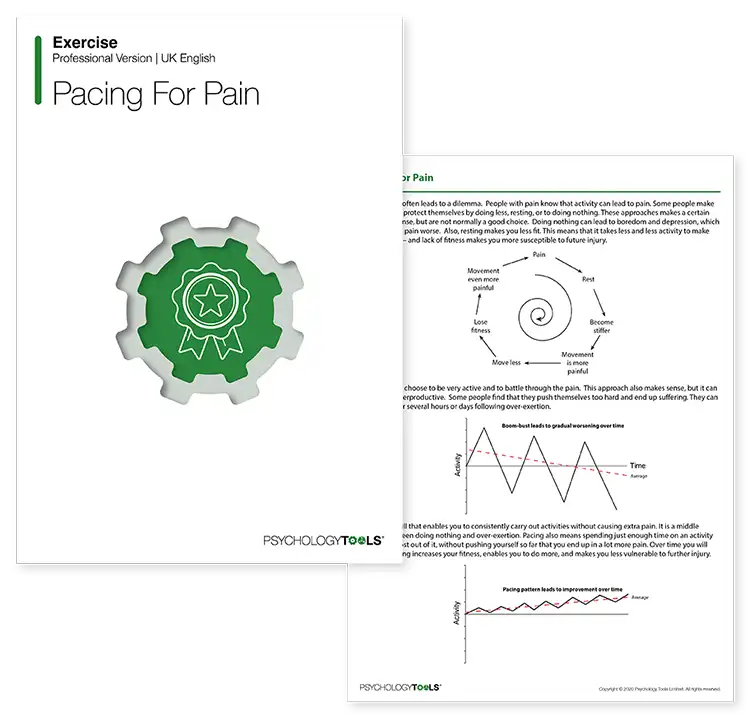
Professional version

Offers theory, guidance, and prompts for mental health professionals. Downloads are in Fillable PDF format where appropriate.
Client version

Includes client-friendly guidance. Downloads are in Fillable PDF format where appropriate.

Overview

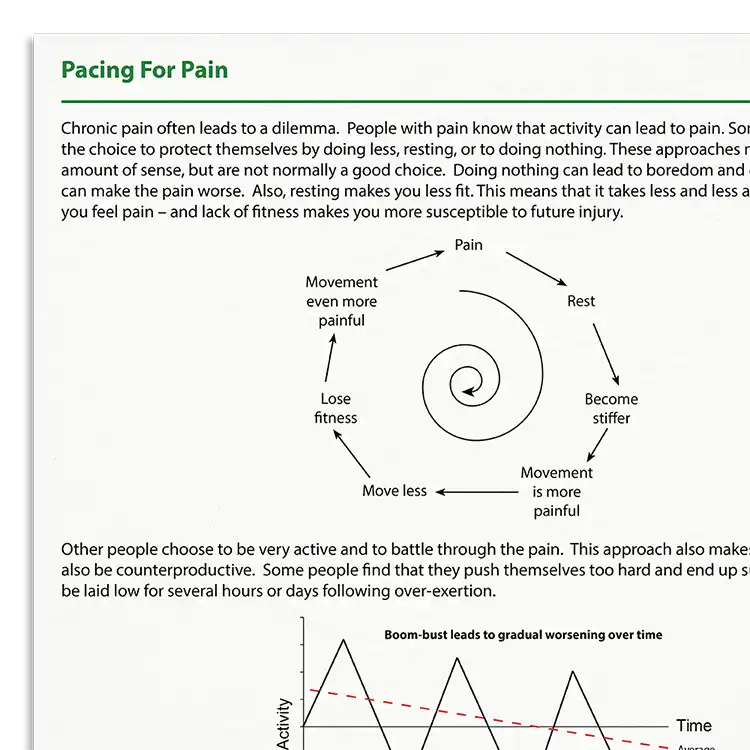
Clients with chronic pain often fall into a 'boom and bust' cycle – doing too much when they feel well and suffering increased pain afterward. This pattern can result in reduced physical fitness, low mood, and greater vulnerability to further injury. Pacing offers a structured alternative: engaging in regular activity based primarily on time rather than being driven solely by symptoms.

This resource supports clients in learning how to find their baseline activity level and gradually increase it. It presents psychoeducational material, baseline calculation, and guidance for overcoming common difficulties.

Why use this resource?

Pacing helps clients manage chronic pain more effectively by promoting behavioral consistency and improving function.

  • Helps reduce the boom–bust cycle that can contribute to increased pain and disability over time.
  • Encourages movement while reducing the likelihood of overexertion.
  • Helps build fitness and confidence in activity engagement.
  • Aligns with behavioral principles used in CBT and pain management.

Key benefits

Structure

Offers step-by-step instructions for calculating baseline activity levels.

Clarity

Explains the risks of both inactivity and overexertion in pain management.

Empowerment

Gives clients a sense of control over pain and activity.

Integration

Complements broader interventions such as CBT for chronic pain or fatigue.

What difficulties is this for?

Chronic Pain

Clients experiencing persistent pain and activity avoidance.

Pain-Related Disability

Helping reintroduce activity in a paced and manageable way.

Integrating it into your practice

01

Explain

Introduce pacing as a technique to improve function and reduce pain flare-ups.

02

Choose

Identify a specific activity (e.g. walking, standing, housework) the client wants to pace.

03

Track

Ask the client to time themselves doing the activity over several days, including both good and bad days.

04

Calculate

Average the times and subtract around one-fifth as a cautious starting baseline.

05

Practice

Encourage consistent engagement at the baseline level, even when pain fluctuates.

06

Support

Use reminders (e.g. timers or alarms) to encourage adherence to breaks and stopping at the right time.

07

Adjust

Monitor progress and increase activity as the client’s tolerance improves.

Theoretical background and therapist guidance

The pacing technique is grounded in behavioral models of chronic pain, which identify cycles of overactivity followed by withdrawal. Clients often avoid activity due to fear of pain, or push themselves excessively when they feel well — both of which can contribute to increased pain and disability over time.

Pacing teaches clients to base activity primarily on time rather than being driven solely by pain. This consistent approach can help reduce pain-related fear, build physical tolerance, and improve overall functioning. It sits comfortably within cognitive-behavioural frameworks and is particularly useful for clients who struggle with cognitive distortions around “pushing through.”

Therapists should anticipate and address barriers such as perfectionism, fear of appearing ‘lazy,’ and guilt over taking breaks.

What's inside

  • Psychoeducation on pacing and the consequences of the boom-bust cycle.
  • A clear example of how to calculate a baseline.
  • Common client difficulties and therapist guidance.
  • Behavioral strategies to support routine and gradual activity increase.
  • Professional handout suitable for in-session use or as between-session homework.
Get access to this resource

FAQs

Pacing is a method of performing activities at a consistent and manageable level based on time, rather than symptoms. It aims to reduce the overactivity–underactivity cycle.
Reframe breaks as a strategy to increase long-term functioning — not weakness or laziness. Encourage clients to reappraise their beliefs.
While both encourage consistent behavior, pacing is specifically tailored to physical activity in the context of pain.
Yes. Pacing is widely used by physiotherapists, occupational therapists, and psychologists as part of integrated care.

How this resource helps improve clinical outcomes

  • Increase client adherence to pain management plans.
  • Help reduce fear-avoidance behaviours and anxiety related to activity.
  • Enhance clients' sense of control and self-efficacy.
  • Encourage engagement in life-enhancing activities.

References and further reading

  • Andrews, N. E., Strong, J., & Meredith, P. J. (2012). Activity pacing, avoidance, endurance, and associations with patient functioning in chronic pain: a systematic review and meta-analysis. Archives of Physical Medicine and Rehabilitation, 93(11), 2109–2121.
  • Birkholtz, M., Aylwin, L., & Harman, R. M. (2004). Activity pacing in chronic pain management: One aim, but which method? Part one: Introduction and literature review. The British Journal of Occupational Therapy, 67(10), 447–452.
  • Nielson, W. R., Jensen, M. P., Karsdorp, P. A., & Vlaeyen, J. W. (2013). Activity pacing in chronic pain: concepts, evidence, and future directions. The Clinical Journal of Pain, 29(5), 461–468.