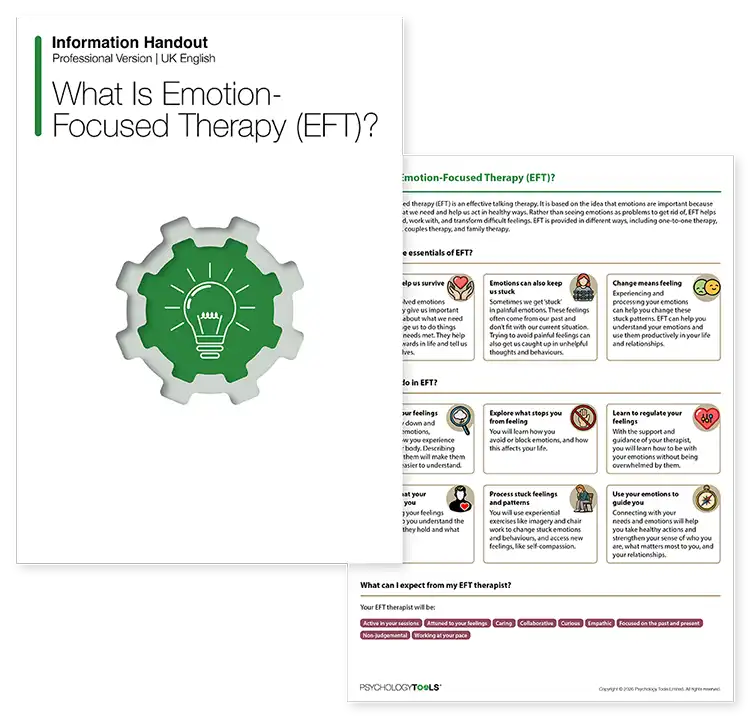
What Is Emotion-Focused Therapy (EFT)?

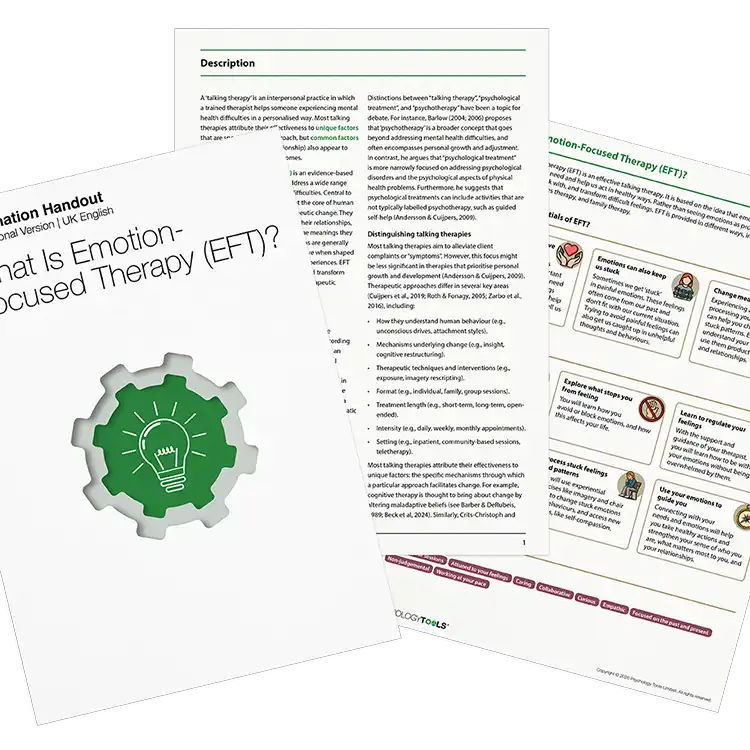
This accessible information handout describes the key principles of emotion-focused therapy (EFT).

Download or send

Professional version

Offers theory, guidance, and prompts for mental health professionals. Downloads are in Fillable PDF format where appropriate.
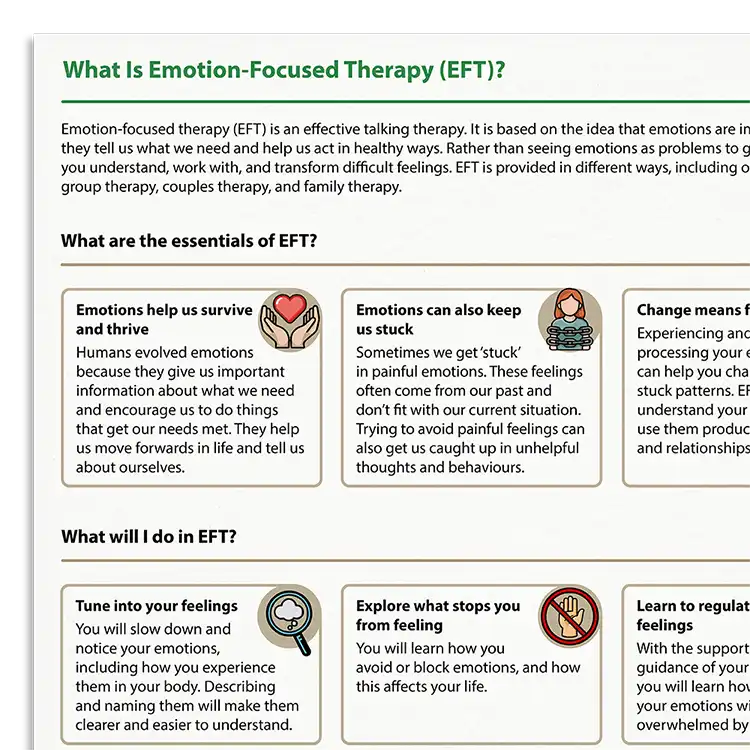
Client version

Includes client-friendly guidance. Downloads are in Fillable PDF format where appropriate.

Overview

Emotion-focused therapy (EFT) is an evidence-based therapy that emphasizes the role of emotion in psychological change. Developed by Leslie Greenberg and colleagues, EFT provides therapists with structured interventions to help clients access, regulate, and transform maladaptive emotions. This What Is Emotion-Focused Therapy (EFT)? information handout is designed to introduce clients to EFT.

Why use this resource?

This handout provides an accessible yet comprehensive explanation of EFT. Therapists can use it to:

  • Introduce clients to the key ideas in EFT.
  • Support treatment selection, informed consent, and goal-setting at the start of therapy.
  • Reinforce clients’ understanding of EFT principles throughout treatment.
  • Communicate the rationale for core therapeutic tasks.

Key benefits

Clear

Presents key EFT principles using client-friendly language and illustrations.

Informative

Explains what EFT is likely to involve.

Versatile

Suitable for a wide range of clients.

Engaging

Encourages collaboration and increased motivation for treatment.

Integrating it into your practice

01

Introduce

Start a conversation about the potential benefits of EFT.

02

Explore

Use the information handout to explore the key ideas in EFT.

03

Reflect

Help clients reflect on how EFT might be helpful to them.

04

Reinforce

Use the handout to consolidate client learning between sessions.

Theoretical background and therapist guidance

Emotion-focused therapy (EFT) is an evidence-based talking therapy that is used to address a wide range of emotional and psychological difficulties. It began development in the 1970s, integrating person-centered therapy (Rogers, 1951), experiential focusing (Gendlin, 1969), gestalt therapy (Perls, 1969), and contemporary emotion theory. Leslie Greenberg and Laura Rice pioneered this early work, using process research to study how clients change in therapy and develop active therapeutic tasks (Greenberg & Rice, 1981). While many approaches treated emotions as disruptive or secondary to cognition, EFT identified them as the primary organizers of experience and meaning. The development of EFT is most closely associated with Greenberg’s work, alongside Robert Elliott, Jeanne Watson, and Rhonda Goldman (Elliott et al., 2004).

Central to EFT is the idea that emotions are at the core of human experience and the route to therapeutic change. Emotions guide our sense of self, shape our relationships, motivate behaviour, and influence the meanings we attach to experiences. While emotions are generally adaptive, they can become maladaptive when shaped by past unmet needs or unresolved experiences. EFT aims to help clients access, regulate, and transform these emotions within a supportive therapeutic relationship.

What's inside

  • A clear and accessible information handout explaining EFT.
  • A comprehensive introduction to EFT written for therapists.
  • Guidance for using the resource with clients.
  • Key references and recommended further reading.
Get access to this resource

FAQs

EFT focuses on helping clients process and transform their emotional responses rather than changing thoughts or behaviors directly.
Yes. EFT helps clients access and transform painful emotional experiences related to trauma.
EFT is an evidence-based treatment for a range of conditions, but it may not be suitable for all individuals. Therapists are encouraged to review best practice guidelines if they are considering offering EFT for the treatment of a specific disorder or condition.

How this resource helps improve clinical outcomes

Using this resource can help clients:

  • Learn about EFT and what to expect from it.
  • Answer the questions they might have about this therapy.
  • Make an informed decision about taking up EFT.
  • Feel confident and motivated about starting EFT.

References and further reading

  • Elliott, R., Watson, J., Goldman, R. N., & Greenberg, L. S. (2004). Learning Emotion-Focused Therapy: The process-experiential approach to change. American Psychological Association.
  • Greenberg, L. S. (2015). Emotion-focused therapy: Coaching clients to work through their feelings (2nd ed.). American Psychological Association.
  • Pascual-Leone, A., & Greenberg, L. S. (2007). Emotional processing in experiential therapy: Why "the only way out is through". Journal of Consulting and Clinical Psychology, 75(6), 875–887.
  • Timulak, L., & Keogh, D. (2017). The client’s perspective on (experiential) emotion-focused therapy: A meta-synthesis. Psychotherapy Research, 27(2), 160–177.