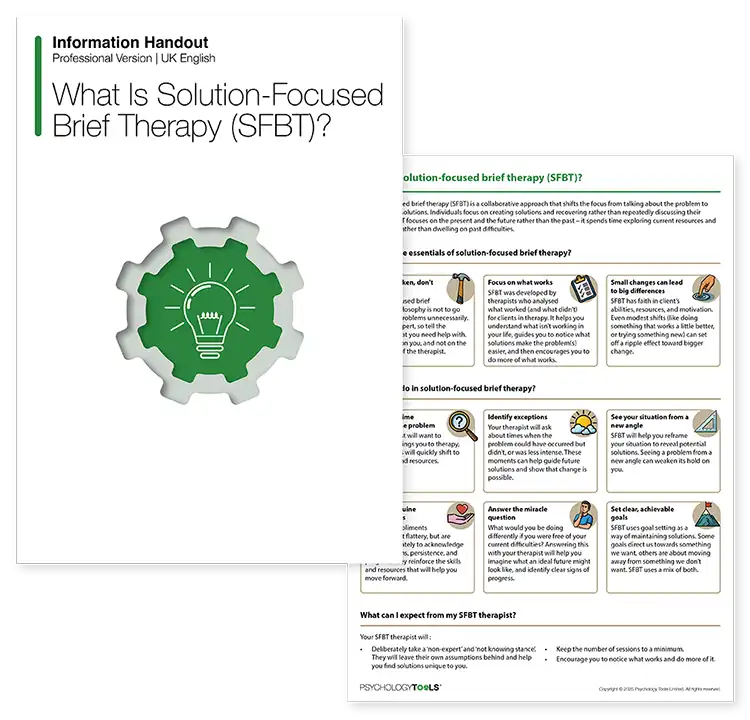
What Is Solution-Focused Brief Therapy (SFBT)?

This accessible information handout describes the key principles of solution-focused brief therapy (SFBT).

Download or send

Professional version

Offers theory, guidance, and prompts for mental health professionals. Downloads are in Fillable PDF format where appropriate.
Client version

Includes client-friendly guidance. Downloads are in Fillable PDF format where appropriate.

Overview

Solution-focused brief therapy (SFBT) is an evidence based talking therapy used to address a wide range of difficulties. Central to SFBT is the premise that meaningful change emerges by focusing on solutions rather than analyzing problems. The approach helps clients articulate a preferred future, notice exceptions to their difficulties, and leverage their strengths and resources to overcome these issues. This What Is Solution-Focused Brief Therapy (SFBT)? information handout is designed to introduce clients to SFBT.

Why use this resource?

This handout provides an accessible yet comprehensive explanation of SFBT. Therapists can use it to:

  • Introduce clients to the key ideas in SFBT.
  • Support treatment selection, informed consent, and goal-setting at the start of therapy.
  • Reinforce clients’ understanding of SFBT principles throughout treatment.
  • Communicate the rationale for core therapeutic tasks.

Key benefits

Clear

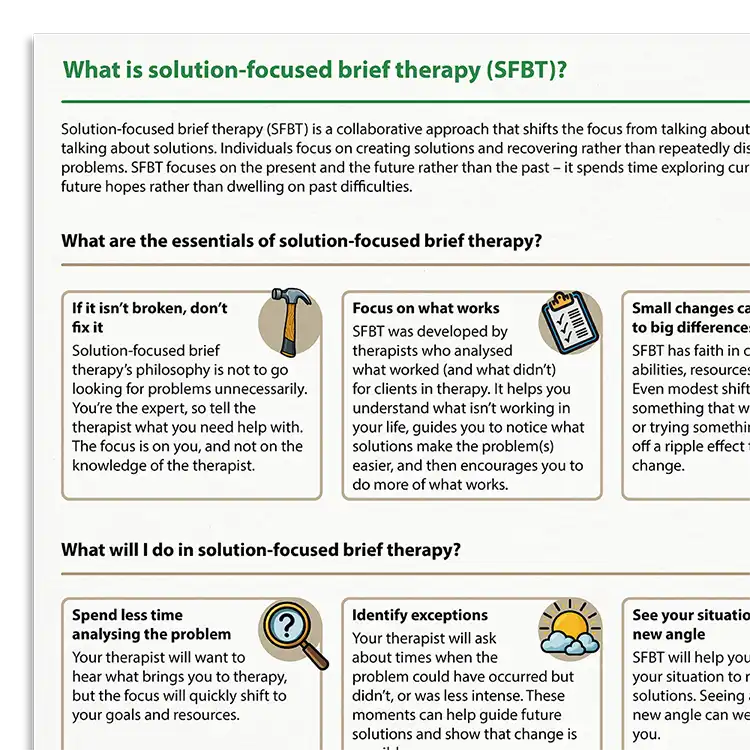
Presents key SFBT principles using client-friendly language and illustrations.

Informative

Explains what SFBT is likely to involve.

Versatile

Suitable for a wide range of clients.

Engaging

Encourages collaboration and increased motivation for treatment.

Integrating it into your practice

01

Introduce

Start a conversation about the potential benefits of SFBT.

02

Explore

Use the information handout to explore the key ideas in SFBT.

03

Reflect

Help clients reflect on how SFBT might be helpful to them.

04

Reinforce

Use the handout to consolidate client learning between sessions.

Theoretical background and therapist guidance

SFBT is an evidence based psychological therapy that has been shown to be effective for various psychosocial problems (Vermeulen-Oskam et al., 2024). It was developed in the 1980s by Steve de Shazer and Insoo Kim Berg at the Brief Family Therapy Center in Milwaukee through intensive observation of what helped clients in session (de Shazer, 1985). The model was built inductively rather than from a theory and was designed to keep sessions to a minimum, thus fitting the “brief” ethos. Its evolution was influenced by other brief therapy traditions and social constructionist ideas, namely that change is co-constructed in language (hence SFBT’s careful attention to clients’ words and meanings; de Shazer, 1985).

In SFBT, time is not spent analyzing problems, causes, or histories. Rather, the focus is on solutions: present- and future-oriented conversations about what the client wants and what is already working. The goal is for clients to do more of what helps and to try something different when current strategies are not working (Berg & Miller, 1992; de Shazer, 1985). In addition, progress is judged by clients’ descriptions of “what will be different” when their difficulties improve, rather than by symptom counts or causal explanations.

What's inside

  • A clear and accessible information handout explaining SFBT.
  • A comprehensive introduction to SFBT written for therapists.
  • Guidance for using the resource with clients.
  • Key references and recommended further reading.
Get access to this resource

FAQs

SFBT focuses less on analyzing problems or restructuring thoughts, and more on identifying and strengthening what works for the client. It is present- and future-focused and does not require exploration of early life experiences.
SFBT is often a short-term therapy, but the number depends on client needs and context.
SFBT is an evidence-based treatment for a range of conditions, but it may not be suitable for all individuals. Therapists are encouraged to review best practice guidelines if they are considering offering SFBT for the treatment of a specific disorder or condition.

How this resource helps improve clinical outcomes

Using this resource can help clients:

  • Learn about SFBT and what to expect from it.
  • Answer the questions they might have about this therapy.
  • Make an informed decision about taking up SFBT.
  • Feel confident and motivated about starting SFBT.

References and further reading

  • Ajmal, Y. & Ratner, H., (2019), Solution focused practice in schools. Routledge.
  • Andersson, G., & Cuijpers, P. (2009). ‘Psychological treatment’ as an umbrella term for evidence-based psychotherapies? Nordic Psychology, 6, 4–15. DOI: 10.1027/1901-2276.61.2.4.
  • Barber, J. P., & DeRubeis, R. J. (1989). On second thought: Where the action is in cognitive therapy for depression. Cognitive Therapy and Research, 13, 441-457. DOI: 10.1007/BF01173905.
  • Barlow, D. H. (2004). Psychological treatments. American Psychologist, 59, 869–878.
  • Barlow, D. H. (2006). Psychotherapy and psychological treatments: The future. Clinical Psychology: Science and Practice, 13, 216-220.
  • Beck, A. T., Rush, A. J., Shaw, B. F., Emery, G., DeRubeis, R. J., & Hollon, S. D. (2024). Cognitive therapy of depression. Guilford Publications.
  • Berquez, A,, & Jeffery, M. (2024), Solution focused brief therapy with children and young people who stammer and their parents: A practical guide from the Michael Palin Centre. Routledge.
  • Crits-Christoph, P., Gibbons, M. B. C., Temes, C. M., Elkin, I., & Gallop, R. (2010). Interpersonal accuracy of interventions and the outcome of cognitive and interpersonal therapies for depression. Journal of Consulting and Clinical Psychology, 78, 420-428. DOI: 10.1037/a0019549.
  • Cuijpers, P., Reijnders, M., & Huibers, M. J. (2019). The role of common factors in psychotherapy outcomes. Annual Review of Clinical Psychology, 15, 207-231. DOI: 10.1146/annurev-clinpsy-050718-095424.
  • De Jong, P., & Berg, I.K. (2002), Interviewing for solutions. Brooks/Cole Thomson Learning.
  • De Shazer, S. (1985). Keys to solutions in brief therapy. Norton.
  • Franklin, C., Bolton, K. W., & Guz, S. (2019). Solution-focused brief family therapy. In B. H. Fiese, M. Celano, K. Deater-Deckard, E. N. Jouriles, & M. A. Whisman (Eds.), APA handbook of contemporary family psychology: Family therapy and training (pp. 139-153). American Psychological Association.
  • Henden, J. (2017). Preventing suicide: The solution focused approach. John Wiley and Sons.
  • Iveson, C. (2003). Solution- focused couples therapy. In B. O’Connell & S. Palmer (Eds.), Handbook of solution- focused therapy (pp. 61–73). Sage.
  • Kim Berg, I., & Reuss, N. H. (1998). Solutions: Step by step. A Substance Abuse Treatment Manual. W. W. Norton and Co.
  • Lambert, M. J. & Ogles, B. M. (2004). The efficacy and effectiveness of psychotherapy. In M. J. Lambert (Ed.), Bergin and Garfield’s handbook of psychotherapy and behavior change (pp. 139–93). Wiley.
  • Leichsenring, F., Salzer, S., Beutel, M. E., Herpertz, S., Hiller, W., Hoyer, J., ... & Leibing, E. (2013). Psychodynamic therapy and cognitive-behavioral therapy in social anxiety disorder: A multicenter randomized controlled trial. American Journal of Psychiatry, 170, 759-767. DOI: 10.1176/appi.ajp.2013.12081125.
  • O’Connell, B., Palmer, S., & Williams, H. (2012). Solution focused coaching in practice. Routledge.
  • Poulsen, S., Lunn, S., Daniel, S. I., Folke, S., Mathiesen, B. B., Katznelson, H., & Fairburn, C. G. (2014). A randomized controlled trial of psychoanalytic psychotherapy or cognitive-behavioral therapy for bulimia nervosa. American Journal of Psychiatry, 171, 109-116. DOI: 10.1176/appi.ajp.2013.12121511.
  • Proudlock, S. (2011). The solution focused way: Incorporating solution focused therapy tools and techniques into your everyday work. Speechmark.
  • Proudlock, S., & Wellman, N. (2011). Solution focused groups: The results look promising. Counselling Psychology Review, 26, 45-54.
  • Roth, A., & Fonagy, P. (2005). What works for whom? A critical review of psychotherapy research (2nd ed.). Guilford Press.
  • Strupp, H. H. (1978). Psychotherapy research and practice – an overview. In A. E. Bergin & S. L. Garfield (Eds.), Handbook of psychotherapy and behavior change (2nd ed.) Wiley. pp.3-22
  • Tschacher, W., Junghan, U. M., & Pfammatter, M. (2014). Towards a taxonomy of common factors in psychotherapy - results of an expert survey. Clinical Psychology and Psychotherapy, 21, 82-96. DOI: 10.1002/cpp.1822.
  • Vermeulen-Oskam, E., Franklin, C., van’t Hof, L. P. M., Stams, G. J. J. M., van Vugt, E. S., Assink, M., ... & Zhang, A. (2024). The current evidence of solution-focused brief therapy: A meta-analysis of psychosocial outcomes and moderating factors. Clinical Psychology Review, 114, 102512. DOI: 0.1016/j.cpr.2024.102512.
  • Wampold, B. E., & Imel, Z. E. (2015). The great psychotherapy debate (2nd ed.). Routledge.
  • Wampold, B. E., Mondin, G. W., Moody, M., Stich, F., Benson, K., & Ahn, H. (1997). A metaanalysis of outcome studies comparing bona fide psychotherapies: Empirically, ‘all must have prizes.’ Psychological Bulletin, 122, 203-215. DOI: 10.1037/0033-2909.122.3.203.
  • Wolitzky-Taylor, K. B., Horowitz, J. D., Powers, M. B., & Telch, M. J. (2008). Psychological approaches in the treatment of specific phobias: A meta-analysis. Clinical Psychology Review, 28, 1021-1037. DOI: 10.1016/j.cpr.2008.02.007.
  • Żak, A. M., & Pękala, K. (2024). Effectiveness of solution-focused brief therapy: An umbrella review of systematic reviews and meta-analyses. Psychotherapy Research, 35, 1043–1055. DOI: 10.1080/10503307.2024.2406540.
  • Zarbo, C., Tasca, G. A., Cattaf, F., & Compare, A. (2016). Integrative psychotherapy works. Frontiers in Psychology, 6, 2021. DOI: 10.3389/fpsyg.2015.02021.