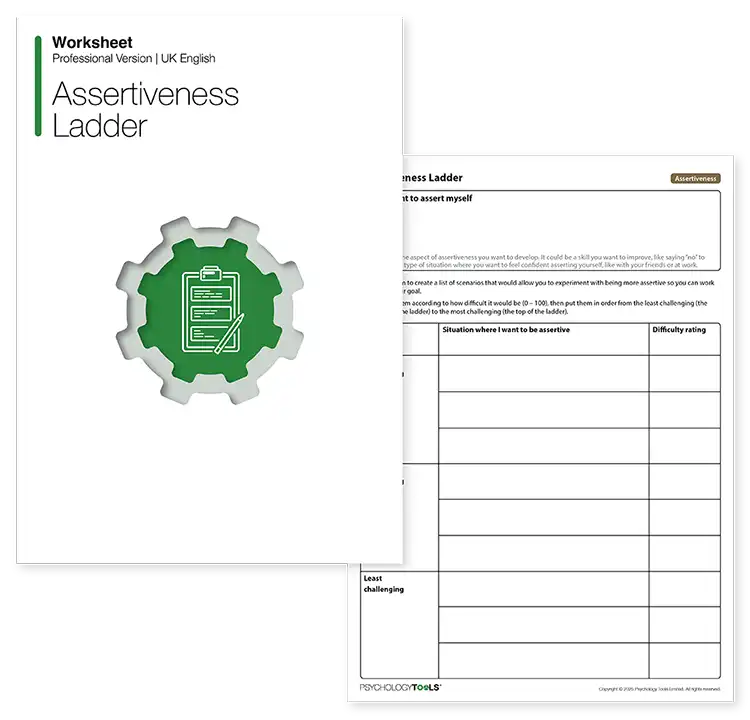
Assertiveness Ladder

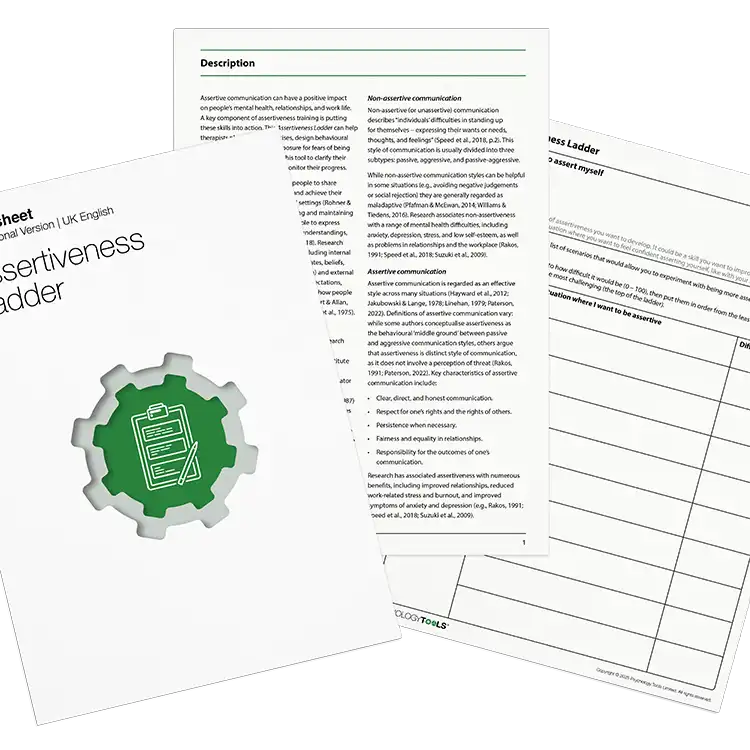
The Assertiveness Ladder helps clients develop their assertive communication skills by practicing them in progressively challenging situations.

Download or send

Professional version

Offers theory, guidance, and prompts for mental health professionals. Downloads are in Fillable PDF format where appropriate.
Client version

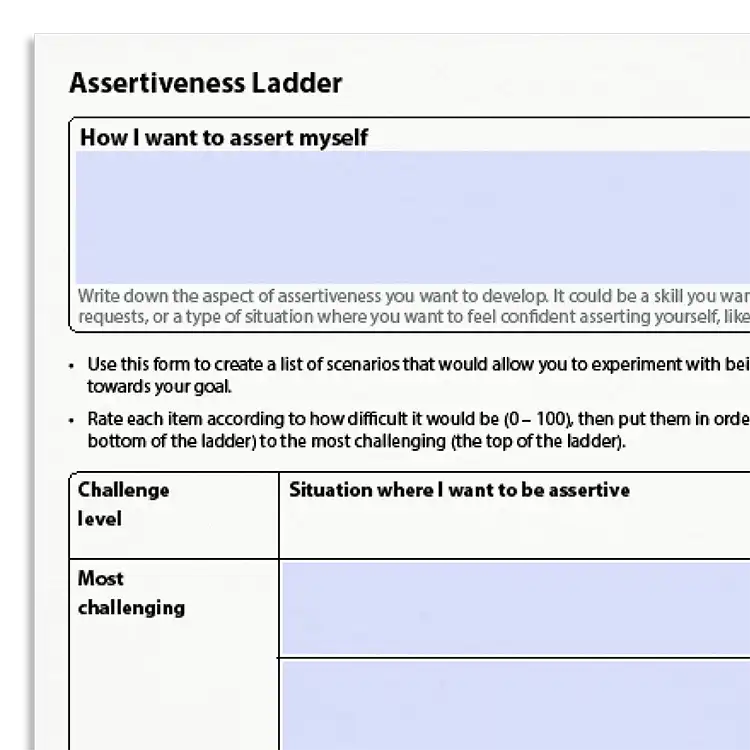
Includes client-friendly guidance. Downloads are in Fillable PDF format where appropriate.

Overview

Assertive communication can have a positive impact on people’s mental health, relationships, and work life. A key component of assertiveness training is putting these skills into action. This Assertiveness Ladder can help therapists plan practice exercises, design behavioral experiments, and facilitate exposure for fears of being assertive. Clients can also use this tool to clarify their goals, identify relevant situations, and monitor their progress.

Why use this resource?

This resource provides a framework for developing assertiveness skills that helps clients:

  • Identify their assertiveness goals.
  • Organize their assertiveness skills.
  • Practice using a graded hierarchy.
  • Support exposure to feared situations.
  • Monitor their progress over time.

Key benefits

Structured

Guides the identification and ranking of situations.

Personalized

Tailors exercises to individual client needs and goals.

Flexible

Can be used to support exposure exercises, behavioral experiments, and skills development.

Insightful

Helps monitor progress over time.

What difficulties is this for?

Generalized anxiety disorder

For clients struggling to express themselves due to fear of negative evaluation.

Social anxiety disorder

To encourage confident, respectful interaction with others.

Depression

Supports clients whose communication is hindered by guilt, hopelessness, or low self-worth.

Borderline personality disorder

Complements DBT work on interpersonal effectiveness.

Relationship issues

For clients experiencing conflict, imbalance, or communication breakdowns in personal or professional settings.

Low self-esteem

Encourages development of self-respect and clear expression of needs.

Workplace stress or burnout

Supports effective communication with colleagues and reduces vulnerability to bullying.

Integrating it into your practice

01

Identify

Help the client specify an assertiveness goal.

02

Generate

Develop a list of real or simulated scenarios that would help the client reach their goal.

03

Rank

Order the list from least to most challenging.

04

Practice

Use the ladder to guide assertiveness skills practice.

05

Reflect

Discuss outcomes and update the ladder as confidence grows.

Theoretical background and therapist guidance

Effective communication is essential for sharing information, coordinating actions, and achieving personal and professional goals (Rohner & Schutz, 2024). It plays a key role in building healthy relationships, allowing individuals to express needs, build trust, and resolve conflicts (McKay et al., 2018).

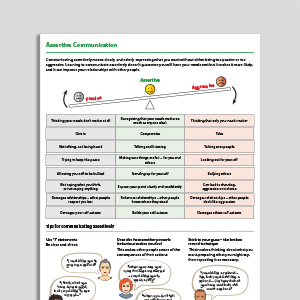
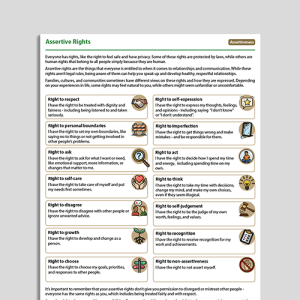
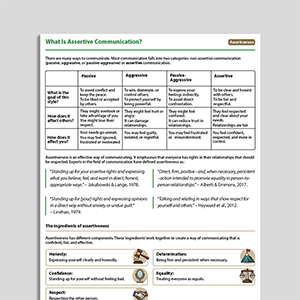
Assertiveness is regarded as an effective communication style across many situations (Hayward et al., 2012; Jakubowski & Lange, 1978; Linehan, 1979; Paterson, 2022).  Research has associated assertiveness with numerous benefits, including improved relationships, reduced work-related stress and burnout, and improved symptoms of anxiety and depression (e.g., Rakos, 1991; Speed et al., 2018; Suzuki et al., 2009).

Graded hierarchies or ‘ladders’ are used in many assertiveness training programmes (Rakos, 1991). A ladder is a personalised list of situations that are progressively more challenging. Creating a graded hierarchy involves generating a list of real or simulated scenarios where an assertive response would be suitable. Items are then ranked according to how challenging, anxiety-provoking, or anger-inducing they are (Gambrill, 2002; Rich & Schroeder, 1976).

Ladders can serve multiple purposes in assertiveness training, including identifying contexts where the client struggles to be assertive, guiding assertiveness skills practice, designing behavioural experiments, planning exposure exercises for fears of being assertive, and tracking clients’ progress over time.

What's inside

  • An easy-to-use ladder for clients who struggle to be assertive.
  • Background information on assertiveness and assertiveness training.
  • Step-by-step therapist guidance for building and using an assertiveness ladder.
  • Key references and recommended reading.
Get access to this resource

FAQs

It is a list of increasingly difficult scenarios where a client can practice assertive communication. It helps structure gradual exposure to challenging interpersonal situations.
It is most useful during the intervention phase of assertiveness training, particularly when clients are ready to practice these skills or test their fears of being assertive.
Yes. The ladder format helps clients face fears incrementally, building their confidence over time.

How this resource helps improve clinical outcomes

By encouraging structured practice of assertive communication, this resource supports:

  • Assertiveness skills development.
  • Reduction in avoidance of challenging interpersonal situations.
  • Individualized assertiveness training.
  • Progress monitoring over time.

References and further reading

  • Alden, L., & Cappe, R. (1981). Nonassertiveness: Skill deficit or selective self-evaluation? Behavior Therapy, 12, 107–114. https://doi.org/10.1016/S0005-7894(81)80111-6
  • Beck, A. T., Emery, G., & Greenberg, R. L. (1985). Anxiety disorders and phobias: A cognitive perspective. Basic Books.
  • Butler, G., Fennell, M., Robson, D., & Gelder, M. (1991). Comparison of behavior therapy and cognitive behavior therapy in the treatment of generalized anxiety disorder. Journal of Consulting and Clinical Psychology, 59(1), 167–175. https://doi.org/10.1037/0022-006X.59.1.167
  • Heimberg, R. G., & Becker, R. E. (2002). Cognitive-behavioral group therapy for social phobia: Basic mechanisms and clinical strategies. Guilford Press.
  • Linehan, M. M. (2014). DBT skills training manual (2nd ed.). Guilford Press.
  • McManus, F., Van Doorn, K., & Yiend, J. (2012). Examining the link between self-beliefs, emotion, and behavior in people with depression symptoms and low self-esteem. Behaviour Research and Therapy, 50(10), 634–640. https://doi.org/10.1016/j.brat.2012.06.006
  • Rakos, R. F. (1991). Assertive behavior: Theory, research, and training. Advances in Behaviour Research and Therapy, 13(2), 101–139. https://doi.org/10.1016/0146-6402(91)90004-6
  • Speed, B. C., Goldstein, B. L., & Goldfried, M. R. (2018). Assertiveness training: A forgotten evidence-based treatment. Clinical Psychology: Science and Practice, 25(1), e12216. https://doi.org/10.1111/cpsp.12216
  • Williams, M. J., & Tiedens, L. Z. (2016). The subtle suspension of backlash: A meta-analysis of penalties for women’s implicit and explicit dominance behavior. Psychological Bulletin, 142, 165–197. https://doi.org/10.1037/bul0000039