What Is Dialectical Behavior Therapy (DBT)?

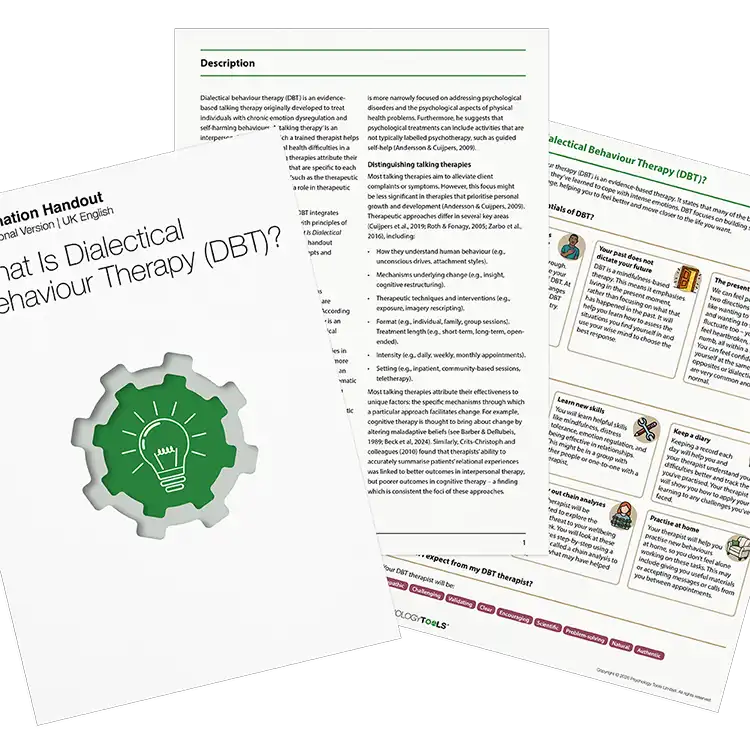
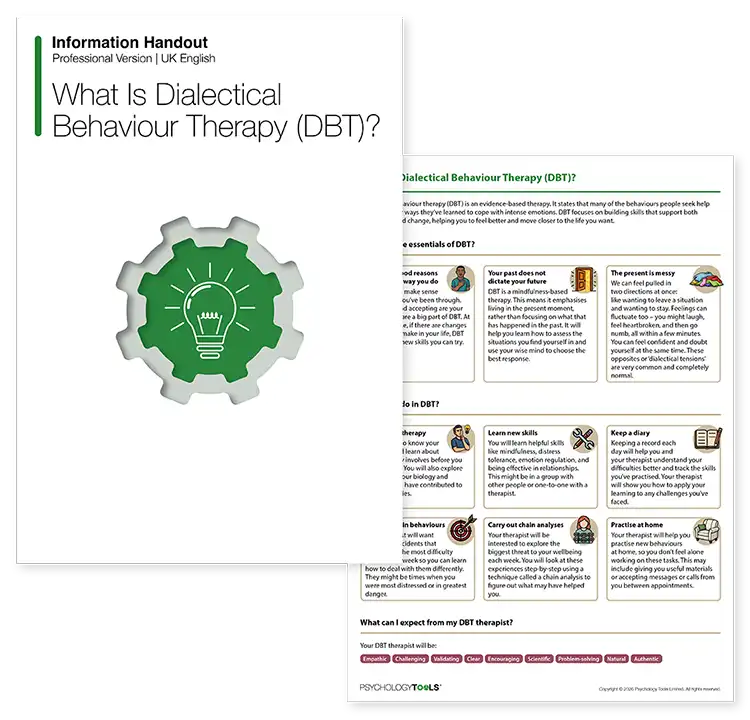
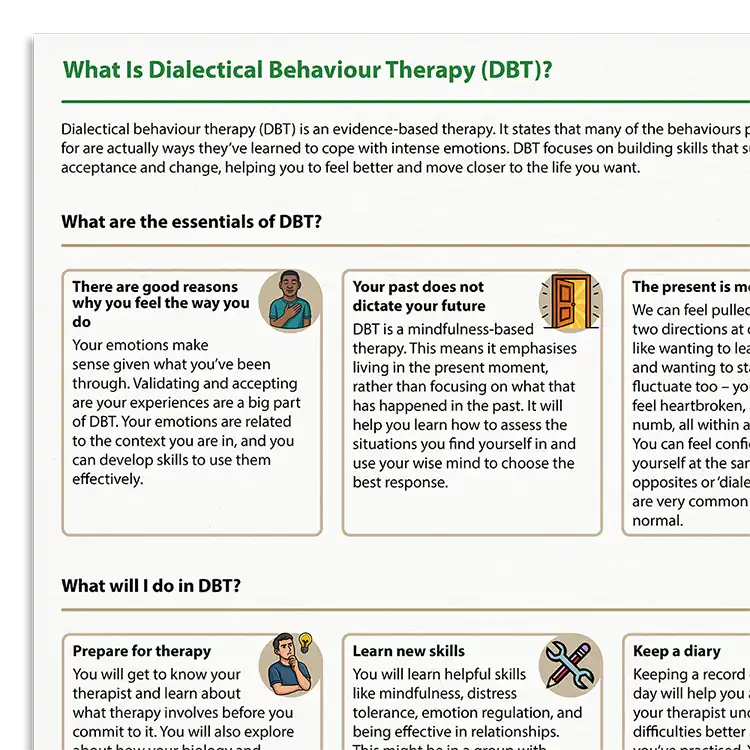
This accessible information handout describes the key principles of dialectical behavior therapy (DBT) and what clients can expect from this talking therapy.

Download or send

Professional version

Offers theory, guidance, and prompts for mental health professionals. Downloads are in Fillable PDF format where appropriate.
Client version

Includes client-friendly guidance. Downloads are in Fillable PDF format where appropriate.

Overview

Dialectical behavior therapy (DBT) is an evidence-based psychological treatment created by Marsha Linehan in the late 1980s. It was originally developed to treat people with borderline personality disorder (BPD) and chronic suicidal ideation. Delivered by a team of therapists, it integrates cognitive-behavioural techniques with principles of mindfulness and dialectics.  The What Is Dialectical Behaviour Therapy (DBT)? information handout introduces DBT, outlining its key concepts and therapeutic tasks.

Key benefits

Clear

Presents key DBT principles using client-friendly language and illustrations.

Informative

Explains what DBT is and what it is likely to involve.

Versatile

Suitable for a range of clients.

Engaging

Encourages collaboration and increased motivation for treatment.

Integrating it into your practice

01

Introduce

Start a conversation about the potential benefits of DBT.

02

Explore

Use the information handout to explore the key ideas in DBT.

03

Reflect

Help clients reflect on how DBT might be helpful to them.

04

Reinforce

Use the handout to support and consolidate learning between sessions.

Theoretical background and therapist guidance

Dialectical behaviour therapy is an evidence-based psychological treatment developed by Marsha Linehan in the late 1980s to treat people with borderline personality disorder (BPD) and chronic suicidal ideation (Linehan, 1993, 2015). Since then, DBT has been adapted for a range of difficulties, including emotion dysregulation, self-harm, eating disorders, substance misuse, and post-traumatic stress disorder (e.g., Ben-Porath et al., 2020; Warner & Murphy, 2022).

DBT is grounded in behavioural science, Zen mindfulness practices, and dialectical philosophy. The term “dialectical” refers to the synthesis of opposites, particularly the balance between acceptance and change.

DBT is structured around four core modules: mindfulness (enhancing awareness of the present moment), distress tolerance (building skills to survive crises without making the situation worse), emotion regulation (understanding and managing intense emotions), and interpersonal effectiveness (how to navigate relationships skilfully).

What's inside

  • A clear and accessible information handout explaining DBT.
  • An introduction to DBT written for therapists.
  • Guidance for using the resource with clients.
  • Key references and recommended further reading.
Get access to this resource

FAQs

An evidence-based therapy that integrates cognitive-behavioural techniques with principles of mindfulness and dialectics.
Mindfulness, distress tolerance, emotion regulation, interpersonal effectiveness.
DBT is an evidence-based treatment for a range of conditions, but it may not be suitable for all individuals. Therapists are encouraged to review best practice guidelines if they are considering offering DBT for the treatment of a specific disorder or condition.

How this resource helps improve clinical outcomes

  • Learn about DBT and what to expect from it.
  • Answer the questions they might have about this therapy.
  • Make an informed decision about taking up DBT.
  • Feel confident and motivated about starting DBT.

References and further reading

  • Andersson, G., & Cuijpers, P. (2009). ‘Psychological treatment’ as an umbrella term for evidence-based psychotherapies? Nordic Psychology, 6, 4–15. DOI: 10.1027/1901-2276.61.2.4.
  • Barber, J. P., & DeRubeis, R. J. (1989). On second thought: Where the action is in cognitive therapy for depression. Cognitive Therapy and Research, 13, 441-457. DOI: 10.1007/BF01173905.
  • Barlow, D. H. (2004). Psychological treatments. American Psychologist, 59, 869–878.
  • Barlow, D. H. (2006). Psychotherapy and psychological treatments: The future. Clinical Psychology: Science and Practice, 13, 216-220.
  • Beck, A. T., Rush, A. J., Shaw, B. F., Emery, G., DeRubeis, R. J., & Hollon, S. D. (2024). Cognitive therapy of depression (2nd ed.). Guilford Press.
  • Ben-Porath, D., Duthu, F., Luo, T., Gonidakis, F., Compte, E. J., & Wisniewski, L. (2020). Dialectical behavioral therapy: an update and review of the existing treatment models adapted for adults with eating disorders. Eating Disorders, 28, 101-121. DOI: 10.1080/10640266.2020.1723371
  • Crits-Christoph, P., Gibbons, M. B. C., Temes, C. M., Elkin, I., & Gallop, R. (2010). Interpersonal accuracy of interventions and the outcome of cognitive and interpersonal therapies for depression. Journal of Consulting and Clinical Psychology, 78, 420-428. DOI: 10.1037/a0019549.
  • Cuijpers, P., Reijnders, M., & Huibers, M. J. (2019). The role of common factors in psychotherapy outcomes. Annual Review of Clinical Psychology, 15, 207-231. DOI: 10.1146/annurev-clinpsy-050718-095424.
  • Cuijpers, P., Miguel, C., Ciharova, M., Harrer, M., Basic, D., Cristea, I. A., ... & Karyotaki, E. (2024). Absolute and relative outcomes of psychotherapies for eight mental disorders: a systematic review and meta‐analysis. World Psychiatry, 23, 267-275. DOI: 10.1002/wps.21203.
  • Kliem, S., Kröger, C., & Kosfelder, J. (2010). Dialectical behavior therapy for borderline personality disorder: A meta-analysis using mixed-effects modeling. Journal of Consulting and Clinical Psychology, 78, 936-951. DOI: 0.1037/a0021015.
  • Lambert, M. J. & Ogles, B. M. (2004). The efficacy and effectiveness of psychotherapy. In M. J. Lambert (Ed.), Bergin and Garfield’s handbook of psychotherapy and behavior change (pp. 139–93). Wiley.
  • Linehan, M. M. (1993). Cognitive-behavioral treatment of borderline personality disorder. Guilford Press.
  • Linehan, M. M. (2015). DBT skills training manual (2nd ed.). Guilford Press.
  • Leichsenring, F., Salzer, S., Beutel, M. E., Herpertz, S., Hiller, W., Hoyer, J., ... & Leibing, E. (2013). Psychodynamic therapy and cognitive-behavioral therapy in social anxiety disorder: A multicenter randomized controlled trial. American Journal of Psychiatry, 170, 759-767. DOI: 10.1176/appi.ajp.2013.12081125.
  • National Institute for Health and Care Excellence (NICE), (2009). Borderline personality disorder: Recognition and management. NICE Clinical Guideline CG78.
  • Öst, L.-G., Svensson, L., Hellström, K., & Lindwall, R. (2001). One-session treatment of specific phobias in youths: A randomized clinical trial. Journal of Consulting and Clinical Psychology, 69, 814–824. DOI: 10.1037/0022-006X.69.5.814.
  • Poulsen, S., Lunn, S., Daniel, S. I., Folke, S., Mathiesen, B. B., Katznelson, H., & Fairburn, C. G. (2014). A randomized controlled trial of psychoanalytic psychotherapy or cognitive-behavioral therapy for bulimia nervosa. American Journal of Psychiatry, 171, 109-116. DOI: 10.1176/appi.ajp.2013.12121511.
  • Roth, A., & Fonagy, P. (2005). What works for whom? A critical review of psychotherapy research (2nd ed.). Guilford Press.
  • Stoffers, J. M., Völlm, B. A., Rücker, G., Timmer, A., Huband, N., & Lieb, K. (2012). Psychological therapies for people with borderline personality disorder. Cochrane Database of Systematic Reviews, (8). DOI: 10.1002/14651858.CD005652.pub2.
  • Strupp, H. H. (1978). Psychotherapy research and practice – an overview. In A. E. Bergin & S. L. Garfield (Eds.), Handbook of psychotherapy and behavior change (2nd ed.) (pp.3-22). Wiley.
  • Tschacher, W., Junghan, U. M., & Pfammatter, M. (2014). Towards a taxonomy of common factors in psychotherapy - results of an expert survey. Clinical Psychology and Psychotherapy, 21, 82-96. DOI: 10.1002/cpp.1822.
  • Wampold, B. E., & Imel, Z. E. (2015). The great psychotherapy debate (2nd ed.). Routledge.
  • Wampold, B. E., Mondin, G. W., Moody, M., Stich, F., Benson, K., & Ahn, H. (1997). A metaanalysis of outcome studies comparing bona fide psychotherapies: Empirically, ‘all must have prizes.’ Psychological Bulletin, 122, 203-215. DOI: 10.1037/0033-2909.122.3.203.
  • Warner, N., & Murphy, M. (2022). Dialectical behaviour therapy skills training for individuals with substance use disorder: A systematic review. Drug and Alcohol Review, 41, 501-516. DOI: 10.1111/dar.13362.
  • Wolitzky-Taylor, K. B., Horowitz, J. D., Powers, M. B., & Telch, M. J. (2008). Psychological approaches in the treatment of specific phobias: A meta-analysis. Clinical Psychology Review, 28, 1021-1037. DOI: 10.1016/j.cpr.2008.02.007.
  • Zarbo, C., Tasca, G. A., Cattaf, F., & Compare, A. (2016). Integrative psychotherapy works. Frontiers in Psychology, 6, 2021. DOI: 10.3389/fpsyg.2015.02021.