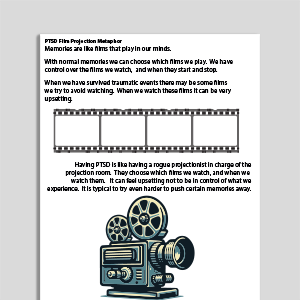
PTSD Film Projection Metaphor
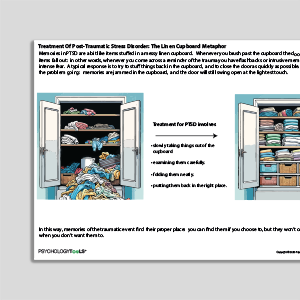
PTSD Linen Cupboard Metaphor
What Is Metaphor?
Metaphor is an essential component of the art of psychotherapy and its use is more apparent in some branches than others. The noted psychiatrist and clinical hypnotherapist Milton Erickson is considered a master of the art of metaphor and was known for his ‘teaching tales’ which often imparted important messages by indirect means. There is a strong use of metaphor within the cognitive behavioral family of therapies. Beck describes a number of uses of metaphor in his 1979 Cognitive Therapy of Depression. The use of metaphor is perhaps described most succinctly in Oxford Guide to Metaphors in CBTin which the authors argue “The business of cognitive therapy is to transform meanings. What better way to achieve this than through a metaphor?” (Stott, Mansell, Salkovskis, Lavender, & Cartwright-Hatton, 2010).References
Beck, A. T., Rush, A. J., Shaw, B. F., & Emery, G. (1979). Cognitive therapy of depression. New York: Guilford Press.
Lakoff, G., & Johnson, M. (1980a). Conceptual metaphor in everyday language. The Journal of Philosophy, 77(8), 453–486.
Lakoff, G., & Johnson, M. (1980b). The metaphorical structure of the human conceptual system. Cognitive Science, 4(2), 195–208.
Lakoff, G., & Johnson, M. (1980c). Metaphors we live by. Chicago: University of Chicago Press.
Stott, R., Mansell, W., Salkovskis, P., Lavender, A., & Cartwright-Hatton, S. (2010). Oxford guide to metaphors in CBT: Building cognitive bridges. New York: Oxford University Press.
Links to external resources
Psychology Tools makes every effort to check external links and review their content. However, we are not responsible for the quality or content of external links and cannot guarantee that these links will work all of the time.
Please login to view our external resources.