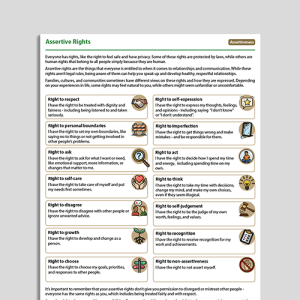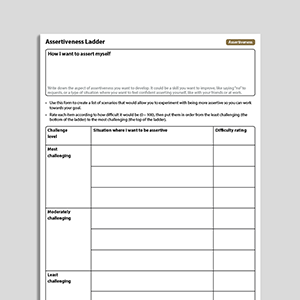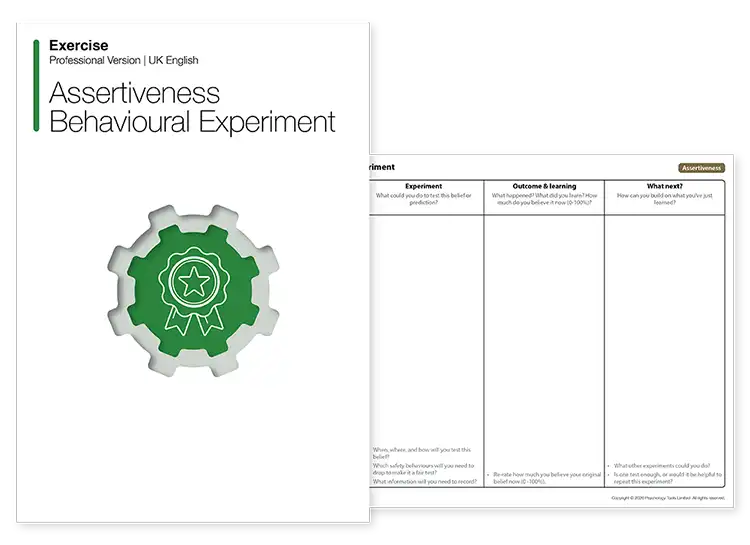
Assertiveness Behavioral Experiment

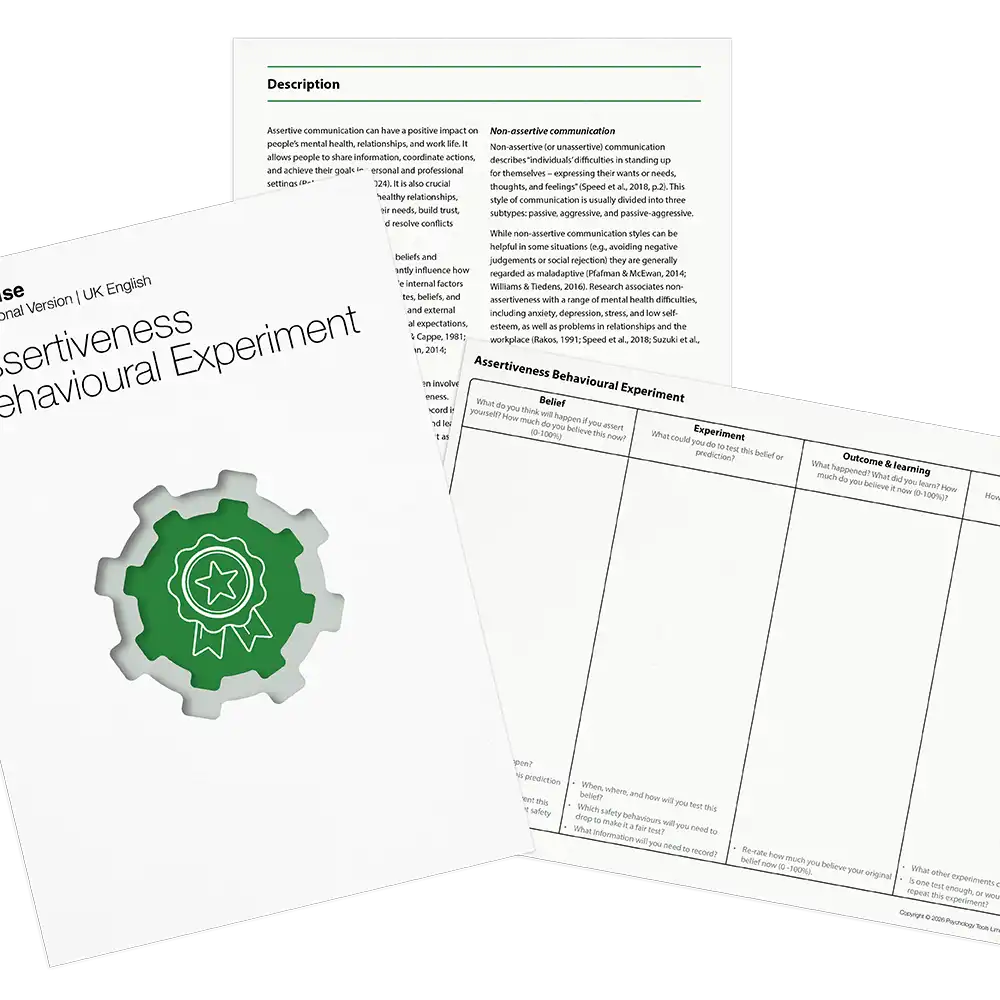
Behavioral experiments enable clients to test their beliefs about assertive communication and develop more effective interpersonal behavior.

Download or send

Professional version

Offers theory, guidance, and prompts for mental health professionals. Downloads are in Fillable PDF format where appropriate.
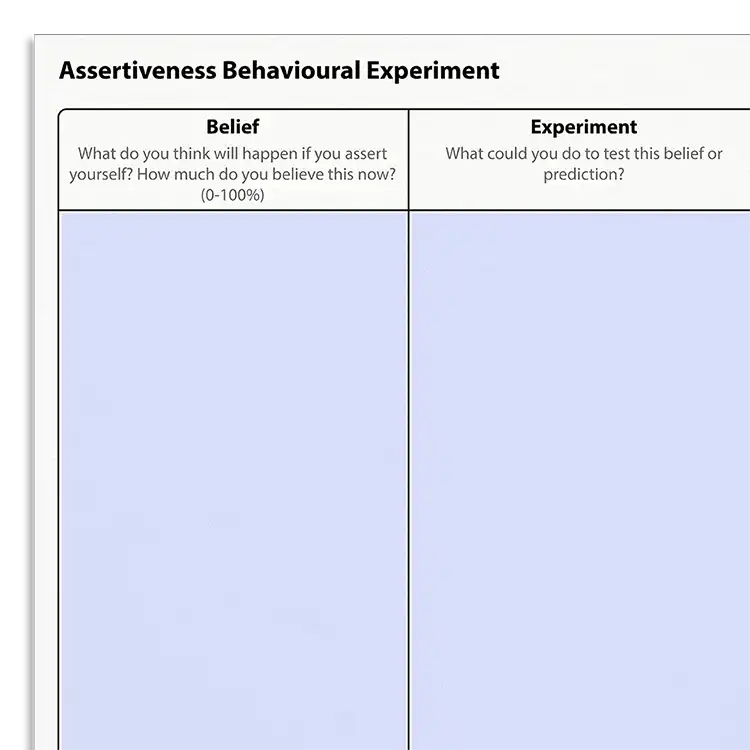
Client version

Includes client-friendly guidance. Downloads are in Fillable PDF format where appropriate.

Overview

Assertive communication can be challenging for individuals who hold unhelpful beliefs and assumptions about standing up for themselves. This Assertiveness Behavioral Experiment record is designed to help clients plan, implement, and learn from experiments that test their beliefs about assertive communication.

Why use this resource?

Many clients avoid assertive behavior due to fears of rejection, conflict, or being perceived negatively. These beliefs often go untested, perpetuating patterns of passive or aggressive communication. This worksheet helps clients:

  • Clarify their beliefs about assertiveness.
  • Test these beliefs through personalized experiments.
  • Address fears and reservations about self-expression.
  • Develop their assertiveness skills. 

Key benefits

Clear

Helps clients identify unhelpful beliefs that maintain unassertive behavior.

Collaborative

Allows therapists to work with clients to test problematic beliefs.

Structured

Provides a framework for planning, conducting, and reflecting on experiments.

Versatile

Can be used with a wide range of clients who struggle with assertive communication.

What difficulties is this for?

Social Anxiety Disorder (SAD)

Testing fears about judgment or rejection during interactions.

Generalized Anxiety Disorder (GAD)

Testing worries about self-expression.

Low Self-Esteem

Challenging negative self-beliefs and increasing self-efficacy.

Depression

Breaking cycles of avoidance and withdrawal.

Interpersonal Difficulties

Supporting assertiveness in relationships, work, and other social contexts.

Integrating it into your practice

01

Identify

Help clients articulate their belief about assertiveness (e.g., “If I say no, people will be angry.”).

02

Plan

Collaboratively design an assertiveness experiment to test this belief.

03

Predict

Record the client's prediction of what will happen during the experiment.

04

Conduct

Support the client in carrying out the behavioral experiment.

05

Reflect

Review the outcome with the client and evaluate how it supports or challenges the original belief.

Theoretical background and therapist guidance

Assertiveness is regarded as an effective communication style across many situations. Various theoretical models have been used to account for assertive and non-assertive communication. According to cognitive models, information processing and cognitions (e.g., negative beliefs and outcome expectations) plays a key role in shaping how people communicate (e.g., Vagos and Pereira, 2016).

Alongside verbal cognitive interventions such as cognitive restructuring, negative beliefs that obstruct assertiveness can be targeted using behavioral experiments. These are planned experiential activities designed to gather information. Depending on the goal of the exercise, they may aim to test the validity of clients' existing beliefs, develop or test more adaptive beliefs, or inform the formulation or case conceptualization (Bennett-Levy et al., 2004).

Hypothesis-testing experiments are a popular form of experiment where the client deliberately thinks or acts differently in a challenging situation (Rouf et al., 2004). Hypothesis-testing experiments include:

  • Testing ‘hypothesis A’. The client tests an existing (unhelpful) belief. For example, they might say “no” to friend's request (the experiment) to see if this leads to a hostile response (the unhelpful belief).
  • Testing ‘hypothesis B’. The client tests a new (helpful) belief. For example, a client might test the new belief “it is acceptable to disagree with others” by expressing a different opinion during a team meeting and observing how others respond.
  • Testing ‘hypothesis A’ vs. ‘hypothesis B’. The client tests whether the original (maladaptive) belief or a newly constructed (adaptive) belief better accounts for the evidence. For example, a client might experiment with stating a preference with friends (“I’ll ask to meet in a quieter venue”) to see whether they are critical of this request (hypothesis A) or understanding and accepting (hypothesis B).

This Assertiveness Behavioral Experiment record is designed to help clients plan, implement, and learn from experiments that test their beliefs about assertive communication.

What's inside

  • An overview of behavioral experiments and their implementation in therapy.
  • Guidance for helping clients identify, test, and re-evaluate their beliefs about assertive communication.
  • Useful prompts for constructing experiments in sessions.
  • Key references and recommendations for further reading.
Get access to this resource

FAQs

An assertiveness behavioral experiment is a structured activity in which a client actively and deliberately tests a belief or assumption (e.g., “If I say what I want, people will reject me.”).
Assertiveness training teaches general communication skills, while behavioral experiments are designed to test specific beliefs about self-expression.
Even if the outcome is negative or mixed, the client still gains valuable data. This can help generate alternative explanations, refine hypotheses, or plan future experiments.

How this resource helps improve clinical outcomes

This worksheet can help clients:

  • Test and re-evaluate beliefs that hinder assertive communication.
  • Practice and develop their communication skills.
  • Build self-confidence.
  • Develop more balanced and helpful thoughts about social interactions and self-expression.

References and further reading

  • Alden, L., & Cappe, R. (1981). Nonassertiveness: Skill deficit or selective self-evaluation? Behavior Therapy, 12, 107-114. DOI: 10.1016/S0005-7894(81)80111-6.
  • Birtchnell, J. (1996). How humans relate: A new interpersonal theory. Psychology Press.
  • Birtchnell, J. (2002). Relating in psychotherapy: The application of a new theory. Brunner Routledge. DOI: 10.1002/cpp.615.
  • Bonham-Carter, D. (2012). Assertiveness: A practical guide. Icon Books.
  • Chłopicki, W. (2017). Communication styles: An overview. Styles of Communication, 9, 9-25.
  • Duckworth, M. P. (2009). Assertiveness skills and the management of related factors. In W. T. O’Donohue & J. E. Fisher (Eds.), General principles and empirically supported techniques of cognitive behavior therapy (pp. 124–132). John Wiley and Sons.
  • Hall, E. T. (1966). The hidden dimension. Doubleday.
  • Gilbert, P., & Allan, S. (1994). Assertiveness, submissive behaviour and social comparison. British Journal of Clinical Psychology, 33, 295-306. DOI: 10.1111/j.2044-8260.1994.tb01125.x.
  • Hagberg, T., Manhem, P., Oscarsson, M., Michel, F., Andersson, G., & Carlbring, P. (2023). Efficacy of transdiagnostic cognitive-behavioral therapy for assertiveness: A randomized controlled trial. Internet Interventions, 32, 100629. DOI: 10.1016/j.invent.2023.100629.
  • Hansford, B. C., & Hattie, J. A. (1987). Perceptions of communicator style and self-concept. Communication Research, 14, 189-203. DOI: 10.1177/009365087014002003.
  • Hayward, M., Strauss, C., & Kingdon, D. (2012). Overcoming distress voices: A self-help guide using cognitive behavioral techniques. Robinson.
  • Jakubowski, P., & Lange, A. J. (1978). The assertive option: Your rights and responsibilities. Research Press Company.
  • Kanfer, F. H., & Schefft, B. K. (1988). Guiding the process of therapeutic change. Research Press.
  • Kazdin, A. E., & Mascitelli, S. (1982). Behavioral rehearsal, self-instructions, and homework practice in developing assertiveness. Behavior Therapy, 13, 346-360. DOI: 10.1016/S0005-7894(82)80043-9.
  • Linehan, M. M. (1979). Structured cognitive-behavioral treatment of assertion problems. In P. C. Kendall & S. V. Hollon (Eds.), Cognitive-behavioral interventions: Theory, research, and procedures (pp. 205-240). Academic Press.
  • McFall, M. E., Winnett, R. L., Bordewick, M. C., & Bornstein, P. H. (1982). Nonverbal components in the communication of assertiveness. Behavior Modification, 6, 121-140. DOI: 10.1177/01454455820061008.
  • McKay, M., Davis, M., & Fanning, P. (2018). Messages: The communication skills workbook (4th ed.). New Harbinger Publications.
  • Norton, R. W. (1978). Foundation of a communicator style construct. Human Communication Research, 4, 99-112. DOI: 10.1111/j.1468-2958.1978.tb00600.x.
  • Orenstein, H., Orenstein, E., & Carr, J. E. (1975). Assertiveness and anxiety: A correlational study. Journal of Behavior Therapy and Experimental Psychiatry, 6, 203-207. DOI: 10.1016/0005-7916(75)90100-7.
  • Paterson, R. J. (2022). The assertiveness workbook: How to express your ideas and stand up for yourself at work and in relationships (2nd ed.). New Harbinger Publications.
  • Pfafman, T. M., & McEwan, B. (2014). Polite women at work: Negotiating professional identity through strategic assertiveness. Women’s Studies in Communication, 37, 202-219. DOI: 10.1080/07491409.2014.911231.
  • Rakos, R. F. (1991). Assertive behavior: Theory, research, and training. Routledge.
  • Rohner, J., & Schutz, A. (2024). Psychology of communication. Springer.
  • Speed, B. C., Goldstein, B. L., & Goldfried, M. R. (2018). Assertiveness training: A forgotten evidence-based treatment. Clinical Psychology: Science and Practice, 25, e12216. DOI: 10.1111/cpsp.12216.
  • Stokes, T. F., & Osnes, P. G. (1989). An operant pursuit of generalization. Behavior Therapy, 20, 337-355. DOI: 10.1016/S0005-7894(89)80054-1.
  • Suzuki, E., Saito, M., Tagaya, A., Mihara, R., Maruyama, A., Azuma, T., & Sato, C. (2009). Relationship between assertiveness and burnout among nurse managers. Japan Journal of Nursing Science, 6, 71-81. DOI: 10.1111/j.1742-7924.2009.00124.x.
  • Vagos, P., & Pereira, A. (2016). A cognitive perspective for understanding and training assertiveness. European Psychologist, 21, 109–121. DOI: 10.1027/1016-9040/a000250.
  • Williams, M. J., & Tiedens, L. Z. (2016). The subtle suspension of backlash: A meta-analysis of penalties for women’s implicit and explicit dominance behavior. Psychological Bulletin, 142, 165–197. DOI: 10.1037/bul0000039.