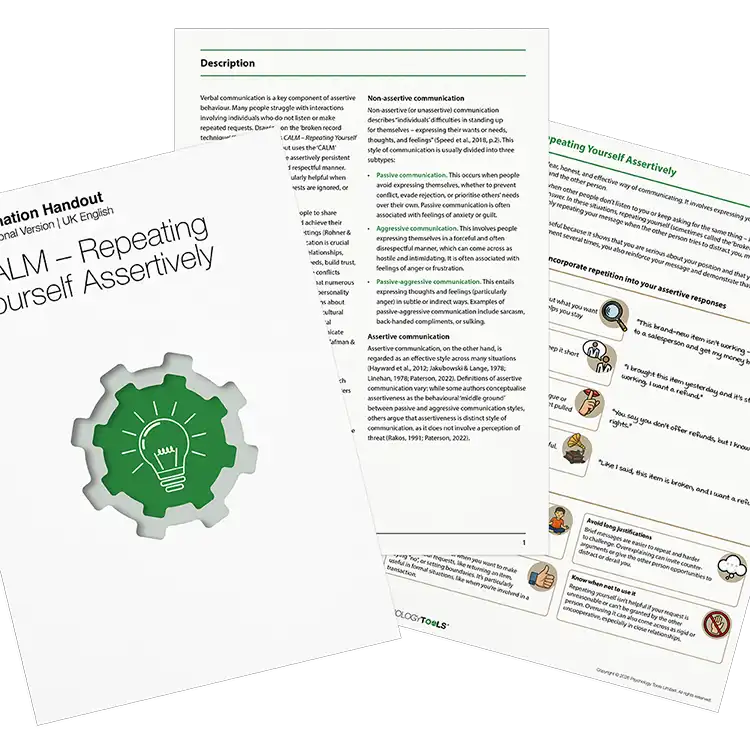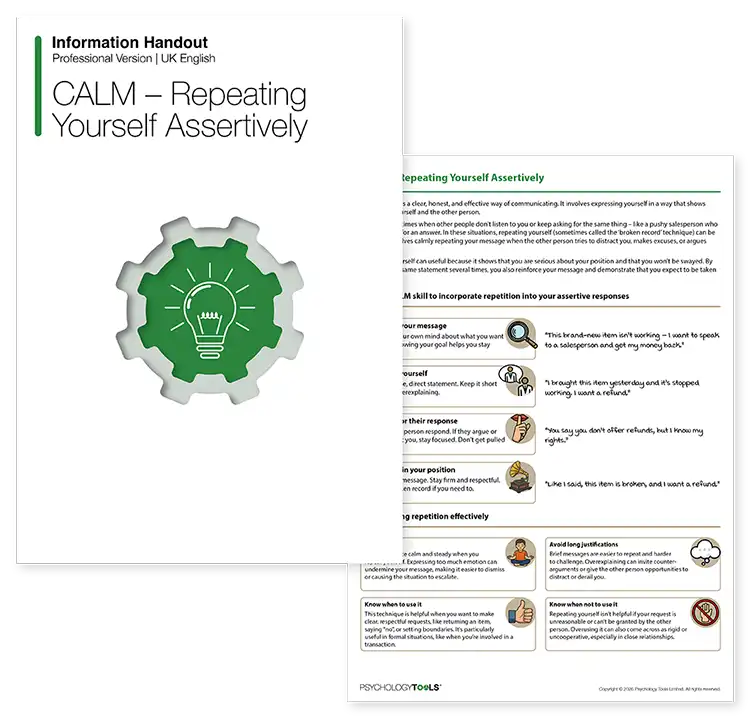
CALM – Repeating Yourself Assertively

A practical information handout that helps clients use repetition effectively and assertively during difficult interactions, without escalating conflict.

Download or send

Professional version

Offers theory, guidance, and prompts for mental health professionals. Downloads are in Fillable PDF format where appropriate.
Client version

Includes client-friendly guidance. Downloads are in Fillable PDF format where appropriate.

Overview

Assertive communication sometimes requires repetition, especially in challenging interpersonal situations where the other person does not listen, respond, or comply with reasonable requests. The CALM – Repeating Yourself Assertively resource teaches clients how to effectively restate their needs, messages, or boundaries, without resorting to aggression or passivity.

Drawing on the ‘broken record technique’ (Smith, 1975), this resource describes how to be assertively persistent with other people in a calm and respectful manner. The information handout is designed to support effective communication and help clients develop their assertiveness skills during sessions and when practicing on their own.

Why use this resource?

Many people struggle to be assertive when their requests are ignored or challenged. This resource helps break that pattern.

  • Provides a simple, structured script that can be used in many situations.
  • Effective in interpersonal situations where repetition and persistence is needed.
  • Explains when this technique is helpful and when it can be less helpful.
  • Supports the development of assertive communication skills.

Key benefits

Clear

Step-by-step guidance for using repetition effectively.

Practical

Includes example statements clients can use.

Versatile

Suitable for a wide range of interactions.

Informative

Explains when this technique can be helpful and unhelpful.

What difficulties is this for?

Social Anxiety Disorder (SAD)

To encourage confident, respectful social interactions.

Generalized Anxiety Disorder (GAD)

For anxious clients who struggle to express themselves.

Depression

Supports clients whose communication is hindered by hopelessness or low self-worth.

Interpersonal Difficulties

For clients experiencing social difficulties that are impacted by communication problems.

Low Self-Esteem

Encourages development of self-respect and clear expression of needs.

Integrating it into your practice

01

Educate

Explain what assertiveness is and why it can be helpful.

02

Introduce

Orientate clients to the script, including what it entails and when it can be useful.

03

Review

Discuss each step of the script, including example statements clients can use.

04

Practice

Model or role-play implementing the script.

05

Assign

Give as homework to reflect on and prepare for real-life scenarios.

06

Discuss

Explore the client’s use of the technique and reflect on outcomes.

07

Expand

Combine with other assertiveness tools, such as body language exercises.

Theoretical background and therapist guidance

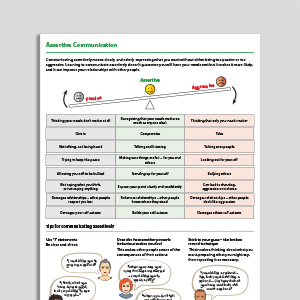
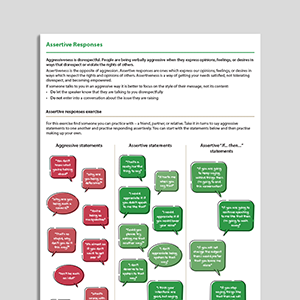
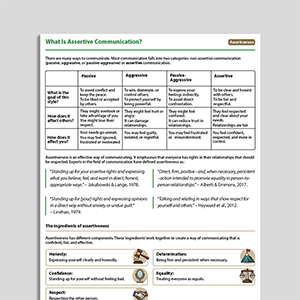
While basic assertiveness skills (such as using assertive body language and I-messages) form the foundation of assertive communication, many clients benefit from more structured guidance for navigating specific real-world interactions (Duckworth, 2008). This is especially true of emotionally charged situations, such as saying no to requests or relationship difficulties. Assertiveness scripts are commonly used to address this (e.g., Linehan, 2015; Martin, 2021; Paterson, 2022). From a practical perspective, they serve as a bridge between learning and implementing assertive communication. For therapists, these scripts provide a framework for developing and sequencing assertive messages in specific contexts. For clients, the scripts can help reduce anxiety, simplify complex exchanges, and support practice within or between sessions.

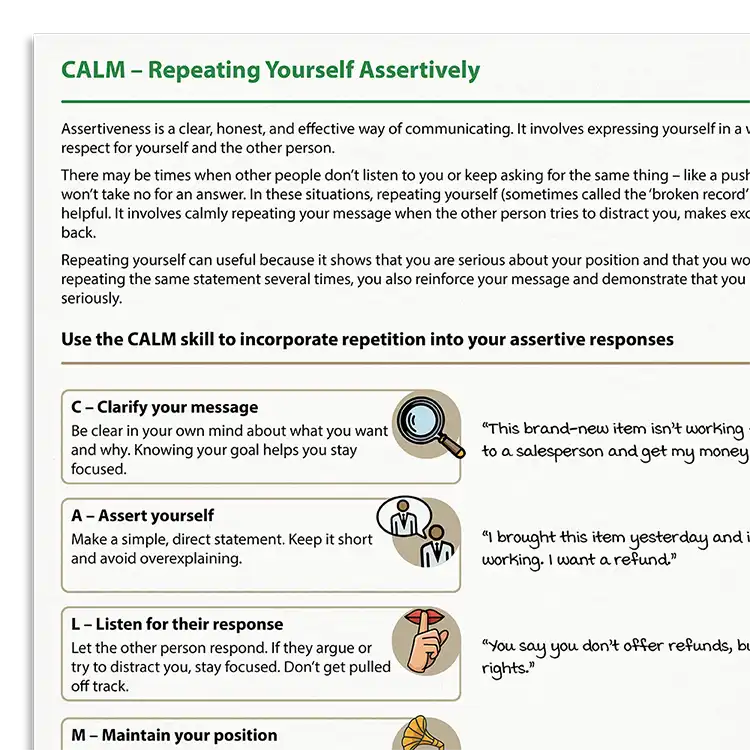
Asserting oneself in situations where others make repeated requests or struggle to listen can be particularly difficult, and often requires persistence. A well-known method for managing such interactions is the ‘broken record technique’, which involves calmly repeating one’s message without deviation or emotional reactivity (Smith, 1975). Drawing on this technique, the CALM – Repeating Yourself Assertively information handout uses the ‘CALM’ acronym to describe how to be assertively persistent with other people in a calm and respectful manner. Clients will find this script particularly helpful when they need to set a limit, their requests are ignored, or they feel pressured to comply.

What's inside

  • An introduction to assertiveness and assertiveness skills training.
  • A step-by-step script for formulating assertive statements.
  • Therapist guidance for using the resource with clients.
  • Recommendations for further reading. 
Get access to this resource

FAQs

It’s a method of calmly repeating your message or request without escalation, even when it is met with resistance or deflection.
It’s especially useful in situations where clients feel their needs or requests are ignored, or when others pressure them to change their stance.
Use role-plays in session, provide structured scripts, and reflect on how the technique felt during real-world use.
Combine the script with in-session modelling, role-plays, and constructive feedback before using in real-world situations.

How this resource helps improve clinical outcomes

  • Supports the development of assertiveness skills.
  • Builds confidence in making requests and setting boundaries.
  • Provides practical steps to use in real-life interactions.

References and further reading

  • Alberti, R. E., & Emmons, M. L. (2017). Your perfect right: Assertiveness and equality in your life and relationships (10th ed.). Impact Publishers.
  • Speed, B. C., Goldstein, B. L., & Goldfried, M. R. (2018). Assertiveness training: A forgotten evidence-based treatment. Clinical Psychology: Science and Practice, 25, e12216. https://doi.org/10.1111/cpsp.12216