Free Compassion Audio Tracks
This is a free audio collection from Psychology Tools For Developing Self-Compassion designed to introduce self-compassion skills taking compassion focused therapy (CFT) approach.
Download or send
Overview
Psychology Tools For Developing Self-Compassion is a 30-track audio collection which guides clients through an empirically-supported programme of compassionate mind training (CMT). This skills-development program is designed for those who struggle with self-criticism, shame, self-esteem, or any other consequences of living with a tricky brain.
To accompany the launch of our audio collection Psychology Tools For Developing Self-Compassion, we have made 2 tracks available to try for free.
Theoretical background and therapist guidance
The concept of compassion is frequently misunderstood. Amongst practitioners of compassion focused therapy (CFT), compassion is often defined as “a sensitivity to the suffering of self and others, with a commitment to relieve and prevent it”. This definition has two important parts. The first psychology of compassion involves being sensitive to and engaging in distress, whether in ourselves or someone else. The second psychology of compassion involves a commitment to skillfully relieve distress, and to prevent suffering from returning.
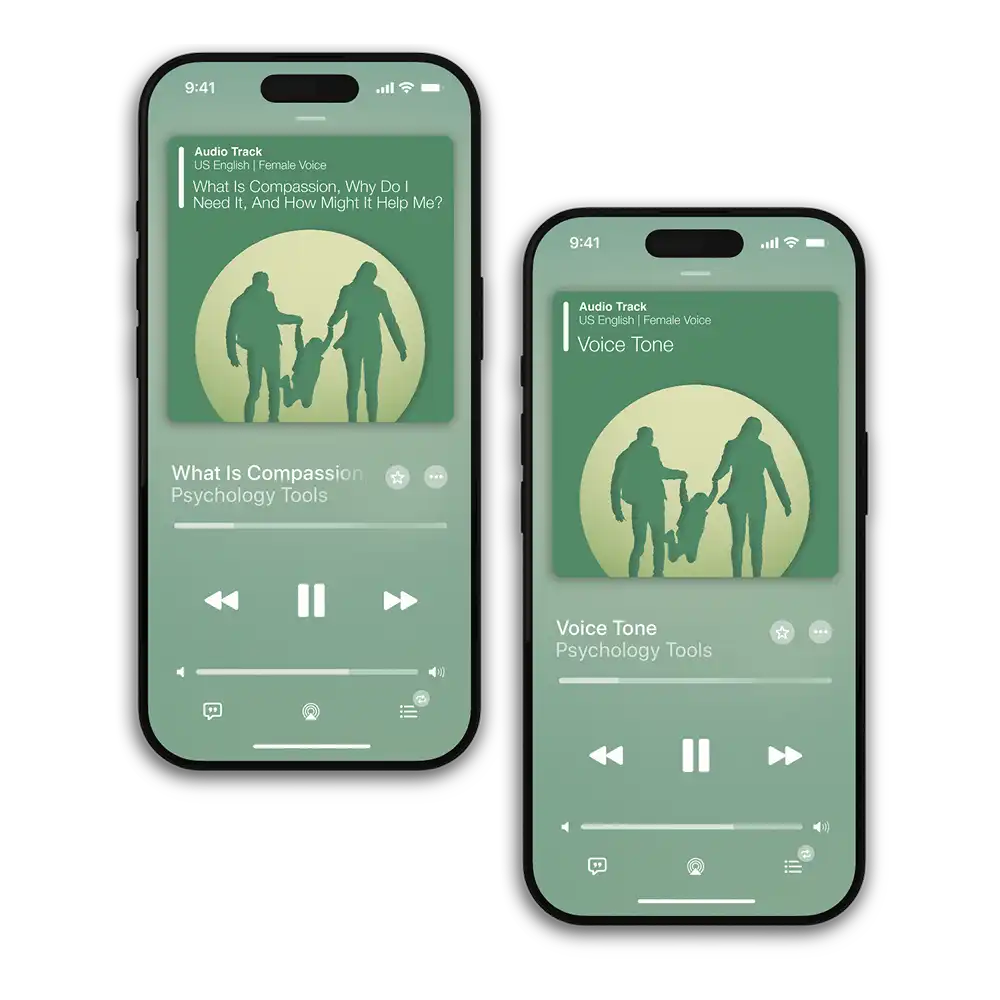
What Is Compassion, Why Do I Need It, And How Might It Help Me? is a track taken from the Psychology Tools For Developing Self-Compassion audio collection. In this introductory track, Dr Chris Irons conducts a broad exploration into how and why human beings suffer, what compassion is, and its roots in the human motive of caregiving. He introduces compassion focused therapy, from which this compassionate mind training (CMT) program is drawn.
One of the aims of CFT and CMT is to activate and develop the soothing system, as this allows us to counteract the effects and stresses of the threat and drive systems. In simple terms, when the soothing system is active, we are more inclined to feel and give compassion. Like any practical skill, however, the soothing system is developed and strengthened through training and practice.
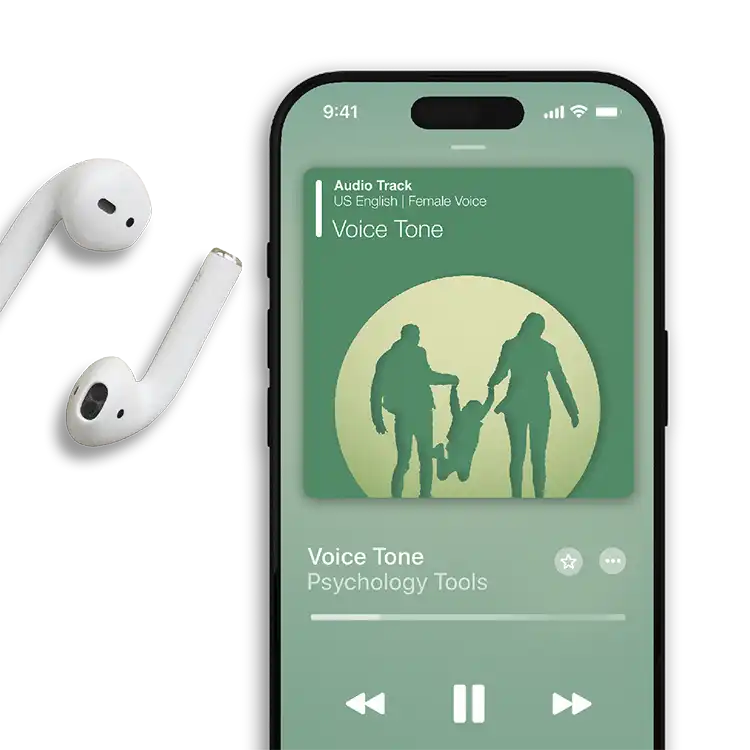
The Voice Tone exercise is a track taken from the Psychology Tools For Developing Self-Compassion audio collection. Care-giving and soothing received from others is often associated with particular behaviors and voice tones. Similarly, threatening and self-critical behaviors are associated with particular voice tones. Training ourselves to adopt behaviors that we associate with compassion, kindness, and care-giving can have the effect of increasing our ability to self-soothe. In this exercise, the listener is guided to speak some short phrases using different tones of voice and to reflect upon their felt sense when they feel these phrases ‘land’ when delivered in different tones of voice.
References and further reading
- Gilbert, P. (2014). The origins and nature of compassion focused therapy. British Journal of Clinical Psychology, 53(1), 6-41.
- Gilbert, P. (2020). Compassion: From its evolution to a psychotherapy. Frontiers in Psychology, 3123.
- Irons, C., & Beaumont, E. (2017). The compassionate mind workbook: A step-by-step guide to developing your compassionate self. Robinson.
- Irons, C., & Heriot‐Maitland, C. (2021). Compassionate Mind Training: An 8‐week group for the general public. Psychology and psychotherapy: Theory, research and practice, 94(3), 443-463.
- Leboeuf, I., Andreotti, E., Irons, C., Beaumont, E., & Antoine, P. (2022). A randomized controlled study of a French compassionate mind training. Mindfulness, 13(11), 2891-2903.
- Savari, Y., Mohagheghi, H., & Petrocchi, N. (2021). A preliminary investigation on the effectiveness of compassionate mind training for students with major depressive disorder: A randomized controlled trial. Mindfulness, 12(5), 1159-1172.
Product
Company
Support
- © 2026 Psychology Tools. All rights reserved
- Terms & Conditions
- Privacy Policy
- Cookies Policy
Working...