Passive Communication

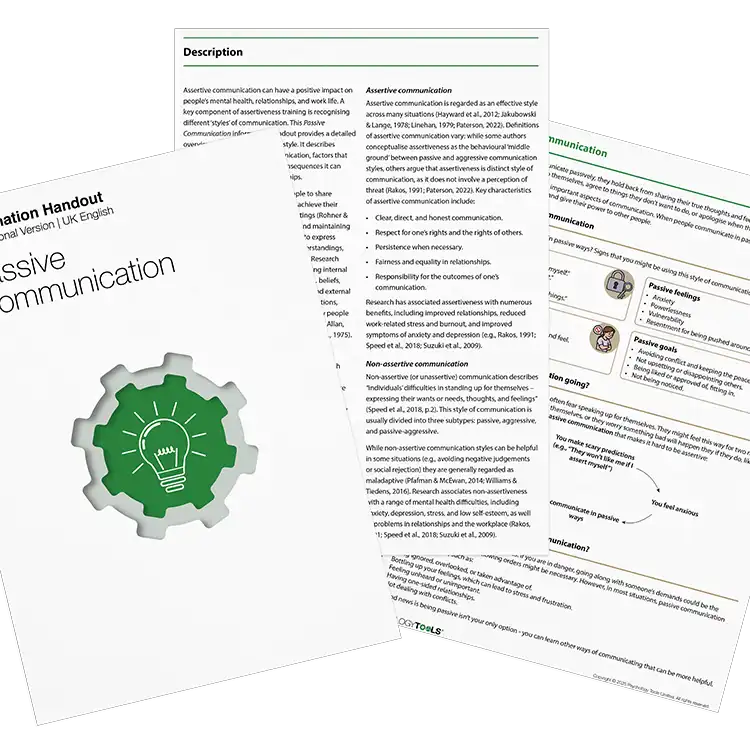
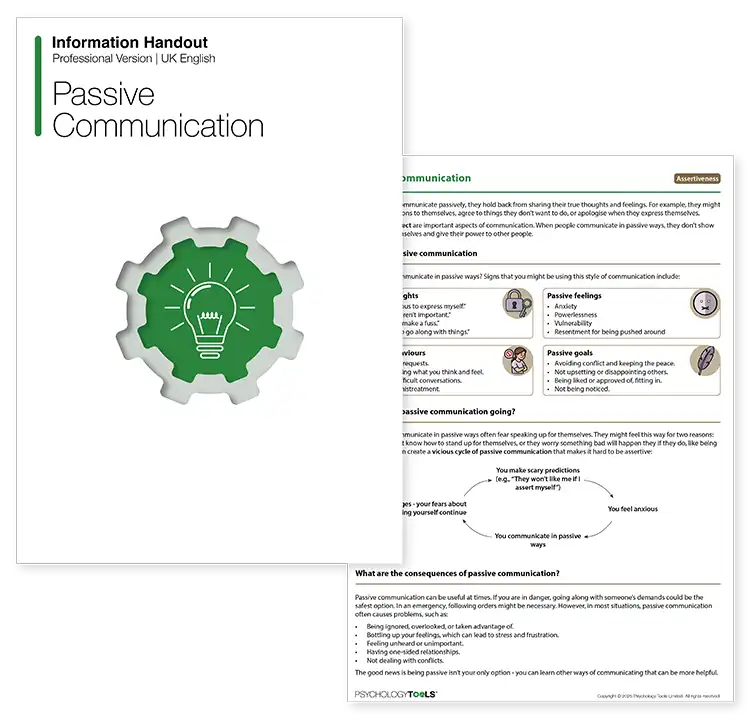
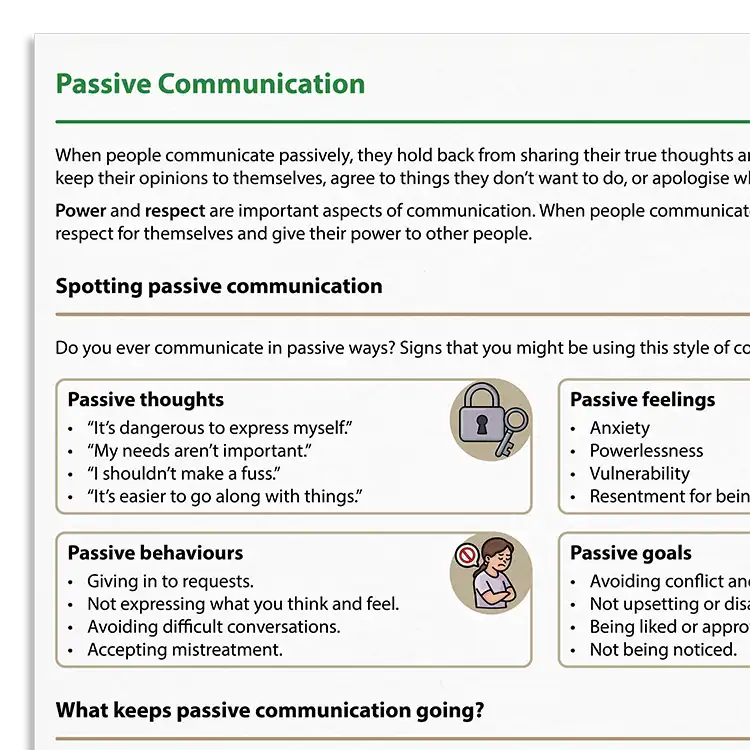
This information handout describes the common signs of passive communication, factors that perpetuate it, and the negative consequences it can have for people and their relationships.

Download or send

Professional version

Offers theory, guidance, and prompts for mental health professionals. Downloads are in Fillable PDF format where appropriate.
Client version

Includes client-friendly guidance. Downloads are in Fillable PDF format where appropriate.

Overview

Assertive communication can have a positive impact on people’s mental health, relationships, and work life. A key component of assertiveness training is recognising different ‘styles’ of communication. This Passive Communication information handout provides a detailed overview of this communication style. It describes common signs of passive communication, factors that perpetuate it, and the negative consequences it can have for people and their relationships.

Why use this resource?

Many clients are unaware of their communication style and the impact it has on their relationships and wellbeing. This handout helps clients recognize passive communication patterns and understand the consequences it can have.

  • Describes the common signs of passive communication.
  • Explains what keeps passive communication going.
  • Highlights the risks and drawbacks of passivity.
  • Presents assertive communication as a helpful alternative.

Key benefits

Informative

Explains what passive communication looks and sounds like.

Explorative

Encourages self-awareness and self-reflection.

Motivating

Contrasts passivity with more helpful communication styles.

Flexible

Can be used in individual and group settings.

What difficulties is this for?

Social Anxiety Disorder (SAD)

For clients who fear judgment and avoid speaking up.

Generalized Anxiety Disorder (GAD)

For people who struggle with expressing concerns or saying no.

Depression

For clients who find it difficult to advocate for themselves.

Borderline Personality Disorder (BPD)

As part of dialectical behavior therapy (DBT) skills training for interpersonal effectiveness.

Low Self-Esteem

Helps clients confidently express their thoughts, feelings, and needs.

Relationship Problems

For clients struggling with patterns of avoidance, conflict, or submission.

Workplace Stress

For difficulties with boundaries, conflict, or assertiveness at work.

Integrating it into your practice

01

Explain

Introduce clients to the idea of communication styles.

02

Define

Use the handout to establish a shared understanding of passive communication.

03

Recognize

Help clients notice instances where they use passive communication.

04

Motivate

Explore the costs of passivity and the benefits of change.

05

Compare

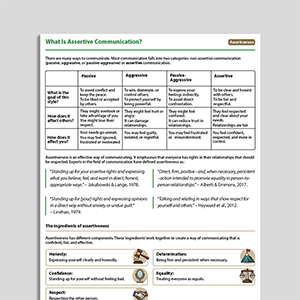
Highlight the differences between passive and assertive communication.

06

Practice

Help the client learn and rehearse assertive communication skills.

Theoretical background and therapist guidance

Effective communication allows people to share information, coordinate actions, and achieve their goals in personal and professional settings (Rohner & Schutz, 2024). It is crucial for forming and maintaining healthy relationships, enabling people to express their needs, build trust, address misunderstandings, and resolve conflicts (McKay et al., 2018).

Research has identified several ‘communication styles’: clusters of conversational behaviors that constitute a communication pattern (Chłopicki, 2017). Passive communication is characterized by restricted self-expression, where people tend to withhold their thoughts, feelings, needs, or preferences. This communication style often arises from a desire to avoid conflict, criticism, or rejection (Bonham-Carter, 2012; Paterson, 2022). Common signs of passive communication include yielding to others' requests or unreasonable demands, going along with others’ decisions, appeasing others, and prioritizing the needs of others over one's own. Unfortunately, passive communication, along with related submissive behavior, is associated with various negative consequences, including social and psychological difficulties (e.g., Allan & Gilbert, 1997).

Assertive communication, on the other hand, is regarded as an effective style across many situations (Hayward et al., 2012; Jakubowski & Lange, 1978; Linehan, 1979; Paterson, 2022). It involves expressing oneself clearly, directly, and honestly, while respecting one’s rights and the rights of others. Research has associated assertiveness with numerous benefits, including improved relationships, reduced work-related stress and burnout, and improved symptoms of anxiety and depression (e.g., Rakos, 1991; Speed et al., 2018; Suzuki et al., 2009).

What's inside

  • A clear and accessible overview of passive communication for clients.
  • Detailed information about communication styles for therapists.
  • Therapist prompts for using the resource with clients.
  • Recommendations for further reading.
Get access to this resource

FAQs

Use this resource to highlight the problems associated with passive communication and highlight more helpful styles, such as assertiveness.
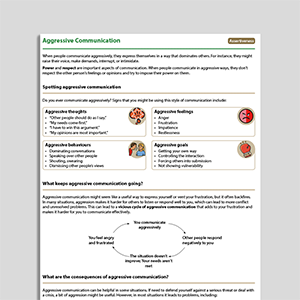
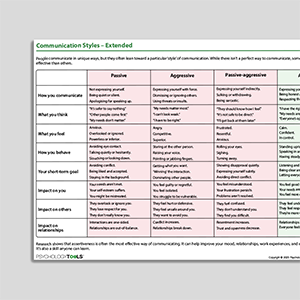
It pairs well with handouts on assertive, aggressive, and passive-aggressive styles.
This is common. Encourage clients to explore how their style may shift depending on the context or relationship.

How this resource helps improve clinical outcomes

  • Provides insight into common communication styles and their impact.
  • Highlights the problems associated with non-assertive communication.
  • Promotes self-awareness and recognition of patterns of relating.
  • Supports development of more effective communication styles, such as assertiveness.

References and further reading

  • Alden, L., & Cappe, R. (1981). Nonassertiveness: Skill deficit or selective self-evaluation? Behavior Therapy, 12, 107-114. DOI: 10.1016/S0005-7894(81)80111-6.
  • Bonham-Carter, D. (2012). Assertiveness: A practical guide. Icon Books.
  • Chłopicki, W. (2017). Communication styles: an overview. Styles of Communication, 9 (2).
  • Gilbert, P., & Allan, S. (1994). Assertiveness, submissive behaviour and social comparison. British Journal of Clinical Psychology, 33, 295-306. DOI: 10.1111/j.2044-8260.1994.tb01125.x.
  • Hayward, M., Strauss, C., & Kingdon, D. (2012). Overcoming distress voices: A self-help guide using cognitive behavioral techniques. Robinson.
  • Jakubowski, P., & Lange, A. J. (1978). The assertive option: Your rights and responsibilities. Research Press Company.
  • Linehan, M. M. (1979). Structured cognitive-behavioral treatment of assertion problems. In P. C. Kendall & S. V. Hollon (Eds.), Cognitive-behavioral interventions: Theory, research, and procedures (pp.205-240). Academic Press.
  • McKay, M., Davis, M., & Fanning, P. (2018). Messages: The communication skills workbook (4th ed.). New Harbinger Publications.
  • Norton, R. W. (1978). Foundation of a communicator style construct. Human Communication Research, 4, 99-112. DOI: 10.1111/j.1468-2958.1978.tb00600.x.
  • Orenstein, H., Orenstein, E., & Carr, J. E. (1975). Assertiveness and anxiety: A correlational study. Journal of Behavior Therapy and Experimental Psychiatry, 6, 203-207. DOI: 10.1016/0005-7916(75)90100-7.
  • Paterson, R. J. (2022). The assertiveness workbook: How to express your ideas and stand up for yourself at work and in relationships (2nd ed.). New Harbinger Publications.
  • Pfafman, T. M., & McEwan, B. (2014). Polite women at work: Negotiating professional identity through strategic assertiveness. Women's Studies in Communication, 37, 202-219. DOI: 10.1080/07491409.2014.911231.
  • Rakos, R. F. (1991). Assertive behavior: Theory, research, and training. Routledge.
  • Rohner, J., & Schutz, A. (2024). Psychology of communication. Springer.
  • Speed, B. C., Goldstein, B. L., & Goldfried, M. R. (2018). Assertiveness training: A forgotten evidence-based treatment. Clinical Psychology: Science and Practice, 25, e12216. DOI: 10.1111/cpsp.12216.
  • Suzuki, E., Saito, M., Tagaya, A., Mihara, R., Maruyama, A., Azuma, T., & Sato, C. (2009). Relationship between assertiveness and burnout among nurse managers. Japan Journal of Nursing Science, 6, 71-81. DOI: 10.1111/j.1742-7924.2009.00124.x.