STOP – Ending Conversations Assertively

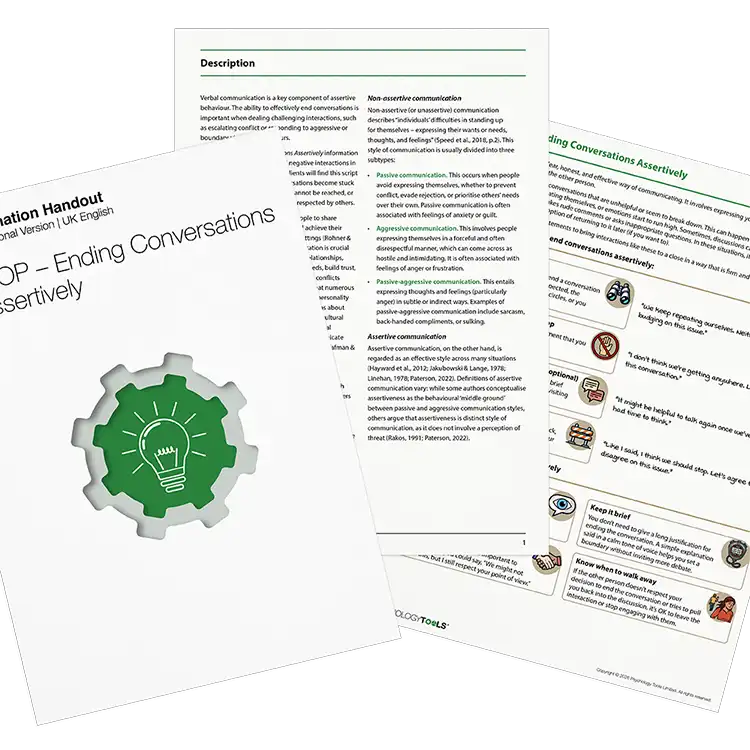
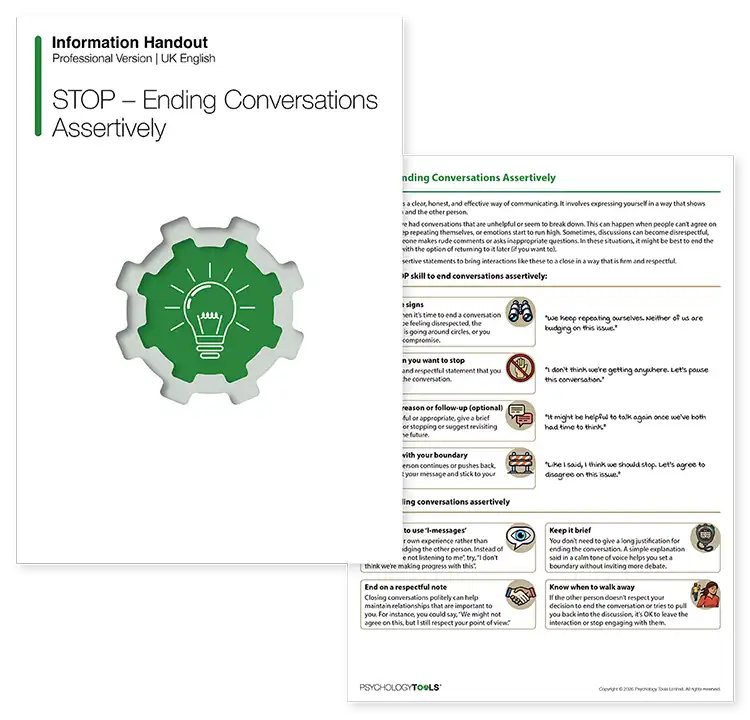
STOP – Ending Conversations Assertively is a practical information handout that teaches clients how to disengage from unhelpful conversations in a calm, firm, and respectful way.

Download or send

Professional version

Offers theory, guidance, and prompts for mental health professionals. Downloads are in Fillable PDF format where appropriate.
Client version

Includes client-friendly guidance. Downloads are in Fillable PDF format where appropriate.

Overview

Verbal communication is a key component of assertive behaviour. The ability to effectively end conversations is important when dealing challenging interactions, such as escalating conflict or responding to aggressive or boundary-violating behaviours.

This STOP – Ending Conversations Assertively information handout describes how to end negative interactions in a firm and respectful manner. Clients will find this script particularly helpful when conversations become stuck or unproductive, a compromise cannot be reached, or their personal boundaries are not respected by others.

Why use this resource?

Many clients find it difficult to disengage from conversations that become hostile or unproductive. This resource offers a clear strategy for doing so while maintaining respectful communication.

  • Helps clients recognize when conversations are no longer constructive.
  • Provides a structured script for disengaging assertively.
  • Reinforces healthy interpersonal boundaries.
  • Encourages respectful communication even in difficult interactions.

Key benefits

Clear

Provides a simple and memorable framework for ending conversations respectfully.

Practical

Helps clients maintain healthy boundaries during difficult interactions.

Accessible

Easy to understand and apply.

Versatile

Suitable for a wide range of clients.

What difficulties is this for?

Social Anxiety Disorder (SAD)

To encourage confident, respectful social interactions.

Generalized Anxiety Disorder (GAD)

For anxious clients who struggle to express themselves.

Relationship Issues

For clients experiencing interpersonal difficulties that are impacted by communication problems.

Depression

Supports clients whose communication is hindered by guilt, hopelessness, or low self-worth.

Low Self-Esteem

Encourages development of self-respect and clear expression of needs.

Workplace Difficulties

Supports effective communication with colleagues.

Integrating it into your practice

01

Introduce

Present the STOP model when teaching assertiveness or interpersonal effectiveness skills.

02

Identify

Help clients recognize the signs that is appropriate to assertively end a conversation.

03

Practice

Use role-plays to rehearse assertive statements for ending conversations.

04

Reflect

Review how the strategy worked in real-world interactions and refine responses.

05

Reinforce

Encourage repeated practice so clients become more confident in applying the technique.

Theoretical background and therapist guidance

Effective communication allows people to share information, coordinate actions, and achieve their goals in personal and professional settings (Rohner & Schutz, 2024). Importantly, communication is crucial for forming and maintaining healthy relationships, enabling individuals to express their needs, build trust, address misunderstandings, and resolve conflicts (McKay et al., 2018). 

Assertiveness is regarded as an effective style of communication many situations (Hayward et al., 2012; Jakubowski & Lange, 1978; Linehan, 1978; Paterson, 2022). Definitions of assertive communication vary: while some authors conceptualise assertiveness as the behavioural ‘middle ground’ between passive and aggressive communication styles, others argue that assertiveness is distinct style of communication, as it does not involve a perception of threat (Rakos, 1991; Paterson, 2022).

Initiating, maintaining, and concluding conversations are key components of assertive communication (Lazarus, 1973). Ending conversations effectively is particularly important when it comes to navigating challenging interactions, such as those involving escalating conflict or behaviours that are aggressive, coercive, or boundary-violating (e.g., Kuhnke, 2013; Simpson Rowe et al., 2012). For individuals who struggle to be assertive, developing this ability serves multiple purposes, including upholding personal boundaries, promoting self-respect, reducing conflict, supporting emotional regulation, and building self-efficacy.

This STOP – Ending Conversations Assertively information handout describes how to end negative interactions in a firm and respectful manner. Clients will find this script particularly helpful when conversations become stuck or unproductive, a compromise cannot be reached, or their personal boundaries are not respected by others.

What's inside

  • A comprehensive introduction to assertiveness for therapists.
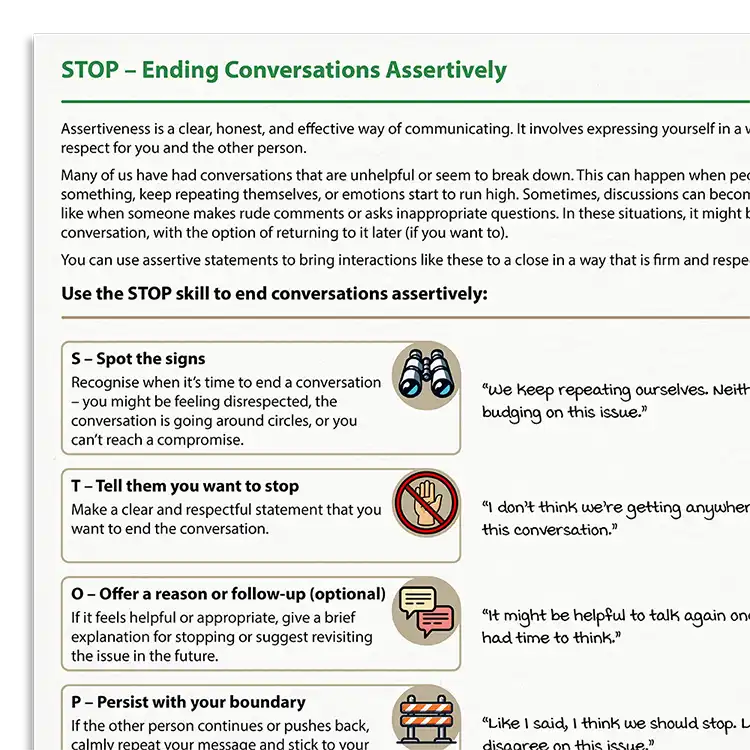
  • Explanation of the STOP framework.
  • Sample dialogue illustrating the framework in action.
  • Therapist notes to support in-session use and practice.
Get access to this resource

FAQs

STOP is a structured assertiveness script designed to help people recognize when a conversation has become unproductive and end it respectfully and firmly.
It can be helpful when conversations become repetitive, hostile, or disrespectful.
Clients can calmly repeat their intention to end the discussion and, if necessary, disengage physically by leaving the interaction.

How this resource helps improve clinical outcomes

This resource supports therapeutic progress by helping clients:

  • Build their communication skills.
  • Maximize the effectiveness of assertive communication.
  • Increase self-confidence.
  • Develop stronger interpersonal boundaries.

For clinicians, the worksheet provides a structured and practical tool that integrates easily with cognitive behavioral therapy (CBT), dialectical behavior therapy (DBT), and broader assertiveness training interventions.

References and further reading

  • Alberti, R. E., & Emmons, M. L. (2017). Your perfect right: Assertiveness and equality in your life and relationships (10th ed.). Impact Publishers.
  • Alden, L., & Cappe, R. (1981). Nonassertiveness: Skill deficit or selective self-evaluation? Behavior Therapy, 12, 107-114. DOI: 10.1016/S0005-7894(81)80111-6.
  • Bonham-Carter, D. (2012). Assertiveness: A practical guide. Icon Books.
  • Chłopicki, W. (2017). Communication styles: An overview. Styles of Communication, 9, 9-25.
  • Duckworth, M. P. (2008). Assertiveness skills and the management of related factors. In W. T. O’Donohue & J. E. Fisher (Eds.), General principles and empirically supported techniques of cognitive behavior therapy (pp. 124–132). John Wiley and Sons.
  • Duckworth, M. P., & Mercer, V. (2006). Assertiveness training. In J. E. Fisher & W. T. O’Donohue (Eds.), Practitioner’s guide to evidence-based psychotherapy (pp. 80-92). Springer.
  • Epstein, N., Degiovanni, I. S., & Jayne-Lazarus, C. (1978). Assertion training for couples. Journal of Behavior Therapy and Experimental Psychiatry, 9, 149-155. DOI: 10.1016/0005-7916(78)90062-9.
  • Gilbert, P., & Allan, S. (1994). Assertiveness, submissive behaviour and social comparison. British Journal of Clinical Psychology, 33, 295-306. DOI: 10.1111/j.2044-8260.1994.tb01125.x.
  • Hagberg, T., Manhem, P., Oscarsson, M., Michel, F., Andersson, G., & Carlbring, P. (2023). Efficacy of transdiagnostic cognitive-behavioral therapy for assertiveness: A randomized controlled trial. Internet Interventions, 32, 100629. DOI: 10.1016/j.invent.2023.100629.
  • Hayward, M., Jones, A. M., Bogen-Johnston, L., Thomas, N., & Strauss, C. (2017). Relating therapy for distressing auditory hallucinations: a pilot randomized controlled trial. Schizophrenia Research, 183, 137-142.
  • Hayward, M., Pilny, M., & Lincoln, T. (2025). Relating Therapy for distressing voices: A treatment protocol. Psychology and Psychotherapy: Theory, Research and Practice. DOI: 10.1111/papt.12595.
  • Hayward, M., Strauss, C., & Kingdon, D. (2012). Overcoming distress voices: A self-help guide using cognitive behavioral techniques. Robinson.
  • Jakubowski, P., & Lange, A. J. (1978). The assertive option: Your rights and responsibilities. Research Press Company.
  • Lange, A. J. & Jakubowski, P. (1976). Responsible assertive behavior. Research Press.
  • Lazarus, A. A. (1973). On assertive behavior: A brief note. Behavior Therapy, 4, 697-699. DOI: 10.1016/S0005-7894(73)80161-3.
  • Linehan, M. M. (1979). Structured cognitive-behavioral treatment of assertion problems. In P. C. Kendall & S. V. Hollon (Eds.), Cognitive-behavioral interventions: Theory, research, and procedures (pp.205-240). Academic Press.
  • McKay, M., Davis, M., & Fanning, P. (2018). Messages: The communication skills workbook (4th ed.). New Harbinger Publications.
  • Orenstein, H., Orenstein, E., & Carr, J. E. (1975). Assertiveness and anxiety: A correlational study. Journal of Behavior Therapy and Experimental Psychiatry, 6, 203-207. DOI: 10.1016/0005-7916(75)90100-7.
  • Paterson, R. J. (2022). The assertiveness workbook: How to express your ideas and stand up for yourself at work and in relationships (2nd ed.). New Harbinger Publications.
  • Pfafman, T. M., & McEwan, B. (2014). Polite women at work: Negotiating professional identity through strategic assertiveness. Women’s Studies in Communication, 37, 202-219. DOI: 10.1080/07491409.2014.911231.
  • Rakos, R. F. (1991). Assertive behavior: Theory, research, and training. Routledge.
  • Rohner, J., & Schutz, A. (2024). Psychology of communication. Springer.
  • Speed, B. C., Goldstein, B. L., & Goldfried, M. R. (2018). Assertiveness training: A forgotten evidence-based treatment. Clinical Psychology: Science and Practice, 25, e12216. DOI: 10.1111/cpsp.12216.
  • Suzuki, E., Saito, M., Tagaya, A., Mihara, R., Maruyama, A., Azuma, T., & Sato, C. (2009). Relationship between assertiveness and burnout among nurse managers. Japan Journal of Nursing Science, 6, 71-81. DOI: 10.1111/j.1742-7924.2009.00124.x.