TACT – Using Pauses Assertively

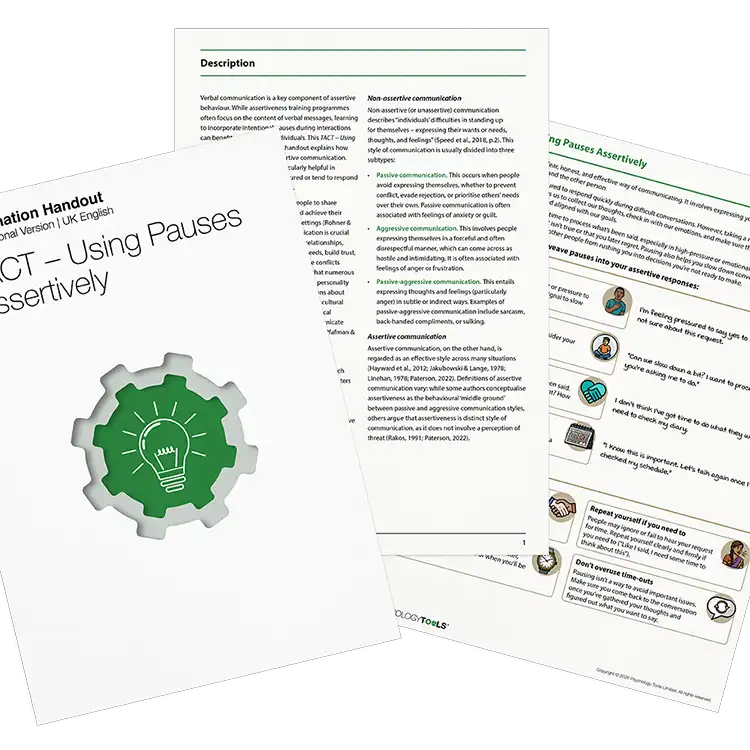
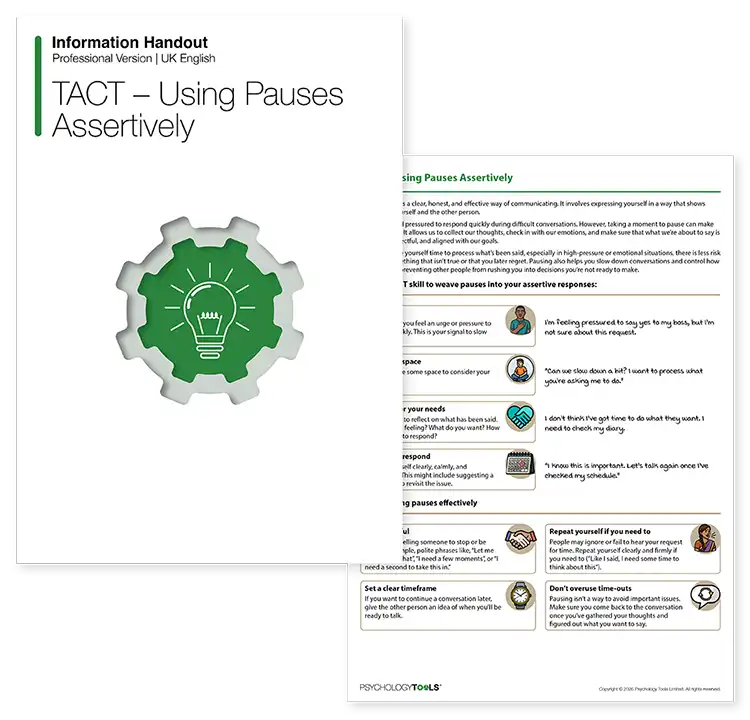
TACT – Using Pauses Assertively is a practical information handout that helps clients use pauses to slow down, regulate emotions, and respond thoughtfully while communicating assertively.

Download or send

Professional version

Offers theory, guidance, and prompts for mental health professionals. Downloads are in Fillable PDF format where appropriate.
Client version

Includes client-friendly guidance. Downloads are in Fillable PDF format where appropriate.

Overview

Verbal communication is a key component of assertive behavior. While assertiveness training programmes often focus on the content of verbal messages, learning to incorporate intentional pauses during interactions can benefit non-assertive individuals. This TACT – Using Pauses Effectively information handout explains how strategic pauses enhance assertive communication. Clients will find this script particularly helpful in situations where they feel pressured or tend to respond in automatic, non-assertive ways.

Why use this resource?

Many clients respond in familiar, non-assertive ways in challenging or high-pressured interactions. This resource helps clients:

  • Interrupt their automatic communication patterns.
  • Slow down and reflection before they respond.
  • Communicate clearly and confidently.
  • Regulate intense emotions, such as anger and anxiety.

Key benefits

Clear

Step-by-step guidance for using pauses effectively.

Practical

Includes example statements clients can use.

Informative

Explains when this technique can be helpful.

Effective

Supports assertiveness, reflection, and emotional regulation.

What difficulties is this for?

Social Anxiety Disorder (SAD)

To support confident, respectful social interactions.

Generalized Anxiety Disorder (GAD)

For anxious clients who struggle to express themselves.

Depression

Supports clients whose communication is hindered by hopelessness or low self-worth.

Interpersonal Difficulties

For clients experiencing social difficulties that are impacted by communication problems.

Low Self-Esteem

Encourages development of self-respect and clear expression of needs.

Integrating it into your practice

01

Educate

Explain what assertiveness is and why it can be helpful.

02

Introduce

Orientate clients to the tool, including what it entails and when it can be useful.

03

Review

Discuss each step of the script, including example statements clients can use.

04

Practice

Model or role-play implementing the script.

05

Assign

Give as homework to reflect on and prepare for real-life scenarios.

06

Discuss

Explore the client’s use of the technique and reflect on outcomes.

07

Expand

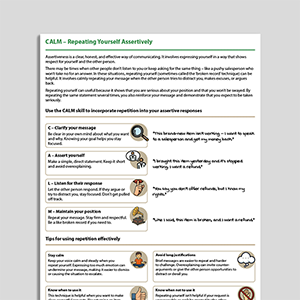
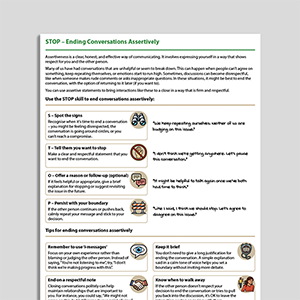
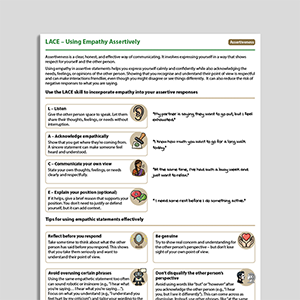
Combine with other assertiveness tools, such as body language exercises.

Theoretical background and therapist guidance

While basic assertiveness skills (such as using assertive body language and I-messages) form the foundation of assertive communication, many clients benefit from more structured guidance for navigating specific real-world interactions (Duckworth, 2008). This is especially true of emotionally charged situations, such as saying no to requests or relationship difficulties. Assertiveness scripts are commonly used to address this (e.g., Linehan, 2015; Martin, 2021; Paterson, 2022). From a practical perspective, they serve as a bridge between learning and implementing assertive communication. For therapists, these scripts provide a framework for developing and sequencing assertive messages in specific contexts. For clients, the scripts can help reduce anxiety, simplify complex exchanges, and support practice within or between sessions.

Assertiveness training often emphasizes the content of verbal communication and how it is conveyed. However, several programs have also highlighted the benefits of using strategic pauses during difficult interactions (e.g., Carr, 2012; Hanks, 2016; Paterson, 2022; McKay et al., 2018). This can give individuals time to process what has been said, check in with their internal experiences to increase self-awareness, and interrupt automatic patterns of non-assertive behavior (e.g., aggressive opposition or compliance).

This TACT – Using Pauses Effectively information handout describes how strategic pauses can be incorporated into assertive communication. Clients will find this script particularly helpful in situations where they feel pressured or respond in automatic, non-assertive ways.

What's inside

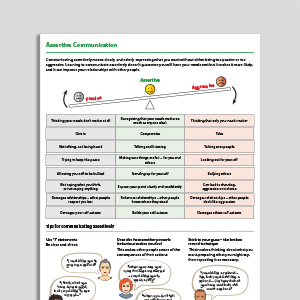
  • An introduction to assertiveness and assertiveness skills training.
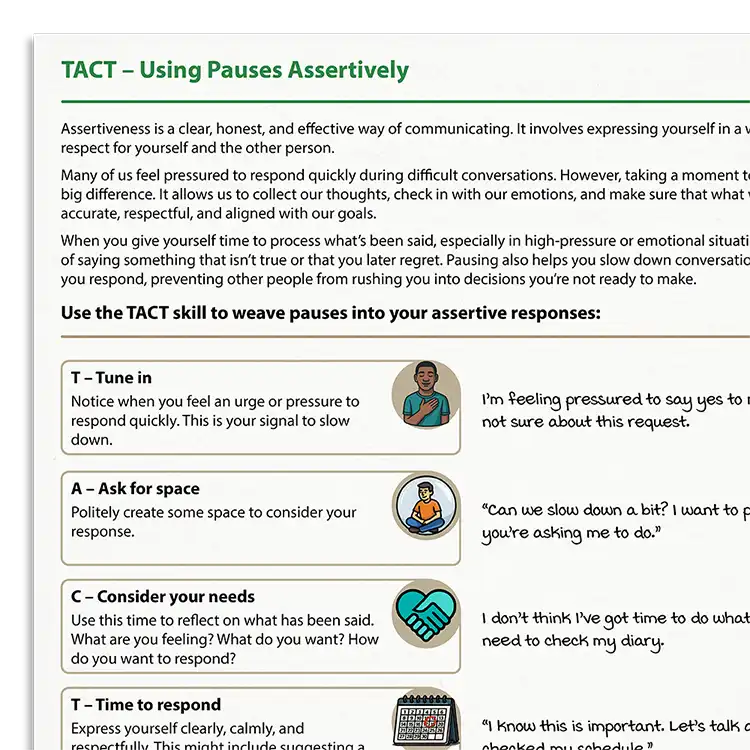
  • A step-by-step script for using pauses effectively.
  • Therapist guidance for using the resource with clients.
  • Recommendations for further reading. 
Get access to this resource

FAQs

TACT is a communication tool that helps people respond more thoughtfully and assertively.
Pauses are particularly useful in high-pressure, emotionally charged, or anxiety-provoking situations where clients feel rushed to respond.
Use role-plays in session, provide structured scripts, and reflect on how the technique felt during real-world use.

How this resource helps improve clinical outcomes

This resource can improve communication skills by helping clients:

  • Interrupt automatic communication patterns.
  • Improve emotional regulation during interactions.
  • Strengthen assertive self-expression.
  • Develop a practical skill for use in everyday situations. 

References and further reading

  • Alberti, R. E., & Emmons, M. L. (2017). Your perfect right: Assertiveness and equality in your life and relationships (10th ed.). Impact Publishers.
  • Carr, D. L. (2012). Brilliant assertiveness: What the most assertive people know, do, and say. Pearson Education Limited.  
  • Hanks, J. D. A. (2016). The assertiveness guide for women: How to communicate your needs, set healthy boundaries, and transform your relationships. New Harbinger Publications.
  • McKay, M., Davis, M., & Fanning, P. (2018). Messages: The communication skills workbook (4th ed.). New Harbinger Publications.
  • Paterson, R. J. (2022). The assertiveness workbook: How to express your ideas and stand up for yourself at work and in relationships (2nd ed.). New Harbinger Publications.
  • Speed, B. C., Goldstein, B. L., & Goldfried, M. R. (2018). Assertiveness training: A forgotten evidence-based treatment. Clinical Psychology: Science and Practice, 25, e12216. https://doi.org/10.1111/cpsp.12216