Supporting Flexible Thinking: The All-or-Nothing Thinking Workbook


Psychology Tools
Published
14 Jan 2026
What’s new?
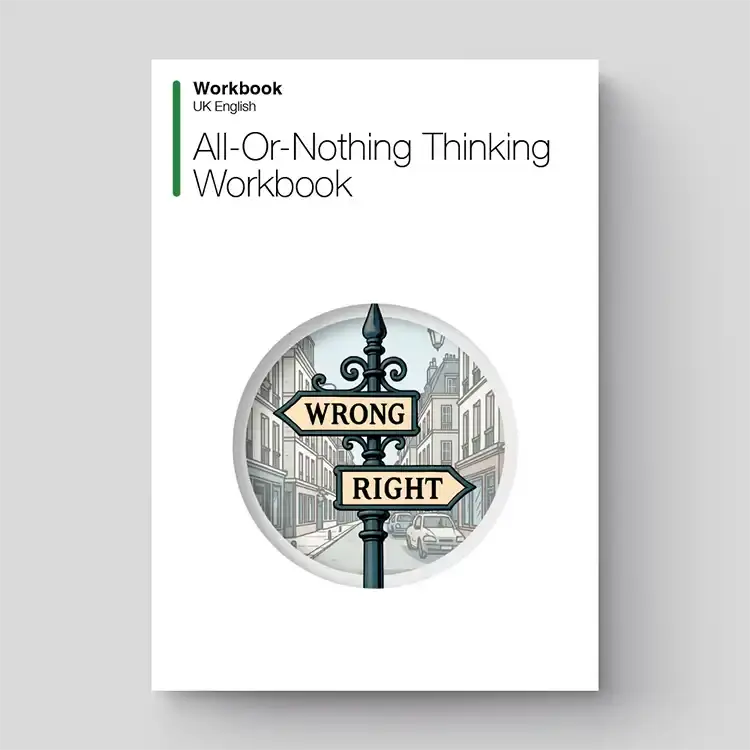
We’re excited to introduce the All-or-Nothing Thinking Workbook, a new CBT-based resource designed to help people recognize and address rigid, black-and-white thinking. This practical workbook supports clients to develop more balanced and helpful ways of thinking.
What is all-or-nothing thinking?
All-or-nothing thinking (also known as black-and-white thinking), is a type of unhelpful thinking style, also known as a cognitive distortion. It involves judging experiences, ourselves, or others in extreme, either/or terms. Things are seen as either good or bad, success or failure, with little room for nuance or middle ground.
For example, noticing a small change in weight might lead to the thought, “I’m fat.” Doing poorly on one test might become, “I’m a complete failure.” These thoughts can be convincing, even when they don’t fully reflect reality.
This thinking style matters because emotions are shaped not only by what happens to us, but by how we interpret those events. These interpretations often take the form of automatic thoughts - quick statements or images that pass through our minds. When these evaluations are rigid or extreme, they can lead to distress and problematic behaviors, and contribute to various mental health difficulties.
How the All-Or-Nothing Thinking Workbook helps
Cognitive behavioral therapy (CBT) offers a clear and effective way to work with all-or-nothing thoughts. CBT helps people notice unhelpful thinking patterns, evaluate how accurate they are, and develop more helpful, balanced alternatives.
The All-or-Nothing Thinking Workbook uses CBT principles to guide users through this process. It combines clear explanations with practical exercises, making it accessible without oversimplifying. The focus is on building awareness, encouraging curiosity, and supporting more flexible responses to difficult thoughts. It includes psychoeducation, guided exercises, relatable examples, and space for reflection, making it suitable for use within and between sessions.
Who is it for?
This resource is designed for a wide range of users, including therapists working with individuals who experience rigid or extreme thinking patterns. It is also suitable for students and trainees learning CBT concepts, as well as individuals who want to better understand and change unhelpful ways of thinking in their own lives.
How can it be used?
Therapists and practitioners can use this workbook to support sessions focused on thinking styles, emotional regulation, and problematic behaviours associated with all-or-nothing thinking. It includes helpful illustrations and practical guidance that can be used to:
Introduce all-or-nothing thinking in a clear, accessible way
Encourage self-awareness and self-reflection
Support self-monitoring and practice between sessions
Strengthen relapse prevention and maintenance work

References
Beck, A. T. (1979). Cognitive therapy and the emotional disorders. Penguin.
Beck, A. T. (1991). Cognitive therapy: A 30-year retrospective. American psychologist, 46(4), 368.
Kahneman, D. (2011). Thinking, fast and slow. Farrar, Straus and Giroux.
Gilbert, P. (1998). The evolved basis and adaptive functions of cognitive distortions. British Journal of Medical Psychology, 71(4), 447-463.
Beck, A. T. (1964). Thinking and depression: II. Theory and therapy. Archives of general psychiatry, 10(6), 561-571.
Burns, D. D., & Good, M. F. (1980). Feeling Good: The new mood therapy. New York: William Morrow and Company.
Bonfá-Araujo, B., & Hauck Filho, N. (2021). “All or nothing”: Extreme responding, dichotomous thinking, and the dark triad of personality. Psico, 52(1), e35441-e35441.
Haselton, M., Nettle, D., & Andrews, P. (2005). The evolution of cognitive bias. In D. M. Buss (Ed.), The handbook of evolutionary psychology (pp. 724–746). John Wiley & Sons.
Bandura, A., & Walters, R. H. (1977). Social learning theory (Vol. 1, pp. 141-154). Englewood Cliffs, NJ: Prentice hall.
Mieda, T., Taku, K., & Oshio, A. (2020). Dichotomous thinking and cognitive ability. Personality and Individual Differences, 110008. doi:10.1016/j.paid.2020.110008
Linehan, M. M. (1993). Cognitive-behavioral treatment of borderline personality disorder. New York: Guilford Press.
Egan, S. J., Piek, J. P., Dyck, M. J., & Rees, C. S. (2007). The role of dichotomous thinking and rigidity in perfectionism. Behaviour research and therapy, 45(8), 1813-1822.
Linehan, M. M., & Wilks, C. R. (2015). The course and evolution of dialectical behavior therapy. American journal of psychotherapy, 69(2), 97-110.
Get sent more useful pieces like this!
Sign up to our monthly newsletter full of helpful ideas, tools, and tips for mental health professionals like you. You'll find out about our latest resources, and you can also read our reviews of the latest research.
It's completely free and you can unsubscribe at any time.