New Worksheet: Assertive Body Language Practice Record


Psychology Tools
Published
18 Mar 2026
What’s new?
We’re pleased to share a new worksheet: Assertive Body Language Practice Record. It is designed to help clients record their assertiveness skills practice and monitor their progress over time. More specifically, it focuses on the use of assertive body language, such as steady eye contact and voice tone.
What’s the issue?
Verbal statements are often emphasized in assertiveness skills training: how to say no, ask for what you need, or disagree respectfully. However, research shows that non-verbal communication is also important.
Non-verbal communication has many dimensions, including eye contact, facial expression, posture, and gestures. These signals influence how confident, hostile, or submissive someone appears – sometimes over and above what they actually say.
Clients who struggle with confidence, anxiety, low mood, or anger may notice patterns in their communication, such as:
- Speaking quietly or forcefully.
- Avoiding eye contact.
- Appearing tense, closed, or uncomfortable.
- Adopting postures that come across as threatening or fearful.
- Standing too far away (or too close) for comfort.
Without monitoring and practice, these habits can limit the effectiveness of assertive verbal communication, even when the client is working hard to change.
What does the tool do?
Assertive body language can improve with awareness, guidance, and practice. Practice records are particularly helpful for identifying aspects of assertive language that need to improved and fine-tuned.
The Assertive Body Language Practice Record focuses on key non-verbal skills that support assertiveness, such as:
- Voice (steady and with an appropriate volume).
- Posture (upright but relaxed).
- Gestures (natural, not rigid or frantic).
- Facial expression (calm and sincere).
- Eye contact (focused and with natural breaks).
- Personal space (finding a distance that feels appropriate for the situation).
After practicing, clients rate each area on a 0–10 scale, give themselves an overall score, and reflect on what they have learned. Over time, this helps build self-awareness, identify patterns, highlight areas for improvement, and track progress.
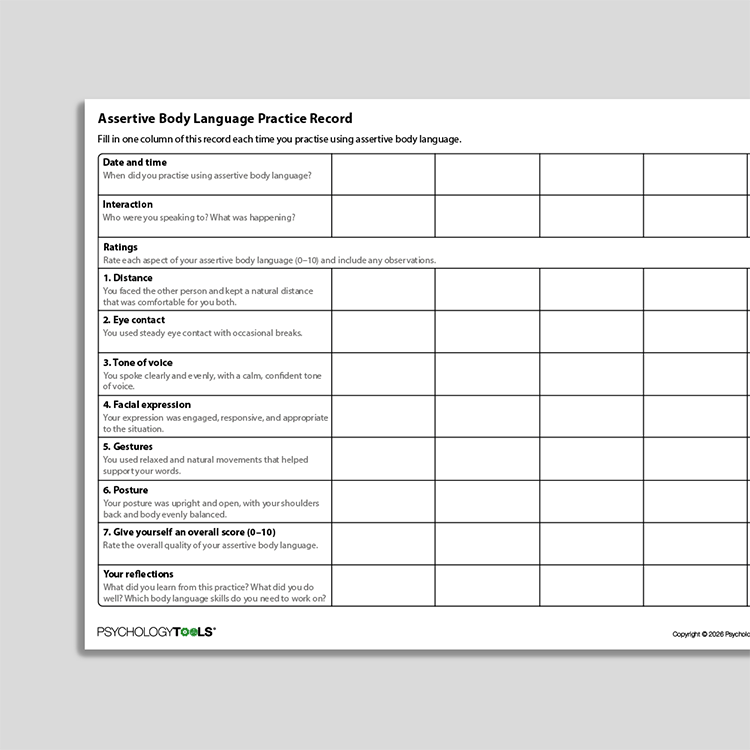
The Assertive Body Language Practice Record is a simple worksheet that clients can use to record their use of assertive body language, including what the interaction was, how they used their non-verbal skills, and what they want to do differently next time. Used regularly, it supports assertiveness skills development and provides useful material for therapy sessions.
Who is it for?
This worksheet is helpful for clients who:
- Struggle to assert themselves.
- Are working on their communication, boundaries, or conflict skills.
- Feel anxious or angry during social interactions.
- Want practical tools to enhance the way they express themselves.
It's also useful for student therapists who are new to assertiveness skills training and clinicians looking for tools that guide and support real-world practice.
How can it be used?
Therapists can use this record to:
- Reinforce the key elements of assertive body language.
- Monitor clients’ between-session practice.
- Identify areas of assertive non-verbal communication that need development.
- Set small behavioral goals with clients (such as “standing more upright”).
- Track progress over time.
Used alongside other interventions such as instruction, modeling, and role-play, it provides a practical bridge between assertiveness training and daily life.
References
- Hall, E. T. (1966). The hidden dimension. Doubleday.
- McKay, M., Davis, M., & Fanning, P. (2018). Messages: The communication skills workbook (4th ed.). New Harbinger.
- Rakos, R. F. (1991). Assertive behavior: Theory, research, and training. Routledge.
- Speed, B. C., Goldstein, B. L., & Goldfried, M. R. (2018). Assertiveness training: A forgotten evidence-based treatment. Clinical Psychology: Science and Practice, 25, e12216.

Get sent more useful pieces like this!
Sign up to our monthly newsletter full of helpful ideas, tools, and tips for mental health professionals like you. You'll find out about our latest resources, and you can also read our reviews of the latest research.
It's completely free and you can unsubscribe at any time.