New Worksheet: Communication Style – Self-Monitoring Record


Psychology Tools
Published
06 Mar 2026
What’s new?
We’re pleased to introduce a new worksheet: Communication Style – Self-Monitoring Record. It helps clients notice what happens during interactions (what they said, how they said it, and what the results were) so that therapy can focus on making communication more effective.
What’s the problem?
Communication is something we do every day, but it’s often hard to see our own patterns in the moment. Many clients have a general sense that they “don’t speak up”, “come on too strong”, or “end up saying things they regret”, but they’re not sure why it happens, what sets it off, or what to do differently next time.
This matters because communication styles can shape day-to-day interactions, relationships, self-esteem, and emotional wellbeing. Some people tend to avoid expressing themselves (passive communication), others are forceful and domineering (aggressive communication), and others express frustration indirectly (passive-aggressive communication). Even when clients understand their communication style in theory, it can be difficult to spot how it plays out in real life – especially when responses are automatic, emotions run high, or the relationship is important.
Without clear information, it’s easy to rely on vague descriptions (“I don’t speak up”) or harsh self-judgments (“I’m just bad with people”), which can make the focus of therapy unclear and change feel impossible.
What’s the solution?
A practical way to build awareness is to use a diary-style approach called self-monitoring. In CBT, self-monitoring helps clients pay attention to a specific target (like a communication style) and record what they notice. The goal is to gather enough detail to answer important questions, such as:
What situations bring out each communication style?
What are the short-term benefits and longer-term costs of it?
Does the communication style have a function?
How is it reinforced?
When does the client communicate more assertively – and what helps them do so?
Over time, patterns become clearer and therapy becomes more focused. Clients can start testing small changes (like adjusting their tone or wording), then use the record to see what improves. This makes communication skills work less about “trying harder” and more about learning what works in real situations.
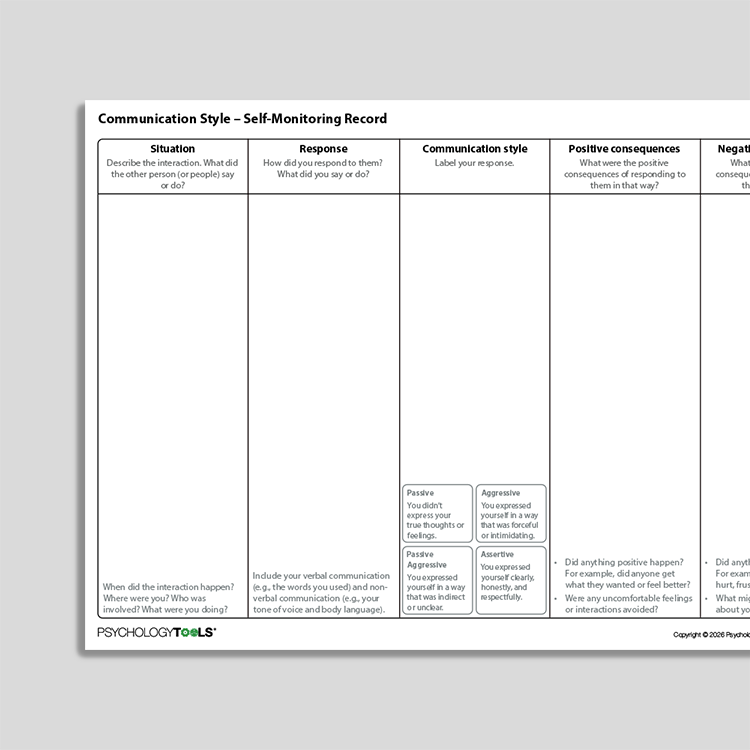
Communication Style – Self-Monitoring Record is designed to help clients capture key details from everyday interactions, including the situation, their response (what they said and did), the communication style used (Passive, Aggressive, Passive-aggressive, or Assertive), and the positive and negative consequences. It provides a structured way to turn messy moments into useful therapy material.
Who is it for?
This worksheet is suitable for clients who:
Struggle to express needs, set boundaries, or handle conflict.
Feel anxious, guilty, or frustrated during conversations.
Get angry quickly, speak harshly, or feel misunderstood.
Want to develop their assertive communication skills.
It can also be helpful for clients struggling with anxiety, low self-esteem, anger, relationship difficulties, or emotion regulation – any difficulties were communication patterns are part of the picture.
How can it be used?
Therapists can use this worksheet to:
Better understand clients’ style of communication.
Identify triggers, patterns, and opportunities for change.
Explore what keeps unhelpful communication styles going.
Highlight exceptions (times communication went better) and build on them.
Track progress over time as clients practice new skills.
It works well alongside assessment and formulation, assertiveness training, and behavioral experiments, giving both therapist and client a shared, concrete starting point for change.
References
Korotitsch, W. J., & Nelson-Gray, R. O. (1999). An overview of self-monitoring research in assessment and treatment. Psychological Assessment, 11, 415–425.
Persons, J. B. (2008). The case formulation approach to cognitive behavior therapy. Guilford Press.
Proudfoot, J., & Nicholas, J. (2010). Monitoring and evaluation in low intensity CBT interventions. In Oxford guide to low intensity CBT interventions (pp. 97–104). Oxford University Press.
Speed, B. C., Goldstein, B. L., & Goldfried, M. R. (2018). Assertiveness training: A forgotten evidence-based treatment. Clinical Psychology: Science and Practice, 25, e12216.

Keep learning with Psychology Tools
Join thousands of mental health professionals who receive our newsletter.
Stay up to date with new articles, practical therapy ideas, reviews of important research, and the latest Psychology Tools resources.
Free. Unsubscribe at any time.