LACE – How To Be Assertive While Showing Empathy


Psychology Tools
Published
11 Mar 2026
What’s new?
We’re pleased to introduce a new handout: LACE – Using Empathy Assertively. It provides clients with a simple script for expressing themselves while also showing understanding for the other person’s viewpoint: a combination that can make difficult conversations warmer and more constructive.
What’s the issue?
Clients sometimes assume that assertiveness means being pushy, demanding, or self-centered. However, many do the opposite during interactions – softening their message so much that their needs or opinions are lost. This is especially common when the relationship matters to them, such as communicating with family members, friends, or colleagues.
In these situations, clients often get stuck between:
Speaking their mind, but worrying they will sound harsh or selfish.
Protecting the other person’s feelings, but ending up feeling unheard or resentful.
What does the tool do?
Empathic assertiveness is a helpful middle path. It involves keeping a message clear and respectful, while also acknowledging the other person’s experience. It doesn’t mean agreeing, giving in, or back-tracking. It means communicating something along the lines of, “I get how you feel and I need to be clear about my position.”
The LACE script gives clients a structure they can use in these situations. It involves:
L – Listening. Show you’ve heard what the other person is saying (“I know you want to go out tonight”).
A – Acknowledging. Name their feelings or perspective (“I can tell you’re excited about seeing the new movie.”).
C – Communicate. State your need, boundary, or request clearly (“At the same time, I’m exhausted and need to rest.”).
E – Explain. Add a brief reason if it helps (“It’s been a tough week at work for me and I feel like I haven’t stopped.”).
This approach is an effective way to reduce tension and defensiveness. Moreover, empathic assertiveness is often well-received by others (Rakos, 1991).
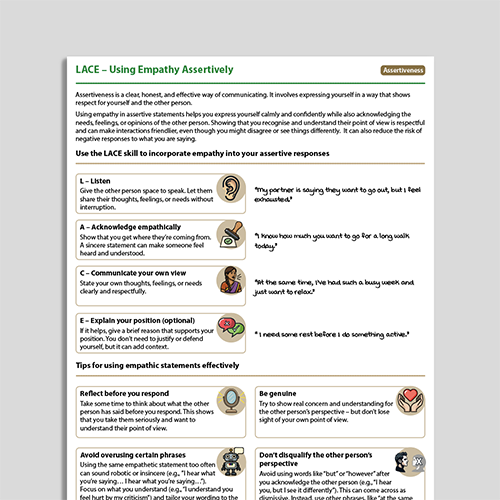
LACE – Using Empathy Assertively is a client-friendly handout that provides guidance for building empathic, assertive messages. It’s designed to support instruction, modeling, role-play, and real-world practice in the context of assertiveness skills training.
Who is it for?
This handout may be useful for clients who:
Avoid speaking up because they fear upsetting others.
Tend to over-apologize, over-explain, or backtrack under pressure.
Struggle with boundaries in close relationships.
Want to handle conflict more calmly and respectfully.
It’s also helpful for student therapists and trainees who want a straightforward framework for learning about empathetic assertive communication.
How can it be used?
Therapists can use this handout to:
Teach clients about the LACE structure.
Help clients develop their own personalized assertiveness scripts.
‘Soften’ assertive messages that might come across as too forceful.
Support in-session role-plays and real-world practice.
Used alongside the other components of assertiveness skills training, LACE offers clients a practical way to be clear and understanding.
References
Alberti, R. E., & Emmons, M. L. (2017). Your perfect right: Assertiveness and equality in your life and relationships (10th ed.). Impact Publishers.
Jakubowski, P., & Lange, A. J. (1978). The assertive option: Your rights and responsibilities. Research Press.
Linehan, M. M. (2015). DBT skills training manual. Guilford Press.
Rakos, R. F. (1991). Assertive behavior: Theory, research, and training. Routledge.
Romano, J. M., & Bellack, A. S. (1980). Social validation of a component model of assertive behavior. Journal of Consulting and Clinical Psychology, 48, 478–490.

Keep learning with Psychology Tools
Join thousands of mental health professionals who receive our newsletter.
Stay up to date with new articles, practical therapy ideas, reviews of important research, and the latest Psychology Tools resources.
Free. Unsubscribe at any time.