Use Pauses Assertively With The TACT Framework


Psychology Tools
Published
14 May 2026
What’s new?
We’re excited to introduce a new resource: TACT – Using Pauses Assertively. This handout helps clients slow down, reflect, and regulate their emotions during difficult interactions, supporting assertive communication.
What’s the issue?
Many people struggle with assertive communication because they feel pressured to respond. In emotionally charged or difficult situations, these responses may become quick or automatic. For example, they might agree despite wanting to say no or say things they later regret.
These patterns are often linked to non-assertive communication, or a difficulty expressing one’s needs clearly and respectfully. When people feel rushed, they have less opportunity to reflect on their thoughts, feelings, and opinions. This makes it harder to respond in a way that aligns with their needs, goals, or values, increasing the risk of non-assertiveness. Over time, this can contribute to ongoing difficulties in relationships, workplace stress, and reduced confidence. Clients may feel stuck in unhelpful interaction patterns, unsure how to express themselves effectively.
What’s the tool?
Learning to use pauses is a simple but powerful skill. Pauses create a moment of space between what is conveyed and how we respond. This small gap can make a surprisingly big difference. The TACT framework offers a clear structure for using pauses assertively:
- T – Tune in. Notice the urge to respond quickly.
- A – Ask for space. Politely create time to think.
- C – Consider your needs. Reflect on what you feel and want.
- T – Time to respond. Express yourself clearly and respectfully.
Using pauses in this way can help clients:
- Interrupt habitual responses.
- Regulate emotions, such as anger and anxiety.
- Think more clearly about what they want to say.
- Reduce the pressure to respond immediately.
- Communicate in a more intentional way.
Pauses can also shift the tone of a conversation, slowing things down and making interactions feel less overwhelming, and capture the listener’s attention.
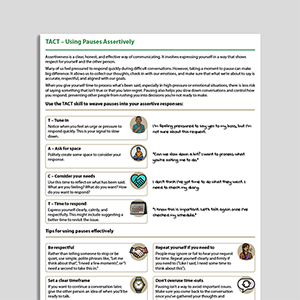
TACT – Using Pauses Assertively is an easy-to-use information handout that helps clients practise this skill. It introduces the TACT model, provides examples, and offers practical guidance for using pauses effectively in real-life situations.
Who is it for?
This resource is helpful for clients who:
- Find it hard to express themselves.
- Struggle with pressured conversations.
- Tend to respond automatically (e.g., agreeing with others or becoming angry).
- Feel unsure about what they need or want to communicate.
It is particularly useful for work on assertive communication, emotional regulation, and interpersonal effectiveness.
How can it be used?
Therapists can use this resource to:
- Introduce the idea of intentional pauses during communication.
- Highlight the benefits of slowing down during difficult interactions.
- Help clients recognize their automatic responses.
- Practice pausing through role-play.
- Support practice in real-world situations.
It provides clear guidance and helpful example scripts, making it easy clients to follow and for therapists to use in their sessions.
References
- Alberti, R. E., & Emmons, M. L. (2017). Your perfect right: Assertiveness and equality in your life and relationships (10th ed.). Impact Publishers.
- McKay, M., Davis, M., & Fanning, P. (2018). Messages: The communication skills workbook (4th ed.). New Harbinger Publications.
- Paterson, R. J. (2022). The assertiveness workbook: How to express your ideas and stand up for yourself at work and in relationships (2nd ed.). New Harbinger Publications.
- Speed, B. C., Goldstein, B. L., & Goldfried, M. R. (2018). Assertiveness training: A forgotten evidence-based treatment. Clinical Psychology: Science and Practice, 25, e12216. DOI: 10.1111/cpsp.12216.

Keep learning with Psychology Tools
Join thousands of mental health professionals who receive our newsletter.
Stay up to date with new articles, practical therapy ideas, reviews of important research, and the latest Psychology Tools resources.
Free. Unsubscribe at any time.