Acceptance And Commitment Therapy (ACT)

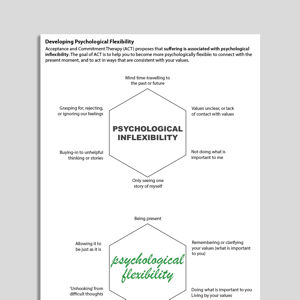
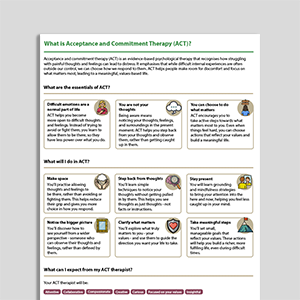
Acceptance and Commitment Therapy (ACT) is one of the ‘third wave’ cognitive and behavioral therapies. It incorporates acceptance and mindfulness strategies alongside change strategies, in recognition that change is not always possible or desirable. ACT is theoretically derived from relational frame theory (RFT) which is a behavior analytic account of the functional properties of human language. The ACT approach proposes that suffering and dysfunction arise from attempts to control or eliminate unwanted experiences. Attempts to control or avoid can lead to the paradoxical effect of greater suffering and a perception of loss of control of the focus for elimination. The aim of ACT is to increase psychological flexibility, which is defined as “contacting the present moment fully as a conscious human being, and based on what the situation affords, changing or persisting in behavior in the service of chosen values” (Hayes, Luoma, Bond, Masuda, & Lillis, 2006).

+ Show all problems

What Is Acceptance And Commitment Therapy?

ACT Processes

Luoma, Hayes, and Walser (2007) describe some of the assumptions made by the ACT approach:
  • Acceptance is the active and aware embrace of private events that are occasioned by our history, without unnecessary attempts to change their frequency or form, especially when doing so would cause psychological harm.

  • Defusion is theprocess of creating non-literal contexts in which language can be seen as an active, ongoing, and relational process that is historical in nature and present in the current context.

  • Self-as-context is a continuous and secure ‘I’ from which events are experienced, but which is also distinct from those events.

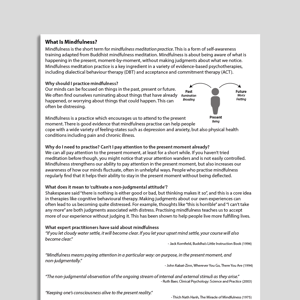
  • Contact with the present moment is an ongoing, nonjudgmental contact with psychological and environmental events as they occur.

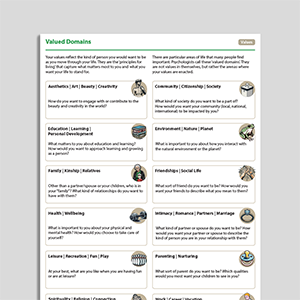
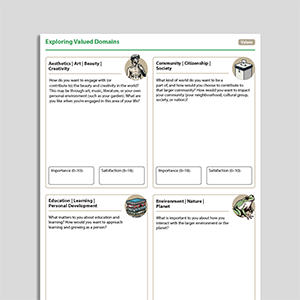
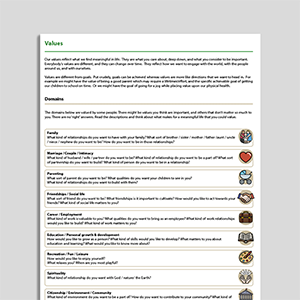
  • Values are verbally constructed, global, desired, and chosen life directions.Values are what truly matter to us and are distinct from goals in that they cannot be ‘achieved’ butrather ‘moved toward or away from.’

  • Committed action is the step-by-step process of acting to create a whole life, one of integrity, which is true to one’s deepest wishes and longings.

References

  • Hayes, S. C., Luoma, J. B., Bond, F. W., Masuda, A., & Lillis, J. (2006). Acceptance and commitment therapy: Model, processes and outcomes. Behaviour Research and Therapy, 44(1), 1–25.

  • Luoma, J. B., Hayes, S. C., & Walser, R. D. (2007). Learning ACT: An acceptance & commitment therapy skills-training manual for therapists. Oakland, CA: New Harbinger.

Links to external resources

Psychology Tools makes every effort to check external links and review their content. However, we are not responsible for the quality or content of external links and cannot guarantee that these links will work all of the time.

Please login to view our external resources.